


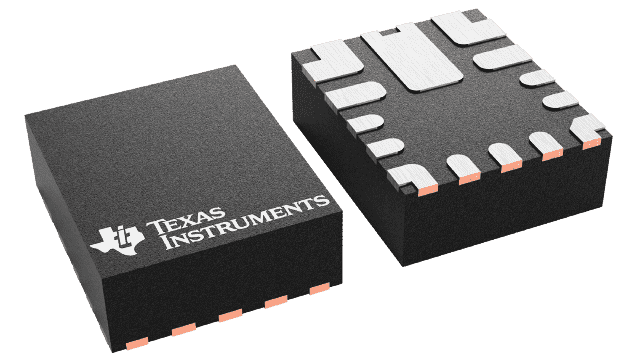
TPS62916QRPYRQ1
ActiveAUTOMOTIVE, 3V TO 17V INPUT, 6A LOW-NOISE BUCK CONVERTER WITH INTEGRATED FERRITE BEAD FILTER
Deep-Dive with AI
Search across all available documentation for this part.
TPS62916QRPYRQ1
ActiveAUTOMOTIVE, 3V TO 17V INPUT, 6A LOW-NOISE BUCK CONVERTER WITH INTEGRATED FERRITE BEAD FILTER
Technical Specifications
Parameters and characteristics for this part
| Specification | TPS62916QRPYRQ1 |
|---|---|
| Current - Output | 6 A |
| Frequency - Switching | 2.2 MHz, 1 MHz, 1.4 MHz |
| Function | Step-Down |
| Grade | Automotive |
| Mounting Type | Surface Mount |
| Number of Outputs | 1 |
| Operating Temperature [Max] | 150 °C |
| Operating Temperature [Min] | -55 °C |
| Output Configuration | Positive |
| Output Type | Adjustable |
| Package / Case | 14-PowerVFQFN |
| Qualification | AEC-Q100 |
| Supplier Device Package | 14-VQFN-HR (2.5x3) |
| Synchronous Rectifier | True |
| Topology | Buck |
| Voltage - Input (Max) [Max] | 17 V |
| Voltage - Input (Min) [Min] | 3 V |
| Voltage - Output (Max) [Max] | 5.5 V |
| Voltage - Output (Min/Fixed) | 0.8 V |
Pricing
Prices provided here are for design reference only. For realtime values and availability, please visit the distributors directly
| Distributor | Package | Quantity | $ | |
|---|---|---|---|---|
| Digikey | N/A | 0 | $ 2.72 | |
| Texas Instruments | LARGE T&R | 1 | $ 3.54 | |
| 100 | $ 3.10 | |||
| 250 | $ 2.17 | |||
| 1000 | $ 1.75 | |||
Description
General part information
TPS62916-Q1 Series
The automotive-qualifiedTPS6291x-Q1 devices are a family of high-efficiency, low noise, and low ripple current mode synchronous buck converters. The devices are designed for noise sensitive applications that normally use an LDO for post regulation such as high-speed ADCs, clock and jitter cleaner, serializer, deserializer, and radar applications.
To reduce the output voltage ripple, the device loop compensation is designed to operate with an optional second-stage ferrite bead L-C filter. Low-frequency noise levels, similar to a low-noise LDO, are further achieved by filtering the internal voltage reference with a capacitor connected to the NR/SS pin. Combined, these features allow for an output voltage ripple below 10µVRMS.
The device operates at a fixed switching frequency of 2.2MHz, 1.4MHz, or 1MHz, and can be synchronized to an external clock. An optional spread spectrum modulation scheme spreads the DC/DC switching frequency over a wider span, which lowers the mixing spurs.
Documents
Technical documentation and resources