


Deep-Dive with AI
Search across all available documentation for this part.
Deep-Dive with AI
Technical Specifications
Parameters and characteristics for this part
| Specification | DG303BDY-T1-E3 |
|---|---|
| Channel Capacitance (CD(off)) | 14 pF |
| Channel Capacitance (CS(off)) | 14 pF |
| Charge Injection | 8 pC |
| Crosstalk | -74 dB |
| Current - Leakage (Max) | 1 nA |
| Demultiplexer Outputs | 1 |
| Mounting Type | Surface Mount |
| Multiplexer Inputs | 2 |
| Number of Circuits | 2 |
| On-State Resistance (Max) | 50 Ohms |
| Operating Temperature (Max) | 85 °C |
| Operating Temperature (Min) | -40 °C |
| Package Length | 0.154 in |
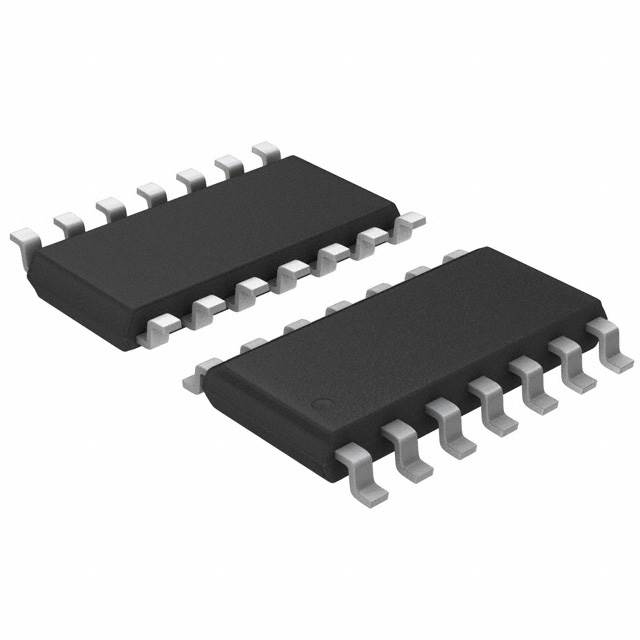
| Package Name | 14-SOIC |
| Package Width | 3.9 mm |
| Switch Circuit Type | DPST |
| Switch Contact | NO, NC |
| Switch Time Toff (Max) | 250 ns |
| Switch Time Ton (Max) | 300 ns |
| Voltage - Supply, Dual (Maximum) | 15 V |
| Voltage - Supply, Dual (Minimum) | -15 V |
Pricing
Prices provided here are for design reference only. For realtime values and availability, please visit the distributors directly
CAD
3D models and CAD resources for this part
Description
General part information
DG303 Series
DG303BDY-T1-E3 is a CMOS analogue switch. Designed on the Vishay Siliconix PLUS-40 CMOS process, this switch is latch-up proof and is designed to block upto 30V peak-to-peak when off. An epitaxial layer prevents latchup. In the on condition the switches conduct equally well in both directions (with no offset voltage) and minimize error conditions with their low on-resistance. Featuring low power consumption (3.5mW typ.) this switch is ideal for battery-powered applications, without sacrificing switching speed. Designed for break-before-make switching action, these devices are CMOS and quasi-TTL compatible. Single supply operation is allowed by connecting the V-rail to 0V. It is used in applications such as low-level switching circuits, programmable gain amplifiers, and portable and battery-powered systems.
Documents
Technical documentation and resources