


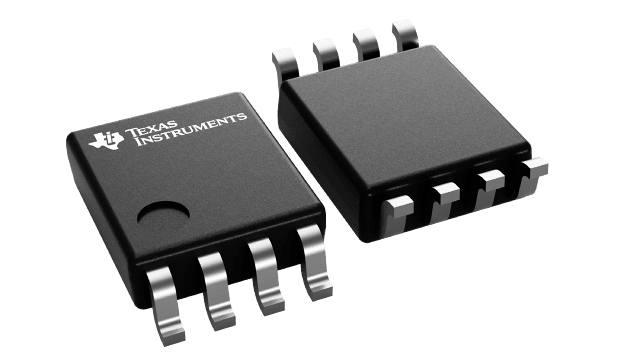
TXS0102VQDCURQ1
ActiveAUTOMOTIVE 2-BIT BIDIRECTIONAL LEVEL SHIFTER FOR OPEN-DRAIN AND PUSH-PULL APPLICATIONS
Deep-Dive with AI
Search across all available documentation for this part.
TXS0102VQDCURQ1
ActiveAUTOMOTIVE 2-BIT BIDIRECTIONAL LEVEL SHIFTER FOR OPEN-DRAIN AND PUSH-PULL APPLICATIONS
Technical Specifications
Parameters and characteristics for this part
| Specification | TXS0102VQDCURQ1 |
|---|---|
| Channel Type | Bidirectional |
| Channels per Circuit | 2 |
| Data Rate | 24 Mbps |
| Grade | Automotive |
| Mounting Type | Surface Mount |
| Number of Circuits | 1 |
| Operating Temperature [Max] | 125 °C |
| Operating Temperature [Min] | -40 °C |
| Output Type | Push-Pull, Open Drain, Tri-State |
| Package / Case | 8-VFSOP |
| Package / Case [custom] | 2.3 mm |
| Package / Case [custom] | 0.091 " |
| Qualification | AEC-Q100 |
| Supplier Device Package | 8-VSSOP |
| Translator Type | Voltage Level |
| Voltage - VCCA [Max] | 3.6 V |
| Voltage - VCCA [Min] | 1.65 V |
| Voltage - VCCB [Max] | 5.5 V |
| Voltage - VCCB [Min] | 2.3 V |
Pricing
Prices provided here are for design reference only. For realtime values and availability, please visit the distributors directly
| Distributor | Package | Quantity | $ | |
|---|---|---|---|---|
| Digikey | N/A | 2874 | $ 0.83 | |
| Texas Instruments | LARGE T&R | 1 | $ 0.58 | |
| 100 | $ 0.45 | |||
| 250 | $ 0.33 | |||
| 1000 | $ 0.24 | |||
Description
General part information
TXS0102V-Q1 Series
This two-bit non-inverting translator is a bidirectional voltage-level translator and can be used to establish digital switching compatibility between mixed-voltage systems. It uses two separate configurable power-supply rails, with the A ports supporting operating voltages from 1.65V to 3.6V while it tracks the VCCA supply, and the B ports supporting operating voltages from 2.3V to 5.5V while it tracks the VCCB supply. This allows the support of both lower and higher logic signal levels while providing bidirectional translation capabilities between any of the 1.8V, 2.5V, 3.3V, and 5V voltage nodes.
When the output-enable (OE) input is low, all I/Os are placed in the high-impedance state, which significantly reduces the power-supply quiescent current consumption.
To put the device in the high-impedance state during power up or power down, OE should be tied to GND through a pulldown resistor; the current-sourcing capability of the driver determines the minimum value of the resistor.