ISL6729IBZ-T
ObsoleteLOW-COST SINGLE-ENDED CURRENT-MODE PWM FOR MICROCONTROLLER-BASED POWER CONVERTERS
Deep-Dive with AI
Search across all available documentation for this part.
ISL6729IBZ-T
ObsoleteLOW-COST SINGLE-ENDED CURRENT-MODE PWM FOR MICROCONTROLLER-BASED POWER CONVERTERS
Deep-Dive with AI
Technical Specifications
Parameters and characteristics for this part
| Specification | ISL6729IBZ-T |
|---|---|
| Clock Sync | False |
| Duty Cycle (Max) [Max] | 99 % |
| Frequency - Switching [Max] | 1 MHz |
| Function | Step-Up/Step-Down |
| Mounting Type | Surface Mount |
| Number of Outputs | 1 |
| Operating Temperature [Max] | 105 °C |
| Operating Temperature [Min] | -40 °C |
| Output Configuration | Positive, Isolation Capable |
| Output Phases | 1 |
| Output Type | Transistor Driver |
| Package / Case | 8-SOIC |
| Package / Case [x] | 0.154 in |
| Package / Case [y] | 3.9 mm |
| Supplier Device Package | 8-SOIC |
| Synchronous Rectifier | True |
| Topology | Forward Converter, Flyback |
| Voltage - Supply (Vcc/Vdd) [Max] | 5.25 V |
| Voltage - Supply (Vcc/Vdd) [Min] | 4.75 V |
Pricing
Prices provided here are for design reference only. For realtime values and availability, please visit the distributors directly
| Distributor | Package | Quantity | $ | |
|---|---|---|---|---|
Description
General part information
ISL6729 Series
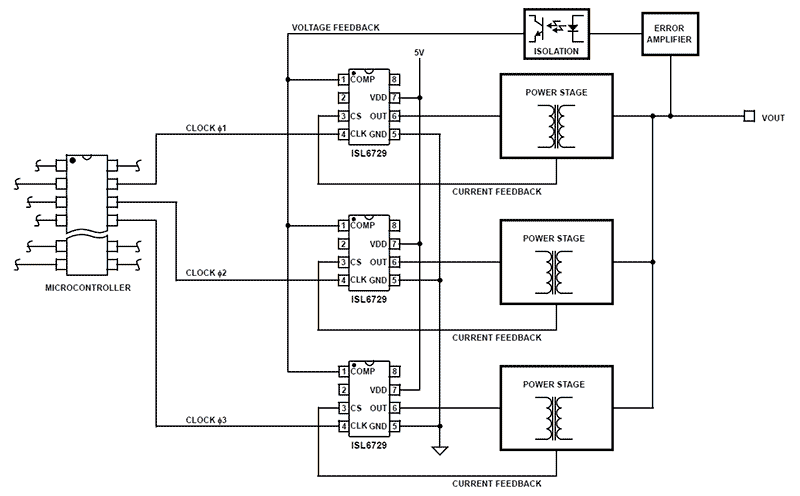
The ISL6729 pulse width modulating (PWM) current mode controller is designed for power conversion applications that are based on a microcontroller, or other device, which can generate a digital clock signal at the desired switching frequency. Similar to the ISL684x family of products, the ISL6729 provides the basic current mode PWM control features, but eliminates the error amplifier, the oscillator, and the reference. An external clock signal applied to the oscillator input provides the time base and sets the maximum duty cycle. The reduced feature set is ideal for those applications where a microcontroller is available to provide the monitor and control functions. The analog PWM provides the cycle-by-cycle peak-current mode control, leaving the monitor and control overhead to the microcontroller.
Documents
Technical documentation and resources