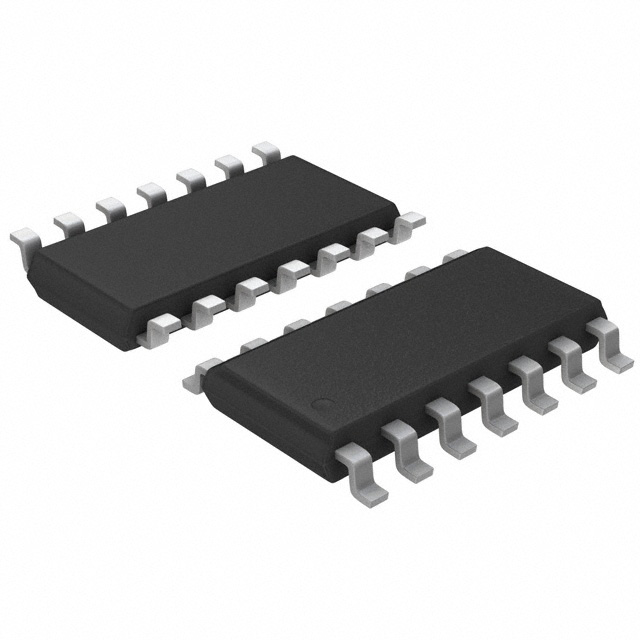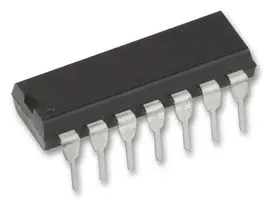
SN74121N
ActiveMONOSTABLE MULTIVIBRATOR WITH SCHMITT-TRIGGER INPUTS
Deep-Dive with AI
Search across all available documentation for this part.
SN74121N
ActiveMONOSTABLE MULTIVIBRATOR WITH SCHMITT-TRIGGER INPUTS
Deep-Dive with AI
Technical Specifications
Parameters and characteristics for this part
| Specification | SN74121N |
|---|---|
| Current - Output High, Low [custom] | 16 mA |
| Current - Output High, Low [custom] | 400 µA |
| Independent Circuits | 2 |
| Logic Type | Monostable |
| Mounting Type | Through Hole |
| Operating Temperature [Max] | 70 °C |
| Operating Temperature [Min] | 0 °C |
| Package / Case | 14-DIP |
| Package / Case [x] | 0.3 " |
| Package / Case [y] | 7.62 mm |
| Propagation Delay | 45 ns |
| Schmitt Trigger Input | False |
| Voltage - Supply [Max] | 5.25 V |
| Voltage - Supply [Min] | 4.75 V |
Pricing
Prices provided here are for design reference only. For realtime values and availability, please visit the distributors directly
| Distributor | Package | Quantity | $ | |
|---|---|---|---|---|
| Digikey | Tube | 1 | $ 5.67 | |
| 10 | $ 5.10 | |||
| 25 | $ 4.82 | |||
| 100 | $ 4.18 | |||
| 250 | $ 3.96 | |||
| 500 | $ 3.55 | |||
| 1000 | $ 3.00 | |||
| 2500 | $ 2.85 | |||
| Newark | Each | 1 | $ 6.43 | |
| 10 | $ 6.04 | |||
| 25 | $ 5.72 | |||
| 50 | $ 5.46 | |||
| 100 | $ 5.23 | |||
| 250 | $ 4.97 | |||
| 500 | $ 4.89 | |||
| Texas Instruments | TUBE | 1 | $ 4.93 | |
| 100 | $ 4.32 | |||
| 250 | $ 3.03 | |||
| 1000 | $ 2.44 | |||
Description
General part information
SN74121 Series
These multivibrators feature dual negative-transition-triggered inputs and a single positive-transition-triggered input which can be used as an inhibit input. Complementary output pulses are provided.
Pulse triggering occurs at a particular voltage level and is not directly related to the transition time of the input pulse. Schmitt-trigger input circuitry (TTL hysteresis) for the B input allow jitter-free triggering from inputs with transition rates as slow as 1 volt/second, providing the circuit with an excellent noise immunity of typically 1.2 volts. A high immunity to VCCnoise of typically 1.5 volts is also provided by internal latching circuitry.
Once fired, the outputs are independent of further transitions of the inputs and are a function only of the timing components. Input pulses may be of any duration relative to the output puls. Output pulse length may be varied from 40 nanoseconds to 28 seconds by choosing appropriate timing components. With no external timing components (i.e., Rintconnected to VCC, Cextand Rext/Cextopen), an output pulse of typically 30 or 35 nanoseconds is achieved which may be used as a d-c triggered reset signal. Output rise and fall times are TTL compatible and independent of pulse length.
Documents
Technical documentation and resources