


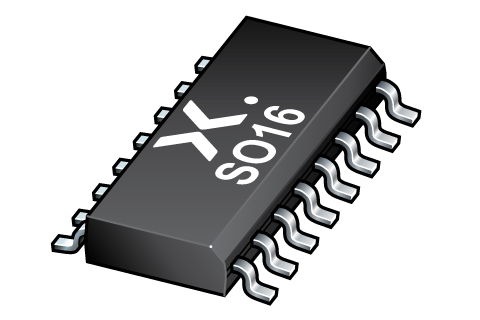
74HC161D-Q100J
ActivePRESETTABLE SYNCHRONOUS 4-BIT BINARY COUNTER; ASYNCHRONOUS RESET
Deep-Dive with AI
Search across all available documentation for this part.
74HC161D-Q100J
ActivePRESETTABLE SYNCHRONOUS 4-BIT BINARY COUNTER; ASYNCHRONOUS RESET
Deep-Dive with AI
Technical Specifications
Parameters and characteristics for this part
| Specification | 74HC161D-Q100J |
|---|---|
| Count Rate | 48 MHz |
| Direction | Up |
| Grade | Automotive |
| Logic Type | Binary Counter |
| Mounting Type | Surface Mount |
| Number of Bits per Element | 4 |
| Number of Elements | 1 |
| Operating Temperature [Max] | 125 °C |
| Operating Temperature [Min] | -40 C |
| Package / Case | 16-SOIC |
| Package / Case | 0.154 in, 3.9 mm |
| Qualification | AEC-Q100 |
| Reset | Asynchronous |
| Supplier Device Package | 16-SO |
| Timing | Synchronous |
| Trigger Type | Positive Edge |
| Voltage - Supply [Max] | 6 V |
| Voltage - Supply [Min] | 2 V |
Pricing
Prices provided here are for design reference only. For realtime values and availability, please visit the distributors directly
| Distributor | Package | Quantity | $ | |
|---|---|---|---|---|
| Digikey | N/A | 635 | $ 0.60 | |
Description
General part information
74HC161D-Q100 Series
The 74HC161-Q100 is a synchronous presettable binary counter with an internal look-head carry. Synchronous operation is provided by having all flip-flops clocked simultaneously on the positive-going edge of the clock (CP). The outputs (Q0 to Q3) of the counters may be preset HIGH or LOW. A LOW at the parallel enable input (PE) disables the counting action and causes the data at the data inputs (D0 to D3) to be loaded into the counter on the positive-going edge of the clock. Preset takes place regardless of the levels at count enable inputs (CEP and CET). A LOW at the master reset input (MR) sets Q0 to Q3 LOW regardless of the levels at input pins CP,PE, CET and CEP (thus providing an asynchronous clear function). The look-ahead carry simplifies serial cascading of the counters. Both CEP and CET must be HIGH to count. The CET input is fed forward to enable the terminal count output (TC). The TC output thus enabled will produce a HIGH output pulse of a duration approximately equal to a HIGH output of Q0. This pulse can be used to enable the next cascaded stage. The maximum clock frequency for the cascaded counters is determined by the CP to TC propagation delay and CEP to CP set-up time, according to the following formula:
Documents
Technical documentation and resources