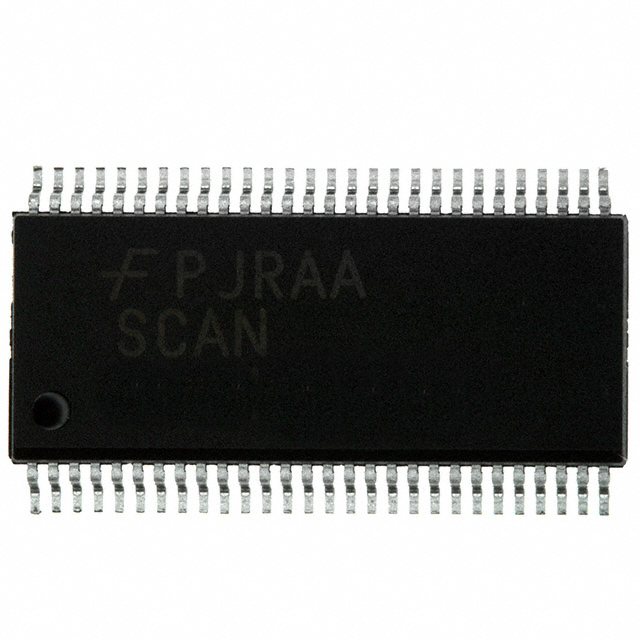
74LVTH16646MTDX
ActiveLOW VOLTAGE 16-BIT TRANSCEIVER/REGISTER WITH 3-STATE OUTPUTS
Deep-Dive with AI
Search across all available documentation for this part.
74LVTH16646MTDX
ActiveLOW VOLTAGE 16-BIT TRANSCEIVER/REGISTER WITH 3-STATE OUTPUTS
Deep-Dive with AI
Technical Specifications
Parameters and characteristics for this part
| Specification | 74LVTH16646MTDX |
|---|---|
| Current - Output High, Low [custom] | 64 mA |
| Current - Output High, Low [custom] | 32 mA |
| Mounting Type | Surface Mount |
| Number of Bits per Element | 8 |
| Number of Elements | 2 |
| Operating Temperature [Max] | 85 °C |
| Operating Temperature [Min] | -40 °C |
| Output Type | 3-State |
| Package / Case | 6.1 mm |
| Package / Case | 0.24 in |
| Package / Case | 56-TFSOP |
| Supplier Device Package | 56-TSSOP |
| Voltage - Supply [Max] | 3.6 V |
| Voltage - Supply [Min] | 2.7 V |
Pricing
Prices provided here are for design reference only. For realtime values and availability, please visit the distributors directly
| Distributor | Package | Quantity | $ | |
|---|---|---|---|---|
| Digikey | Bulk | 188 | $ 1.60 | |
Description
General part information
74LVTH16646 Series
The LVT16646 and LVTH16646 contains sixteen non-inverting bidirectional registered bus transceivers providing multiplexed transmission of data directly from the input bus or from the internal storage registers. Each byte has separate control inputs which can be shorted together for full 16-bit operation. The DIR inputs determine the direction of data flow through the device. The CPAB and CPBA inputs load data into the registers on the LOW-to-HIGH transition (see Functional Description). The LVTH16646 data inputs include bushold, eliminating the need for external pull-up resistors to hold unused inputs. These transceivers are designed for low-voltage (3.3V) VCCapplications, but with the capability to provide a TTL interface to a 5V environment. The LVT16646 and LVTH16646 are fabricated with an advanced BiCMOS technology to achieve high speed operation similar to 5V ABT while maintaining low power dissipation.
Documents
Technical documentation and resources