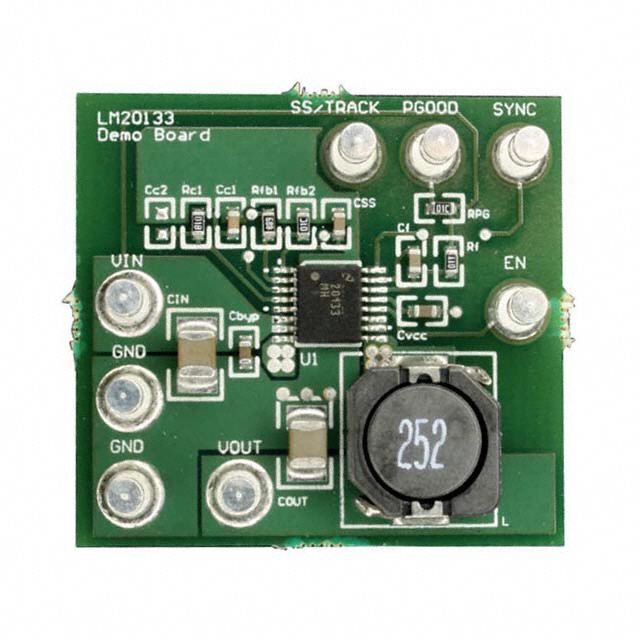
LM20133EVAL
ObsoleteBOARD EVAL 3A POWERWISE LM20133
Deep-Dive with AI
Search across all available documentation for this part.
LM20133EVAL
ObsoleteBOARD EVAL 3A POWERWISE LM20133
Deep-Dive with AI
Technical Specifications
Parameters and characteristics for this part
| Specification | LM20133EVAL |
|---|---|
| Board Type | Fully Populated |
| Current - Output | 3 A |
| Main Purpose | DC/DC, Step Down |
| Outputs and Type | Non-Isolated |
| Outputs and Type | 1 |
| Regulator Topology | Buck |
| Supplied Contents | Board(s) |
| Utilized IC / Part | LM20133 |
| Voltage - Output | 1.2 V |
Pricing
Prices provided here are for design reference only. For realtime values and availability, please visit the distributors directly
| Distributor | Package | Quantity | $ | |
|---|---|---|---|---|
| Digikey | Box | 1 | $ 51.74 | |
Description
General part information
LM20133 Series
The LM20133 is a full featured synchronous buck regulator capable of delivering up to 3A of continuous output current. The current mode control loop can be compensated to be stable with virtually any type of output capacitor. For most cases, compensating the device only requires two external components, providing maximum flexibility and ease of use. The device is optimized to work over the input voltage range of 2.95V to 5.5V making it suited for a wide variety of low voltage systems.
The device features internal over voltage protection (OVP) and over current protection (OCP) circuits for increased system reliability. A precision enable pin and integrated UVLO allows the turn on of the device to be tightly controlled and sequenced. Start-up inrush currents are limited by both an internally fixed and externally adjustable Soft-Start circuit. Fault detection and supply sequencing is possible with the integrated power good circuit.
The switching frequency of the LM20133 can be synchronized to an external clock by use of the SYNC pin. The SYNC pin is capable of synchronizing to input signals ranging from 500 kHz to 1.5 MHz.
Documents
Technical documentation and resources