


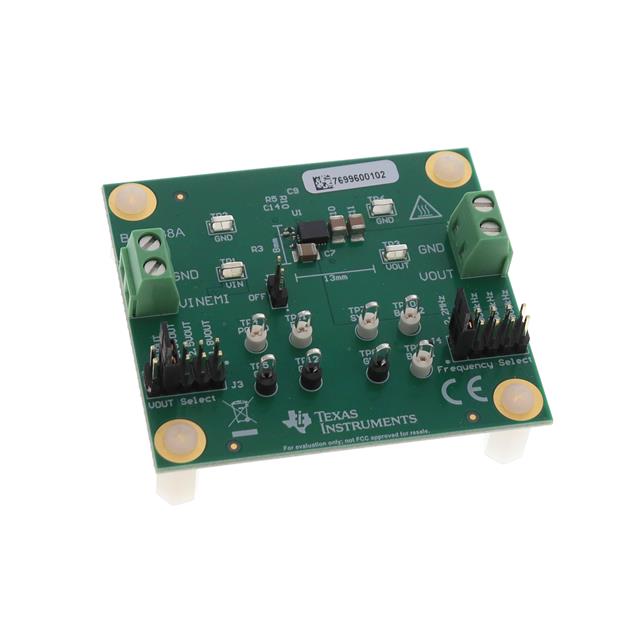
TLVM23625EVM
ActiveTLVM23625 EVALUATION MODULE FOR
Deep-Dive with AI
Search across all available documentation for this part.
TLVM23625EVM
ActiveTLVM23625 EVALUATION MODULE FOR
Deep-Dive with AI
Technical Specifications
Parameters and characteristics for this part
| Specification | TLVM23625EVM |
|---|---|
| Board Type | Fully Populated |
| Current - Output | 2.5 A |
| Frequency - Switching | 2.2 MHz |
| Main Purpose | DC/DC, Step Down |
| Outputs and Type | Non-Isolated |
| Outputs and Type | 1 |
| Regulator Topology | Buck |
| Supplied Contents | Board(s) |
| Utilized IC / Part | TLVM23625 |
| Voltage - Input [Max] | 36 V |
| Voltage - Input [Min] | 3 V |
| Voltage - Output | 5 V |
Pricing
Prices provided here are for design reference only. For realtime values and availability, please visit the distributors directly
| Distributor | Package | Quantity | $ | |
|---|---|---|---|---|
| Digikey | Box | 1 | $ 96.00 | |
Description
General part information
TLVM23625 Series
The TLVM236x5 is a 1.5A or 2.5A, 36V input synchronous step-down DC/DC power module that combines flip chip on lead (FCOL) packaging, power MOSFETs, integrated inductor and boot capacitor in a compact and easy-to-use 3.5mm × 4.5mm × 2mm, 11-pin QFN package. The small HotRod™ QFN package technology enhances the thermal performance, ensuring high ambient temperature operation. devices can be configured for 1V up to 6V output with a resistor feedback divider.
The TLVM236x5 is specifically designed to meet low standby power requirements for always on, industrial applications. Auto mode enables frequency fold back when operating at light loads, allowing a no load current consumption of 1.5µA at 13.5V VIN and high light load efficiency. A seamless transition between PWM and PFM modes along with low MOSFET on resistances provide exceptional efficiency across the entire load range.
The TLVM236x5 uses peak current mode architecture with internal compensation to maintain stable operation with minimal output capacitance. The RT pin can be used to set the frequency between 200kHz and 2.2MHz to avoid noise sensitive frequency bands.
Documents
Technical documentation and resources