Deep-Dive with AI
Search across all available documentation for this part.
Deep-Dive with AI
Technical Specifications
Parameters and characteristics for this part
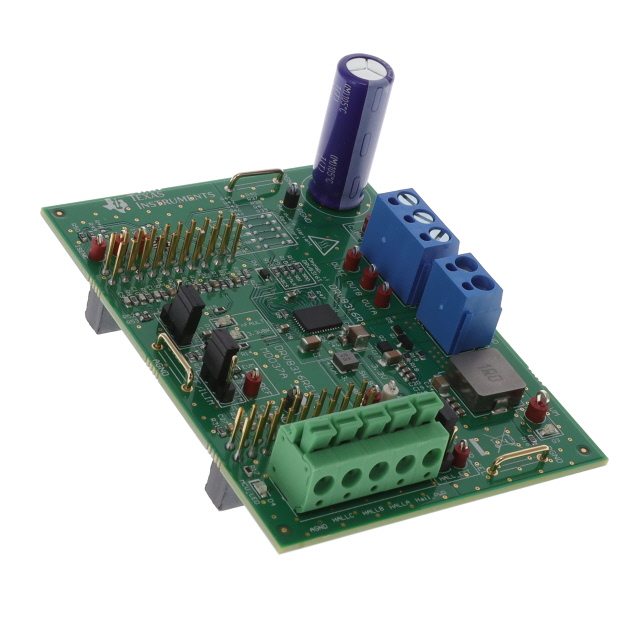
| Specification | DRV8316REVM |
|---|---|
| Contents | Cable(s), Board(s) |
| Embedded | Yes, MCU |
| Function | Gate Driver |
| Primary Attributes | Motors (BLDC) |
| Secondary Attributes | On-Board LEDs, Test Points |
| Supplied Contents | Cable(s), Board(s) |
| Type | Power Management |
| Utilized IC / Part | DRV8316R |
Pricing
Prices provided here are for design reference only. For realtime values and availability, please visit the distributors directly
| Distributor | Package | Quantity | $ | |
|---|---|---|---|---|
| Digikey | Box | 1 | $ 106.80 | |
Description
General part information
DRV8316C Series
DRV8316C integrates three H-bridges with 40-V absolute maximum capability and a very low RDS(ON)of 95 mΩ (high-side + low-side) to enable high power drive capability for 12-V/24-V brushless-DC motors. DRV8316C provides integrated current sensing which eliminates the need for external sense resistors. DRV8316C integrates power management circuits including an voltage-adjustable buck regulator (3.3 V / 5 V, 200-mA) and LDO (3.3 V / 30 mA) that can be used to power external circuits.
DRV8316C provides a configurable 6x or 3x PWM control scheme which can be used to implement sensored or sensorless field-oriented control (FOC), sinusoidal control, or trapezoid control using an external microcontroller. DRV8316C is capable of driving a PWM frequency of up to 200 kHz. DRV8316C is highly configurable either through SPI (DRV8316CR) or pins (DRV8316CT) - PWM mode. slew rate, OCP level, current sense gain are some of the configurable features.
A number of protection features including supply undervoltage lockout (UVLO), overvoltage protection (OVP), charge pump undervoltage (CPUV), overcurrent protection (OCP), over-temperature warning (OTW) and over-temperature shutdown (OTSD) are integrated into DRV8316C to protect the device, motor, and system against fault events. Fault conditions are indicated by the nFAULT pin.
Documents
Technical documentation and resources