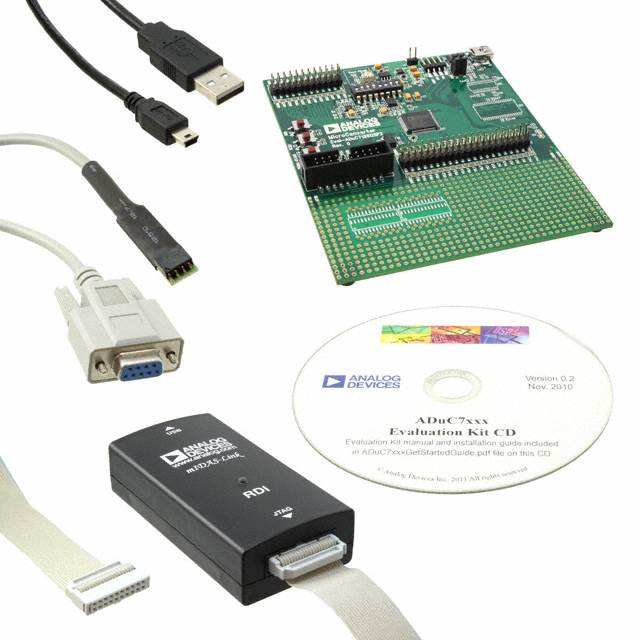
ADUC7126BSTZ126
ActivePRECISION ANALOG MICROCONTROLLER, 12-BIT ANALOG I/O, LARGE MEMORY, ARM7TDMI MCU WITH ENHANCED IRQ HANDLER
Deep-Dive with AI
Search across all available documentation for this part.
ADUC7126BSTZ126
ActivePRECISION ANALOG MICROCONTROLLER, 12-BIT ANALOG I/O, LARGE MEMORY, ARM7TDMI MCU WITH ENHANCED IRQ HANDLER
Deep-Dive with AI
Technical Specifications
Parameters and characteristics for this part
| Specification | ADUC7126BSTZ126 |
|---|---|
| Connectivity | SPI, I2C, EBI/EMI, UART/USART |
| Core Processor | ARM7® |
| Core Size | 16-Bit, 32-Bit |
| Data Converters | D/A 4x12b, A/D 12x12b |
| Mounting Type | Surface Mount |
| Number of I/O | 40 |
| Operating Temperature [Max] | 125 °C |
| Operating Temperature [Min] | -40 °C |
| Oscillator Type | Internal |
| Package / Case | 80-LQFP |
| Peripherals | POR, PWM, WDT |
| Program Memory Size | 126 KB |
| Program Memory Type | FLASH |
| RAM Size | 8K x 32 |
| Speed | 41.78 MHz |
| Voltage - Supply (Vcc/Vdd) [Max] | 3.6 V |
| Voltage - Supply (Vcc/Vdd) [Min] | 2.7 V |
Pricing
Prices provided here are for design reference only. For realtime values and availability, please visit the distributors directly
Description
General part information
ADUC7126 Series
The ADuC7124/ADuC7126 is a fully integrated, 1 MSPS, 12-bit data acquisition systems incorporating high performance multichannel ADCs, 16-bit/32-bit MCUs, and Flash/EE memory on a single chip. The ADC consists of up to 12 single-ended inputs. An additional four inputs are available but are multiplexed with the four DAC output pins. The ADC can operate in single-ended or differential input modes. The ADC input voltage is 0 V to VREF. A low drift band gap reference, temperature sensor, and voltage comparator complete the ADC peripheral set. The DAC output range is programmable to one of three voltage ranges. The DAC outputs have an enhanced feature of being able to retain their output voltage during a watchdog or software reset sequence.The devices operate from an on-chip oscillator and a PLL generating an internal high frequency clock of 41.78 MHz. This clock is routed through a programmable clock divider from which the MCU core clock operating frequency is generated. The microcontroller core is an ARM7TDMI®, 16-bit/32-bit RISC machine, which offers up to 41 MIPS peak performance. Thirty-two kilobytes of SRAM and 126 kB of nonvolatile Flash/EE memory are provided on-chip. The ARM7TDMI core views all memory and registers as a single linear array.The ADuC7124 contains an advanced interrupt controller. The vectored interrupt controller (VIC) allows every interrupt to be assigned a priority level. It also supports nested interrupts to a maximum level of eight per IRQ and FIQ. When IRQ and FIQ interrupt sources are combined, a total of 16 nested interrupt levels are supported. On-chip factory firmware supports in-circuit download via the UART serial interface port or the I2C port, while nonintrusive emulation is also supported via the JTAG interface. These features are incorporated into a low cost QuickStart™Development System supporting this MicroConverter®family. The part contains a 16-bit PWM with six output signals. For communication purposes, the part contains 2×I2C channels that can be individually configured for Master or Slave mode. An SPI interface supporting both master and slave modes is also provided. Thirdly, 2×UART channels are provided. Each UART contains a configurable 16-bit FIFO with the receive and transmit buffers.The parts operate from 2.7 V to 3.6 V and are specified over an industrial temperature range of −40°C to +125°C. When operating at 41.78 MHz, the power dissipation is typically 120 mW. The ADuC7124 is available in either 64-lead LFCSP or 80-lead LFQFP packages.APPLICATIONSIndustrial control and automation systemsSmart sensors, precision instrumentationBase station systems, optical networkingPatient monitoring
Documents
Technical documentation and resources