


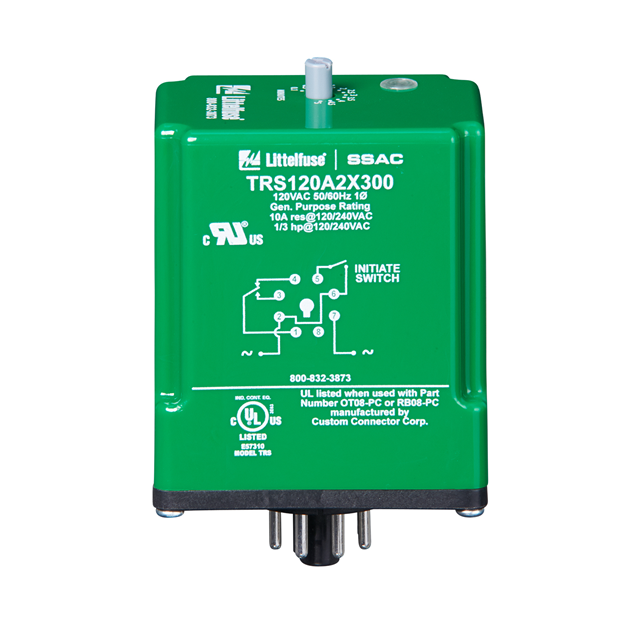
TRS24D7Z10
ActiveTIME DELAY RELAY 24/28VDC 8A SPDT( (60.33MM 104.78MM 44.45MM)) SOCKET
Deep-Dive with AI
Search across all available documentation for this part.
TRS24D7Z10
ActiveTIME DELAY RELAY 24/28VDC 8A SPDT( (60.33MM 104.78MM 44.45MM)) SOCKET
Deep-Dive with AI
Technical Specifications
Parameters and characteristics for this part
| Specification | TRS24D7Z10 |
|---|---|
| Circuit | SPDT (1 Form C) |
| Contact Rating @ Voltage | 10 A |
| Contact Rating @ Voltage [Max] | 240 VAC |
| Contact Rating @ Voltage [Min] | 120 VAC |
| Delay Time [Max] | 10 s |
| Delay Time [Min] | 0.1 Sec |
| Function | One Shot |
| Mounting Type | Socketable |
| Relay Type | Mechanical Relay |
| Termination Style | 11 Pin |
| Termination Style | Plug In |
| Timing Adjustment Method | Hand Dial |
| Timing Initiate Method | Trigger Signal, Input Voltage |
| Voltage - Supply | 24 V |
Pricing
Prices provided here are for design reference only. For realtime values and availability, please visit the distributors directly
Description
General part information
TRS24D7Z10 Series
The TRS Series combines an isolated, 10A electromechanical, relay output with analog timing circuitry. False trigger of the TRS by a transient is unlikely because of the complete isolation of the circuit from the line prior to initiation. The initiate contact is common to one side of the line and may be utilized to operate other loads. Installation is easy due to the TRS’s industry standard 8 or 11-pin plug-in base wiring. Operation (Single Shot) Input voltage must be applied to the input before and during timing. Upon momentary or maintained closure of the initiate switch (leading edge triggered), the output energizes for a measured interval of time. At the end of the delay, the output de-energizes. Opening or reclosing the initiate switch during timing has no affect on the time delay. Applying input voltage with the initiate switch closed will energize the load and begin the time delay.Reset: Reset occurs when the time delay is complete and the initiate switch is opened. Loss of input voltage resets the time delay and output.
Documents
Technical documentation and resources