DC2387A
ActiveDEMONSTRATION BOARD, LTM8071EY#PBF, 60 V, 5 A SILENT SWITCHER STEP-DOWN ΜMODULE REGULATOR
Deep-Dive with AI
Search across all available documentation for this part.
DC2387A
ActiveDEMONSTRATION BOARD, LTM8071EY#PBF, 60 V, 5 A SILENT SWITCHER STEP-DOWN ΜMODULE REGULATOR
Deep-Dive with AI
Technical Specifications
Parameters and characteristics for this part
| Specification | DC2387A |
|---|---|
| Contents | Board(s) |
| Current - Output | 5 A |
| Frequency - Switching | 1 MHz |
| Main Purpose | DC/DC, Step Down |
| Outputs and Type | 1 Non-Isolated Output |
| Regulator Topology | Buck |
| Utilized IC / Part | LTM8071 |
| Voltage - Input [Max] | 60 V |
| Voltage - Input [Min] | 7 V |
| Voltage - Output | 5 V |
Pricing
Prices provided here are for design reference only. For realtime values and availability, please visit the distributors directly
Description
General part information
LTM8071 Series
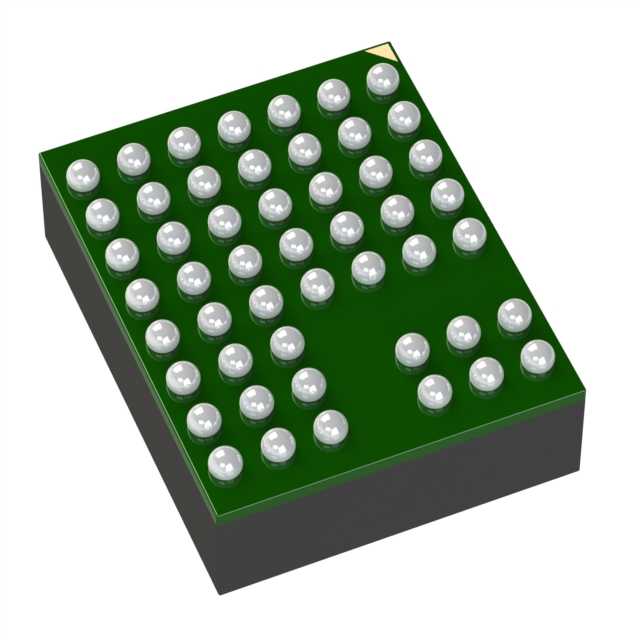
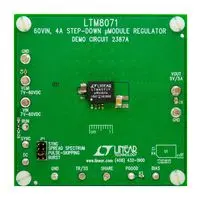
DC2387A is a LTM8071 60VIN, 5A step-down µModule regulator demonstration board. Demonstration circuit 2387A features the LTM®8071 µModule® regulator, a high performance, high efficiency Silent Switcher® step-down regulator. The LTM8071 is a complete DC/DC point-of-load regulator in a thermally enhanced 11.25mm × 9mm × 3.32mm BGA package. The demo board has an input voltage range of 7V to 60V and provides an output current up to 5A. The output voltage is set to 5V on DC2387A. The Silent Switcher design minimizes EMI while delivering high efficiency. Input EMI filtering is available by applying the input voltage to the VEMI turret. Spread spectrum mode can be enabled using the SYNC jumper (JP1) to further reduce EMI emissions. External clock synchronization is available through the SYNC/MODE pin. For high efficiency at low load currents, burst or pulse-skipping modes can be selected with the SYNC jumper (JP1).
Documents
Technical documentation and resources