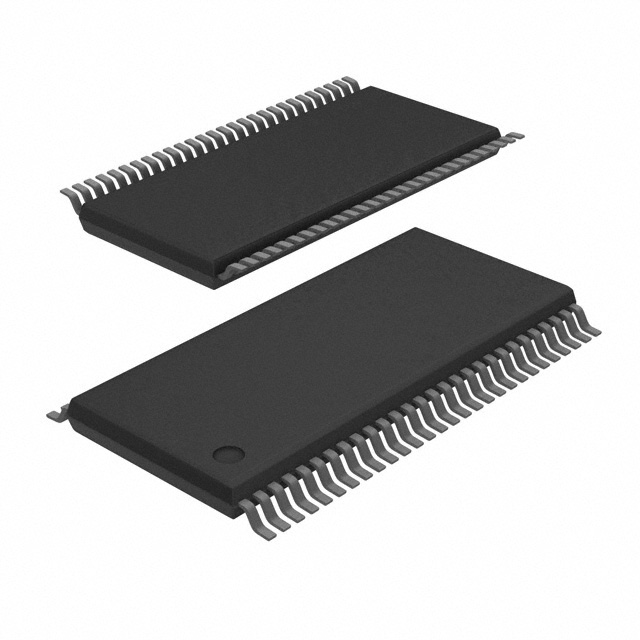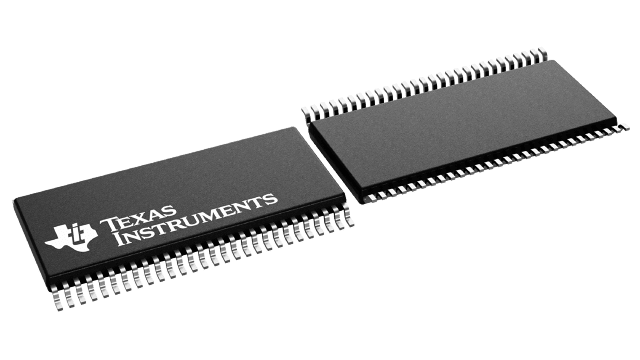
SN74ABT162601DGGR
Active18-BIT UNIVERSAL BUS TRANSCEIVERS WITH 3-STATE OUTPUTS
Deep-Dive with AI
Search across all available documentation for this part.
SN74ABT162601DGGR
Active18-BIT UNIVERSAL BUS TRANSCEIVERS WITH 3-STATE OUTPUTS
Deep-Dive with AI
Technical Specifications
Parameters and characteristics for this part
| Specification | SN74ABT162601DGGR |
|---|---|
| Current - Output High, Low | 32 mA, 64 mA, 12 mA |
| Mounting Type | Surface Mount |
| Number of Circuits | 18 Bit |
| Operating Temperature [Max] | 85 °C |
| Operating Temperature [Min] | -40 °C |
| Package / Case | 6.1 mm |
| Package / Case | 0.24 in |
| Package / Case | 56-TFSOP |
| Supplier Device Package | 56-TSSOP |
| Voltage - Supply [Max] | 5.5 V |
| Voltage - Supply [Min] | 4.5 V |
Pricing
Prices provided here are for design reference only. For realtime values and availability, please visit the distributors directly
| Distributor | Package | Quantity | $ | |
|---|---|---|---|---|
| Digikey | Cut Tape (CT) | 1 | $ 6.55 | |
| Digi-Reel® | 1 | $ 6.55 | ||
| Tape & Reel (TR) | 2000 | $ 3.29 | ||
| Texas Instruments | LARGE T&R | 1 | $ 4.51 | |
| 100 | $ 3.67 | |||
| 250 | $ 2.89 | |||
| 1000 | $ 2.45 | |||
Description
General part information
SN74ABT162601 Series
These 18-bit universal bus transceivers combine D-type latches and D-type flip-flops to allow data flow in transparent, latched, and clocked modes.
Data flow in each direction is controlled by output-enable (OEAB\ and OEBA\), latch-enable (LEAB and LEBA), and clock (CLKAB and CLKBA) inputs. The clock can be controlled by the clock-enable (CLKENAB\ and CLKENBA\) inputs.
For A-to-B data flow, the device operates in the transparent mode when LEAB is high. When LEAB is low, the A data is latched if CLKAB is held at a high or low logic level. If LEAB is low, the A data is stored in the latch/flip-flop on the low-to-high transition of CLKAB. Output-enable OEAB\ is active-low. When OEAB\ is low, the outputs are active. When OEAB\ is high, the outputs are in the high-impedance state. Data flow for B to A is similar to that of A to B but uses OEBA\, LEBA, CLKBA, and CLKENBA\.
Documents
Technical documentation and resources