


HC55185CIMZ96
ObsoleteIC SLIC RINGING VOIP 100V 28PLCC
Deep-Dive with AI
Search across all available documentation for this part.
HC55185CIMZ96
ObsoleteIC SLIC RINGING VOIP 100V 28PLCC
Deep-Dive with AI
Technical Specifications
Parameters and characteristics for this part
| Specification | HC55185CIMZ96 |
|---|---|
| Function | Subscriber Line Interface Concept (SLIC) |
| Mounting Type | Surface Mount |
| Number of Circuits | 1 |
| Operating Temperature [Max] | 85 °C |
| Operating Temperature [Min] | -40 °C |
| Package / Case | 28-LCC (J-Lead) |
| Supplier Device Package | 28-PLCC (11.51x11.51) |
Pricing
Prices provided here are for design reference only. For realtime values and availability, please visit the distributors directly
| Distributor | Package | Quantity | $ | |
|---|---|---|---|---|
Description
General part information
HC55185 Series
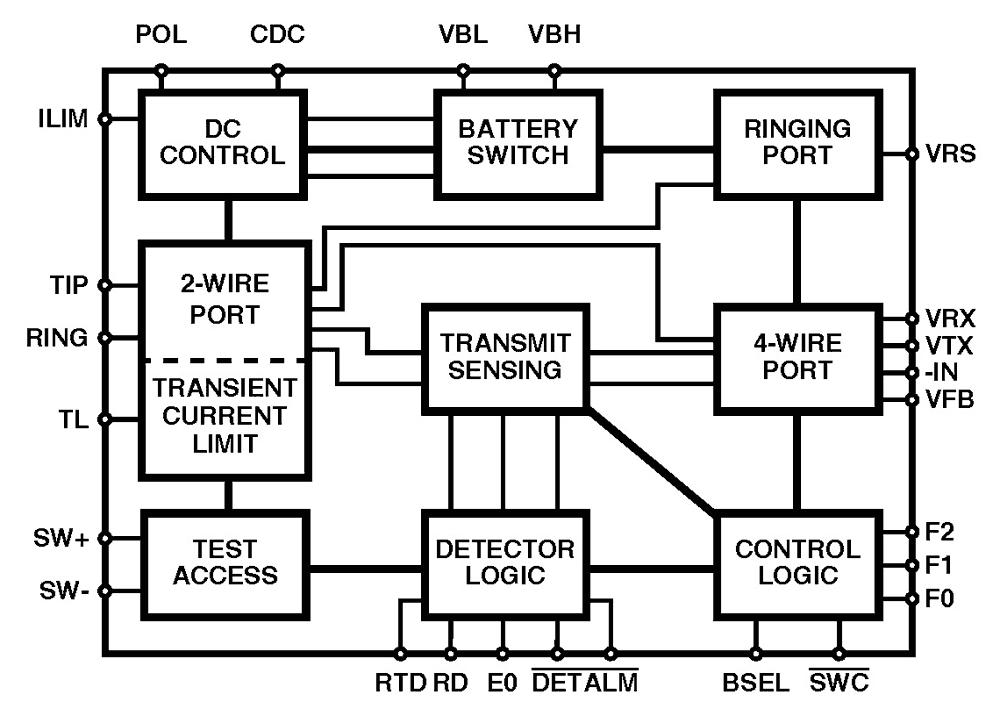
The RSLIC-VoIP family of Ringing Subscriber Line Interface Circuits (RSLIC) supports analog Plain Old Telephone Service (POTS) in short and medium loop length, wireless and wireline applications. Ideally suited for remote subscriber units, this family of products offers flexibility to designers with high ringing voltage and low power consumption system requirements. The RSLIC-VoIP family operates to 100V which translates directly to the amount of ringing voltage supplied to the end subscriber. With the high operating voltage, subscriber loop lengths can be extended to 500Ω (i.e., 5,000 feet) and beyond. Other key features across the product family include low power consumption, ringing using sinusoidal or trapezoidal waveforms, robust auto-detection mechanisms for when subscribers go on or off-hook, and minimal external discrete application components. Integrated test access features are also offered on selected products to support loopback testing as well as line measurement tests. There are five product offerings of the HC55185 with each version providing voltage grades of high battery voltage and longitudinal balance. The voltage feed amplifier design uses low fixed loop gains to achieve high analog performance with low susceptibility to system-induced noise.
Documents
Technical documentation and resources