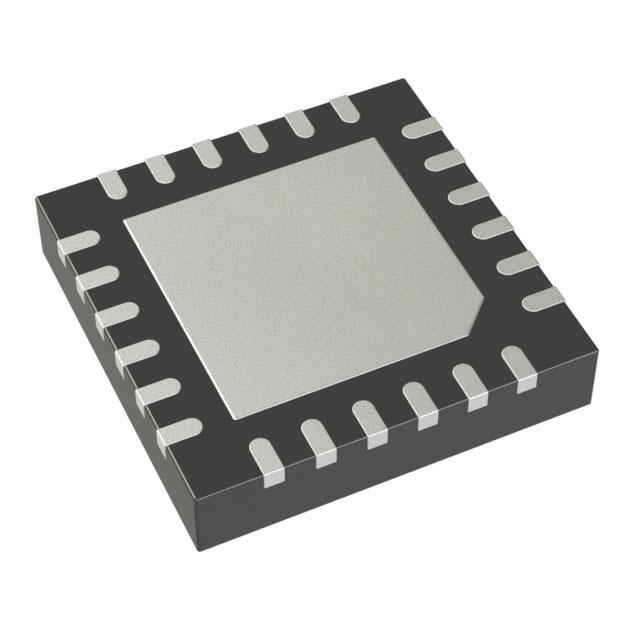
ADP5588ACPZ-R7
ActiveI/O EXPANDER, 8 BIT, I2C, 1.7 V, 3 V, LFCSP-EP, 24 PINS
Deep-Dive with AI
Search across all available documentation for this part.
ADP5588ACPZ-R7
ActiveI/O EXPANDER, 8 BIT, I2C, 1.7 V, 3 V, LFCSP-EP, 24 PINS
Technical Specifications
Parameters and characteristics for this part
| Specification | ADP5588ACPZ-R7 |
|---|---|
| Applications | Alarm Systems, Keypads |
| Interface | I2C |
| Mounting Type | Surface Mount |
| Package / Case | CSP, 24-WFQFN Exposed Pad |
| Package Length | 4 mm |
| Package Name | 24-LFCSP-WQ |
| Package Width | 4 mm |
| Voltage - Supply (Maximum) | 3 V |
| Voltage - Supply (Minimum) | 1.8 V |
Pricing
Prices provided here are for design reference only. For realtime values and availability, please visit the distributors directly
CAD
3D models and CAD resources for this part
Description
General part information
ADP5588 Series
The ADP5588 is an I/O port expander and keypad matrix designed for QWERTY type phones that require a large keypad matrix and expanded I/O lines. I/O expander ICs are used in mobile platforms as a solution to the limited number of GPIOs available in the main processor.In its small 4 mm × 4 mm package, the ADP5588 contains enough power to handle all key scanning and decoding and flag the processor of key presses and releases via the I2C®interface and interrupt. It frees the main microprocessor from having to monitor the keypad, thereby minimizing current drain and increasing processor bandwidth. It is also equipped with a buffer/FIFO and key event counter to handle and keep track of up to 10 unprocessed key or GPI events with overflow wrap and interrupt capability.The ADP5588 has a keylock capability with an option to trigger or not trigger an interrupt at key presses and releases. All communication to the main processor is done using one interrupt line and two I2C-compatible interface lines. The ADP5588 can be configured to have a keypad matrix of up to 8 rows × 10 columns (a maximum of 80 keys).When used for smaller keypad matrices, unused row and column pins can be reconfigured to act as general-purpose inputs, outputs, or light sensor inputs. R0, R1, R2, R3, R4, R5, R6, and R7 denote the row pins of the matrix, while C0, C1, C2, C3, C4, C5, C6, C7, C8, and C9 denote the column pins. At power-up, all rows and columns default as GPIs and must be programmed to function as part of the keypad matrix, GPOs, or light sensor inputs. In addition to keypad and GPIO functionalities, C8 and C9 can also be configured as light sensor inputs.When configured as keypad lines, the function of the C8 and C9 lines is straightforward: the control interface disconnects these lines from the comparator inputs, disables the light sensor comparator, and connects them to the keypad columns of the keypad matrix. When used as light sensor comparator inputs, the control interface disconnects these pins from the keypad, enables the comparators, and connects these lines to the comparator inputs. Two external capacitors (0.1 μF) are required when these pins are configured as light sensor inputs. When used as GPIOs, these pins are removed from the keypad and the light sensor interface, and the light sensor comparators are disabled, along with the logic for the sensors.ApplicationsKeypad and I/O expander designed for QWERTY type phones that require a large keypad matrix
Documents
Technical documentation and resources