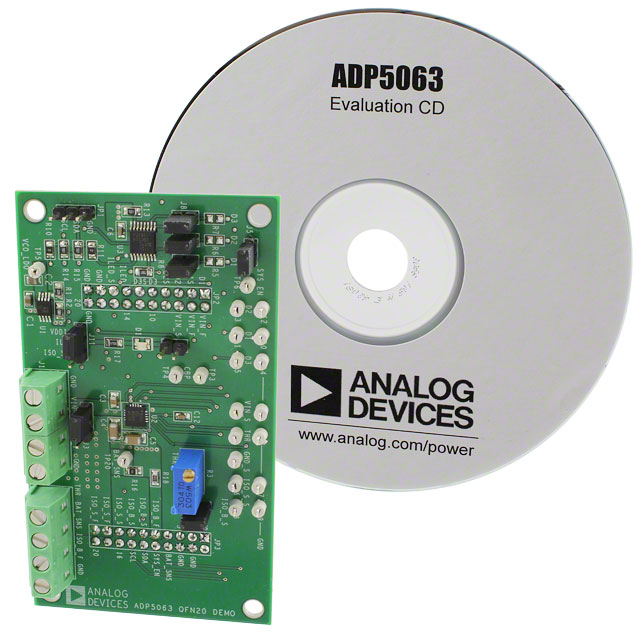
ADP5063ACPZ-1-R7
ActiveLINEAR LIFEPO4BATTERY CHARGER WITH POWER PATH AND USB COMPATIBILITY
Deep-Dive with AI
Search across all available documentation for this part.
ADP5063ACPZ-1-R7
ActiveLINEAR LIFEPO4BATTERY CHARGER WITH POWER PATH AND USB COMPATIBILITY
Technical Specifications
Parameters and characteristics for this part
| Specification | ADP5063ACPZ-1-R7 |
|---|---|
| Battery Chemistry | Lithium Iron Phosphate |
| Battery Pack Voltage | 4.3 V |
| Charge Current - Max | 1.3 A |
| Current - Charging | Constant, Programmable |
| Interface | USB, I2C |
| Mounting Type | Surface Mount |
| Number of Cells | 1 |
| Operating Temperature (Max) | 125 °C |
| Operating Temperature (Min) | -40 °C |
| Package / Case | CSP, 20-WFQFN Exposed Pad |
| Package Length | 4 mm |
| Package Name | 20-LFCSP |
| Package Width | 4 mm |
| Voltage - Supply (Max) | 6.7 V |
Pricing
Prices provided here are for design reference only. For realtime values and availability, please visit the distributors directly
| Distributor | Package | Quantity | $ | Updated |
|---|---|---|---|---|
| Digikey | Cut Tape (CT) | 1 | $ 4.70 | <1d |
| 10 | $ 3.57 | |||
| 25 | $ 3.29 | |||
| 100 | $ 2.98 | |||
| 250 | $ 2.92 | |||
| Tape & Reel (TR) | 1500 | $ 2.63 | <1d | |
| 3000 | $ 2.58 | |||
CAD
3D models and CAD resources for this part
Description
General part information
ADP5063 Series
The ADP5063 charger is fully compliant with USB 3.0 and the USB Battery Charging 1.2 Compliance Plan Specification, and enables charging via the mini USB VBUS pin from a wall charger, car charger, or USB host port.The ADP5063 operates from a 4 V to 6.7 V input voltage range but is tolerant of voltages up to 20 V, thereby alleviating concerns about USB bus spikes during disconnection or connection scenarios.The ADP5063 features an internal field effect transistor (FET) between the linear charger output and the battery. This permits battery isolation and, therefore, system powering under a dead battery or no battery scenario, which allows immediate system function upon connection to a USB power supply.Based on the type of USB source, which is detected by an external USB detection chip, the ADP5063 can be set to apply the correct current limit for optimal charging and USB compliance.The ADP5063 has three factory-programmable digital input/out-put pins that provide maximum flexibility for different systems. These digital input/output pins permit a combination of features, such as input current limits, charging enable and disable, charging current limits, and a dedicated interrupt output pin.APPLICATIONSSingle cell LiFePO4portable equipmentPortable medical devicesPortable instrumentation devicesPortable consumer devices
Documents
Technical documentation and resources