


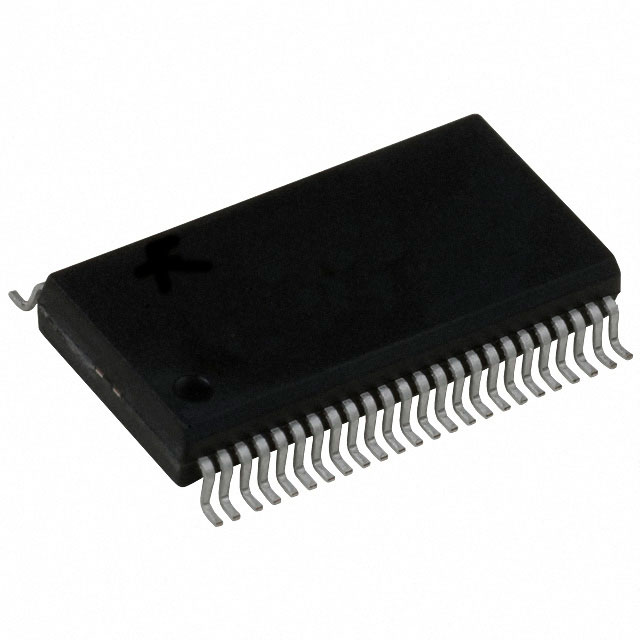
Deep-Dive with AI
Search across all available documentation for this part.
Deep-Dive with AI
Technical Specifications
Parameters and characteristics for this part
| Specification | SN65LVDS96DGGRG4 |
|---|---|
| Data Rate | 1.428 Gbps |
| Function | Deserializer |
| Input Type | LVDS |
| Mounting Type | Surface Mount |
| Number of Inputs | 3 |
| Number of Outputs | 21 |
| Operating Temperature [Max] | 85 °C |
| Operating Temperature [Min] | -40 °C |
| Output Type | LVTTL |
| Package / Case | 48-TFSOP |
| Package / Case | 0.24 in |
| Package / Case [custom] | 6.1 mm |
| Supplier Device Package | 48-TSSOP |
| Voltage - Supply [Max] | 3.6 V |
| Voltage - Supply [Min] | 3 V |
Pricing
Prices provided here are for design reference only. For realtime values and availability, please visit the distributors directly
| Distributor | Package | Quantity | $ | |
|---|---|---|---|---|
| Digikey | Tape & Reel (TR) | 2000 | $ 3.58 | |
Description
General part information
SN65LVDS96 Series
The SN65LVDS96 LVDS serdes (serializer/deserializer) receiver contains three serial-in 7-bit parallel-out shift registers, a 7× clock synthesizer, and four low-voltage differential signaling (LVDS) line receivers in a single integrated circuit. These functions allow receipt of synchronous data from a compatible transmitter, such asthe SN65LVDS95, over four balanced-pair conductors and expansion to 21 bits of single-ended LVTTL synchronous data at a lower transfer rate.
When receiving, the high-speed LVDS data is received and loaded into registers at the rate of seven times the LVDS input clock (CLKIN). The data is then unloaded to a 21-bit wide LVTTL parallel bus at the CLKIN rate. A phase-locked loop clock synthesizer circuit generates a 7× clock for internal clocking and an output clock for the expanded data. The SN65LVDS96 presents valid data on the rising edge of the output clock (CLKOUT).
The SN65LVDS96 requires only four line termination resistors for the differential inputs and little or no control. The data bus appears the same at the input to the transmitter and output of the receiver with data transmission transparent to the user(s). The only user intervention is the possible use of the shutdown/clear (SHTDN) active-low input to inhibit the clock and shut off the LVDS receivers for lower power consumption. A low level on this signal clears all internal registers to a low level.
Documents
Technical documentation and resources
No documents available