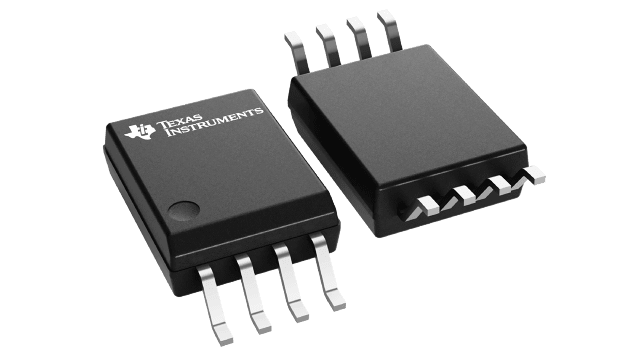
UCC5390ECQDWVQ1
ObsoleteAUTOMOTIVE 17-A 5KV RMS SINGLE CHANNEL ISOLATED GATE DRIVER
Deep-Dive with AI
Search across all available documentation for this part.
UCC5390ECQDWVQ1
ObsoleteAUTOMOTIVE 17-A 5KV RMS SINGLE CHANNEL ISOLATED GATE DRIVER
Technical Specifications
Parameters and characteristics for this part
| Specification | UCC5390ECQDWVQ1 |
|---|---|
| Approval Agency | UL, CQC, VDE |
| Common Mode Transient Immunity (Min) [Min] | 120 kV/µs |
| Current - Output High, Low [custom] | 17 A |
| Current - Output High, Low [custom] | 17 A |
| Current - Peak Output | 10 A |
| Grade | Automotive |
| Mounting Type | Surface Mount |
| Number of Channels [custom] | 1 |
| Operating Temperature [Max] | 150 °C |
| Operating Temperature [Min] | -40 C |
| Package / Case | 8-SOIC (0.295", 7.50mm Width) |
| Propagation Delay tpLH / tpHL (Max) [custom] | 60 ns |
| Propagation Delay tpLH / tpHL (Max) [custom] | 60 ns |
| Pulse Width Distortion (Max) [Max] | 20 ns |
| Qualification | AEC-Q100 |
| Rise / Fall Time (Typ) | 10 ns |
| Supplier Device Package | 8-SOIC |
| Technology | Capacitive Coupling |
| Voltage - Output Supply [Max] | 33 V |
| Voltage - Output Supply [Min] | 13.2 V |
Pricing
Prices provided here are for design reference only. For realtime values and availability, please visit the distributors directly
| Distributor | Package | Quantity | $ | |
|---|---|---|---|---|
| Digikey | N/A | 0 | $ 0.00 | |
| Texas Instruments | TUBE | 1 | $ 3.42 | |
| 100 | $ 2.83 | |||
| 250 | $ 2.03 | |||
| 1000 | $ 1.53 | |||
Description
General part information
UCC5390-Q1 Series
The UCC5390-Q1 is a single-channel, isolated gate driver with 10A source and 10A sink peak current designed to drive MOSFETs, IGBTs, and SiC MOSFETs. The UCC5390-Q1 has its UVLO2 referenced to GND2, which facilitates bipolar supplies and optimizes SiC and IGBT switching behavior and robustness.
The UCC5390-Q1 is available in 8.5mm SOIC-8 (DWV) package and can support isolation voltage up to 5kVRMS. The input side is isolated from the output side with SiO2 capacitive isolation technology with longer than 40 years isolation barrier lifetime. With its high drive strength and true UVLO detection, this device is a good fit for driving IGBTs and SiC MOSFETs in applications such as on-board chargers and traction inverters.
Compared to an optocoupler, the UCC5390-Q1 has lower part-to-part skew, lower propagation delay, higher operating temperature, and higher CMTI.
Documents
Technical documentation and resources