


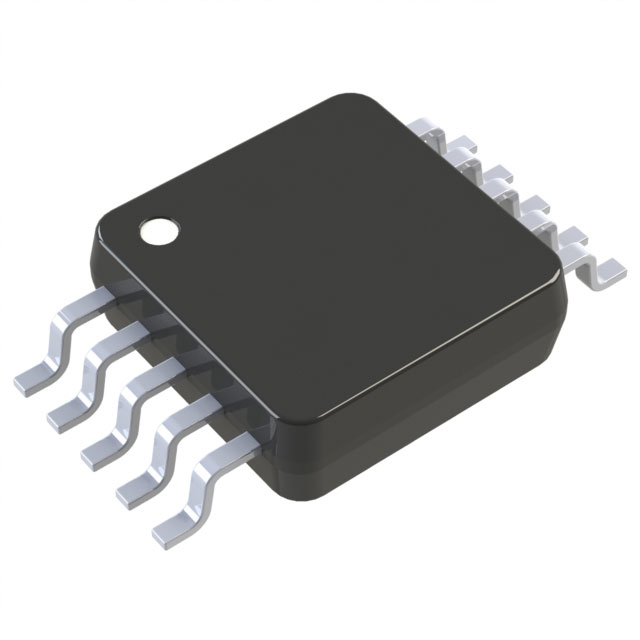
MAX22707AUB+
ActiveLOW POWER, PRECISION ZERO CROSSING DETECTOR
Deep-Dive with AI
Search across all available documentation for this part.
MAX22707AUB+
ActiveLOW POWER, PRECISION ZERO CROSSING DETECTOR
Deep-Dive with AI
Technical Specifications
Parameters and characteristics for this part
| Specification | MAX22707AUB+ |
|---|---|
| Filter Order | 4th |
| Filter Type | Band Pass, Low Pass |
| Frequency - Cutoff or Center | 336 Hz |
| Mounting Type | Surface Mount |
| Number of Filters [custom] | 1 |
| Package / Case | 10-TFSOP, 10-MSOP (0.118", 3.00mm Width) |
| Supplier Device Package | 10-uMAX/uSOP |
| Voltage - Supply [Max] | 5.5 V |
| Voltage - Supply [Min] | 3 V |
Pricing
Prices provided here are for design reference only. For realtime values and availability, please visit the distributors directly
| Distributor | Package | Quantity | $ | |
|---|---|---|---|---|
| Digikey | N/A | 400 | $ 5.81 | |
| 6950 | $ 5.81 | |||
| Tube | 1 | $ 6.89 | ||
| 10 | $ 4.68 | |||
| 25 | $ 4.11 | |||
| 100 | $ 3.47 | |||
| 250 | $ 3.16 | |||
| 500 | $ 2.97 | |||
| 1000 | $ 2.81 | |||
| 2500 | $ 2.64 | |||
Description
General part information
MAX22707 Series
The MAX22707 precision zero crossing detector provides a reliable and repeatable zero crossing detection signal based on an AC line input. The use of switched-capacitor filters helps to ensure minimal zero-crossing delay while tracking change in the input frequency and provides higher precision and a more inherently stable output than discrete solutions.The MAX22707 features a low-power, precision analog filter based on the switched-capacitor technology designed for precision filtering of AC input noise. The device requires only a simple external input network preceding the AC inputs and no additional external components for the filters. The two different filter types can be selected by the Filter Selection pin (FS). The available filter types are the fourth order BPF and LPF. The DC averaging filter capacitor function is used for the latter.The MAX22707 supports two standard line frequencies (50Hz and 60Hz) for both the filter types as well as rectified inputs in the case of LPF. If the BPF is selected, then the frequency selection Mode Control pin (MC) is used to select between 50Hz and 60Hz. If the LPF is selected, then the same pin is used to choose between 50/60Hz or 100/120Hz signal band (see Table 1). The Rectified Select pin (RS) is used to select between sine and rectified units (see Table 2). The MAX22707 is available in a compact 10-pin μMAX package and operates over the -40°C to +125°C temperature range.ApplicationsAC Phase DetectionFlexible Zero Crossing DetectionIndustrial Lighting Dimming
Documents
Technical documentation and resources