


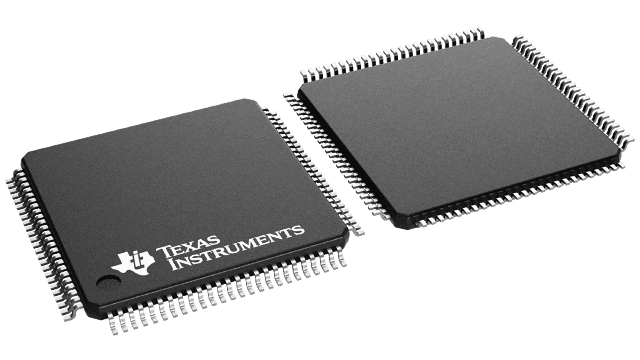
TSB42AC3PZT
ObsoleteHIGH PERFORMANCE IEEE 1394-1995 LINK LAYER FOR INDUSTRIAL AND BRIDGE APPLICATIONS
Deep-Dive with AI
Search across all available documentation for this part.
TSB42AC3PZT
ObsoleteHIGH PERFORMANCE IEEE 1394-1995 LINK LAYER FOR INDUSTRIAL AND BRIDGE APPLICATIONS
Deep-Dive with AI
Technical Specifications
Parameters and characteristics for this part
| Specification | TSB42AC3PZT |
|---|---|
| Function | Link Layer Controller |
| Interface | Parallel |
| Package / Case | 100-TQFP |
| Protocol | IEEE 1394 |
| Standards | IEEE 1394-1995, 1394a-2000 |
| Supplier Device Package | 100-TQFP (14x14) |
| Voltage - Supply | 3.3 V |
Pricing
Prices provided here are for design reference only. For realtime values and availability, please visit the distributors directly
| Distributor | Package | Quantity | $ | |
|---|---|---|---|---|
| Arrow | N/A | 1 | $ 2.54 | |
| 10 | $ 2.54 | |||
| Digikey | N/A | 0 | $ 15.83 | |
| 5469 | $ 15.83 | |||
| Texas Instruments | JEDEC TRAY (10+1) | 1 | $ 15.96 | |
| 100 | $ 13.94 | |||
| 250 | $ 10.75 | |||
| 1000 | $ 9.61 | |||
Description
General part information
TSB42AC3 Series
The TSB42AC3 is a 1394-1995 general purpose link layer ideal for a wide-range of applications, including motion control, motor control, video, and process control. The TSB42AC3 provides a high-performance interface with the capability of transferring data between the 32-bit host controller and the 1394 PHY-link interface. The 1394 PHY-link interface provides the connection to the 1394 physical layer device (PHY) and is supported by the link-layer controller (LLC). The LLC provides the control for transmitting and receiving 1394 packet data between the FIFO and PHY-link interface at rates of 50 (backplane only), 100, 200, and 400 Mbit/s.
The TSB42AC3 has a 32-bit, 50-MHz host interface, which makes connection to most 32-bit hosts fairly easy. The LLC also provides the capability to receive status from the PHY and to access the PHY control and status registers by the application software.
An internal 10K-byte memory is provided that can be configured as multiple variable-size FIFOs and eliminates the need for external FIFOs. Separate FIFOs can be user configured to support asynchronous transmit, isochronous transmit, and general 1394 receive transfer operations. These functions are accomplished by appropriately sizing the asynchronous transmit FIFO (ATF) and isochronous transmit FIFO (ITF). Once the ATF and ITF size are programmed, the remaining memory space is assigned to the general receive FIFO (GRF).
Documents
Technical documentation and resources