Deep-Dive with AI
Search across all available documentation for this part.
Deep-Dive with AI
Technical Specifications
Parameters and characteristics for this part
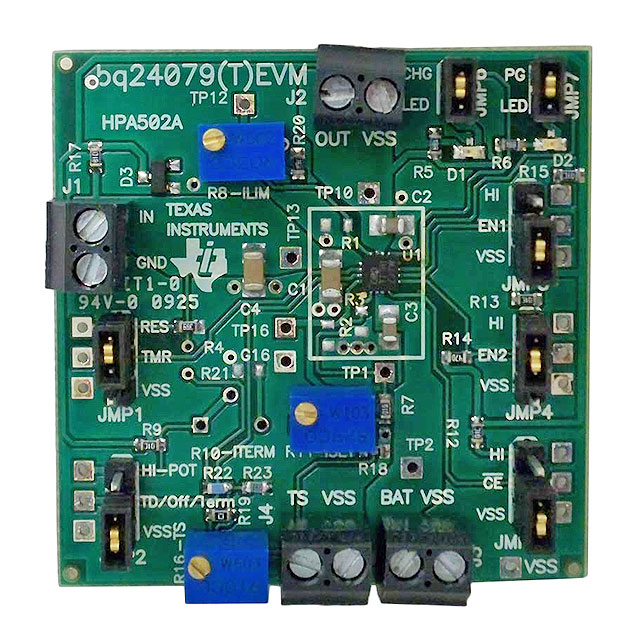
| Specification | BQ24079TEVM |
|---|---|
| Embedded | False |
| Function | Battery Charger |
| Primary Attributes | Li-Ion / Li-Pol (1 Cell) |
| Secondary Attributes | Charge Timer |
| Supplied Contents | Board(s) |
| Type | Power Management |
| Utilized IC / Part | BQ24079T |
Pricing
Prices provided here are for design reference only. For realtime values and availability, please visit the distributors directly
| Distributor | Package | Quantity | $ | |
|---|---|---|---|---|
| Digikey | Box | 1 | $ 58.80 | |
Description
General part information
BQ24079QW-Q1 Series
The bq24079QW-Q1 is an integrated Li-ion linear charger and system power-path management device targeted at space-constraint automotive applications such as telematics/eCall. The device can operate from 4.35 V to 6.4 V and support charge currents up to 1.5 A. The input voltage range with input overvoltage protection supports unregulated adapters. The USB input current limit accuracy and start up sequence allow the bq24079QW-Q1 to meet the USB-IF inrush current specification. Additionally, the input dynamic power management (VIN-DPM) prevents the system load from crashing incorrectly configured USB sources.
The bq24079QW-Q1 features dynamic power-path management (DPPM) that powers the system while simultaneously and independently charging the battery. The DPPM circuit reduces the charge current when the input current limit causes the system output to fall to the DPPM threshold; thus, supplying the system load at all times while monitoring the charge current separately. This feature along with the 4.1-V battery regulation voltage helps to extend battery life time by reducing the number of charge and discharge cycles on the battery, allowing for proper charge termination and enabling the system to run with a defective or absent battery pack.
Additionally, the regulated system input enables instant system turn-on when plugged in even with a totally discharged battery. The power-path management architecture also permits the battery to supplement the system current requirements when the adapter cannot deliver the peak system currents, enabling the use of a smaller adapter.
Documents
Technical documentation and resources
No documents available