


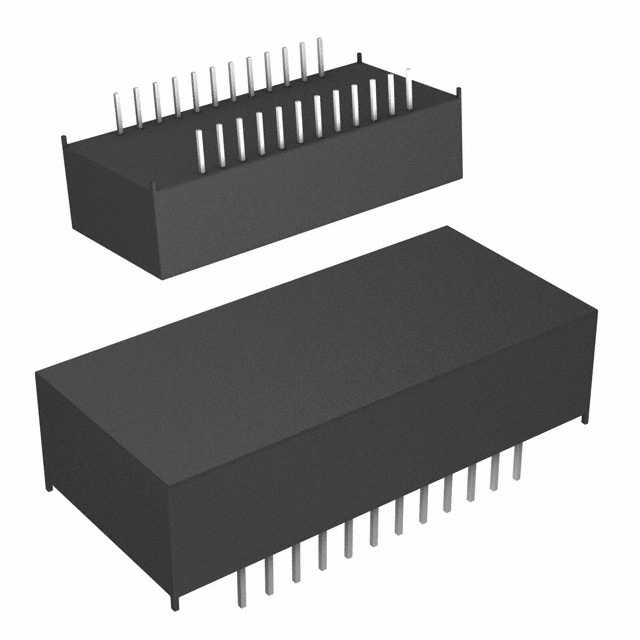
DS12C887+
ActiveREAL TIME CLOCK REAL-TIME CLOCKS
Deep-Dive with AI
Search across all available documentation for this part.
DS12C887+
ActiveREAL TIME CLOCK REAL-TIME CLOCKS
Deep-Dive with AI
Technical Specifications
Parameters and characteristics for this part
| Specification | DS12C887+ |
|---|---|
| Current - Timekeeping (Max) | 15 mA |
| Date Format | YY-MM-DD-dd |
| Features | Alarm, Square Wave Output, NVSRAM, Leap Year, Daylight Savings |
| Interface | Parallel |
| Memory Size | 113 B |
| Mounting Type | Through Hole |
| Operating Temperature [Max] | 70 °C |
| Operating Temperature [Min] | 0 °C |
| Package / Case | 24-DIP Module (0.600", 15.24mm) |
| Supplier Device Package | 24-EDIP |
| Time Format | HH:MM:SS (12/24 hr) |
| Type | Clock/Calendar |
| Voltage - Supply [Max] | 5.5 V |
| Voltage - Supply [Min] | 4.5 V |
Pricing
Prices provided here are for design reference only. For realtime values and availability, please visit the distributors directly
Description
General part information
DS12C887 Series
The DS12885, DS12887, and DS12C887 real-time clocks (RTCs) are designed to be direct replacements for the DS1285 and DS1287. The devices provide a real-time clock/calendar, one time-of-day alarm, three maskable interrupts with a common interrupt output, a programmable square wave, and 114 bytes of battery-backed static RAM (113 bytes in the DS12C887 and DS12C887A). The DS12887 integrates a quartz crystal and lithium energy source into a 24-pin encapsulated DIP package. The DS12C887 adds a century byte at address 32h. For all devices, the date at the end of the month is automatically adjusted for months with fewer than 31 days, including correction for leap years. The devices also operate in either 24-hour or 12-hour format with an AM/PM indicator. A precision temperature-compensated circuit monitors the status of VCC. If a primary power failure is detected, the device automatically switches to a backup supply. A lithium coin-cell battery can be connected to the VBATinput pin on the DS12885 to maintain time and date operation when primary power is absent. The device is accessed through a multiplexed byte-wide interface, which supports both Intel and Motorola modes.ApplicationsEmbedded SystemsNetwork Hubs, Bridges, and RoutersSecurity SystemsUtility Meters