S
STMicroelectronics
| Series | Category | # Parts | Status | Description |
|---|---|---|---|---|
| Part | Spec A | Spec B | Spec C | Spec D | Description |
|---|---|---|---|---|---|



| Series | Category | # Parts | Status | Description |
|---|---|---|---|---|
| Part | Spec A | Spec B | Spec C | Spec D | Description |
|---|---|---|---|---|---|
| Part | Category | Description |
|---|---|---|
 STMicroelectronics STEVAL-ISA068V1Obsolete | Development Boards Kits Programmers | EVAL BOARD FOR ST1S32 |
 STMicroelectronics 74VCXHQ163245TTRObsolete | Integrated Circuits (ICs) | IC TRANSLATION TXRX 2.7V 48TSSOP |
 STMicroelectronics | Development Boards Kits Programmers | VNQ9050LAJ EVALUATION BOARD |
 STMicroelectronics LSM303DLHCTRObsolete | Sensors Transducers | IMU ACCEL/MAG 3-AXIS I2C 14LGA |
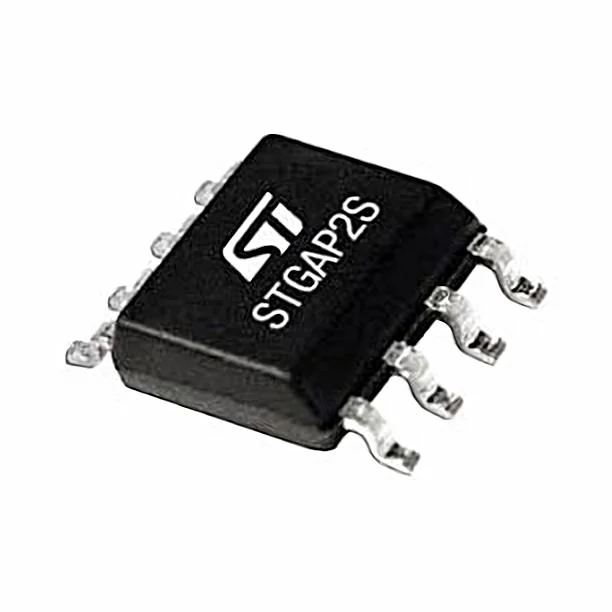 STMicroelectronics M93C56-WMN6TObsolete | Integrated Circuits (ICs) | EEPROM SERIAL-MICROWIRE 2K-BIT 256 X 8/128 X 16 3.3V/5V 8-PIN SO N T/R |
STMicroelectronics | Integrated Circuits (ICs) | STM32U |
 STMicroelectronics TS831-3IZObsolete | Integrated Circuits (ICs) | IC SUPERVISOR 1 CHANNEL TO92-3 |
 STMicroelectronics STMPE1208SQTRObsolete | Integrated Circuits (ICs) | IC I/O EXPANDER I2C 12B 40QFN |
 STMicroelectronics STM32L1-MAGNETObsolete | Development Boards Kits Programmers | IAR EXPERIMENT STM32 L1 EVAL BRD |
 STMicroelectronics VNB35N07Obsolete | Integrated Circuits (ICs) | IC PWR DRIVER N-CHAN 1:1 D2PAK |
| Series | Category | # Parts | Status | Description |
|---|---|---|---|---|
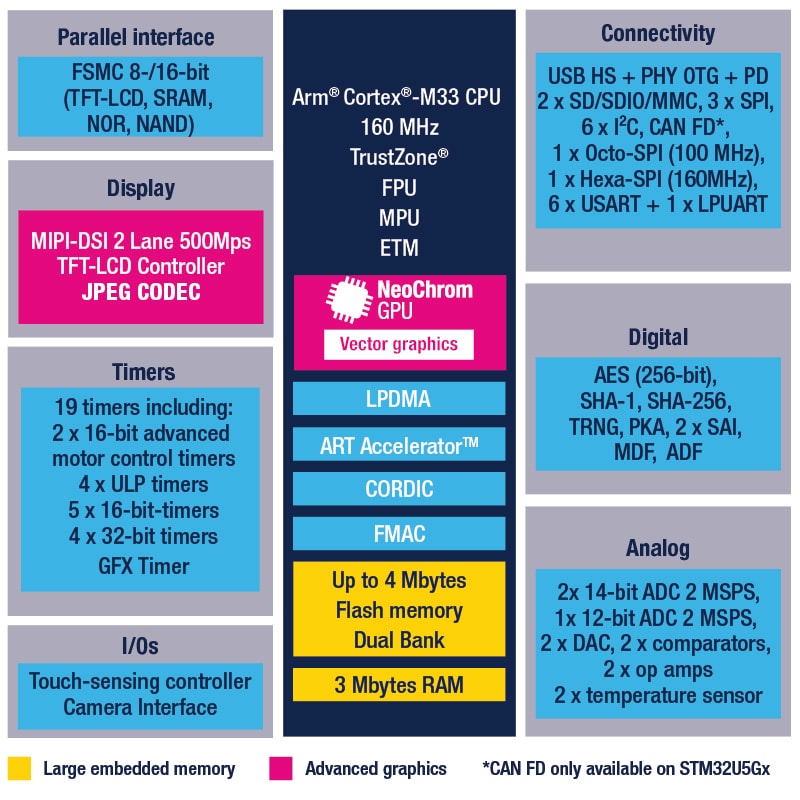
STM32U5G9Advanced Graphics and Ultra Low Power CortexM-33 with Trustzone, NEOCHROM VG GPU, 160MHZ, with 3 MBSRAM and 4M of Flash. | Development Boards, Kits, Programmers | 3 | Active | The STM32U5Gxxx devices belong to an ultra-low-power microcontrollers family (STM32U5 Series) based on the high-performance Arm®Cortex®-M33 32-bit RISC core. They operate at a frequency of up to 160 MHz.
The Cortex®-M33 core features a single-precision FPU (floating-point unit), that supports all the Arm®single-precision data-processing instructions and all the data types.
The Cortex®-M33 core also implements a full set of DSP (digital signal processing) instructions and a MPU (memory protection unit) that enhances the application security.
The devices embed high-speed memories (up to 4 Mbytes of flash memory and 3 Mbytes of SRAM), an FSMC (flexible external memory controller) for static memories (for devices with packages of 100 pins and more), two Octo-SPI and one Hexadeca-SPI memory interfaces (at least one Quad-SPI available on all packages) and an extensive range of enhanced I/Os and peripherals connected to three APB buses, three AHB buses and a 32-bit multi-AHB bus matrix.
The devices offer security foundation compliant with the TBSA (trusted-based security architecture) requirements from Arm®. It embeds the necessary security features to implement a secure boot, secure data storage and secure firmware update. Besides these capabilities, the devices incorporate a secure firmware installation feature that allows the customer to secure the provisioning of the code during its production. A flexible life cycle is managed thanks to multiple levels of readout protection and debug unlock with password. Firmware hardware isolation is supported thanks to securable peripherals, memories and I/Os, and privilege configuration of peripherals and memories.
The devices feature several protection mechanisms for embedded flash memory and SRAM: readout protection, write protection, secure and hide protection areas.
The devices embed several peripherals reinforcing security: a fast AES coprocessor, a secure AES coprocessor with DPA resistance and hardware unique key that can be shared by hardware with fast AES, a PKA (public key accelerator) with DPA resistance, an on-the-fly decryption engine for Octo-SPI external memories, a HASH hardware accelerator, and a true random number generator.
The devices offer active tamper detection and protection against transient and environmental perturbation attacks, thanks to several internal monitoring generating secret data erase in case of attack. This helps to fit the PCI requirements for point of sales applications.
The devices offer two fast 14-bit ADCs (2.5 Msps), one 12-bit ADC (2.5 Msps), two comparators, two operational amplifiers, two DAC channels, an internal voltage reference buffer, a low-power RTC, four 32-bit general-purpose timers, two 16-bit PWM timers dedicated to motor control, three 16-bit general-purpose timers, two 16-bit basic timers and four 16-bit low-power timers.
The devices offer a rich set of graphic oriented peripherals: GPU2D (Neo-Chrom graphic processor) for graphic data fast processing including vector graphic operation, DMA2D (Chrom-ART Accelerator) for enhanced graphic content creation, GFXMMU (Chrom-GRC) allowing up to 20 % of graphic resources optimization, MIPI®DSI Host controller with two DSI lanes running at up to 500 Mbit/s each, and LTDC (LCD-TFT controller), a JPEG hardware compressor/decompressor and a dedicated GFXTIM graphic timer.
The devices support an MDF (multifunction digital filter) with six filters dedicated to the connection of external sigma-delta modulators. Another low-power digital filter dedicated to audio signals is embedded (ADF), with one filter supporting sound-activity detection. The devices embed mathematical accelerators (a trigonometric functions accelerator plus a filter mathematical accelerator). In addition, up to 24 capacitive sensing channels are available.
The devices also feature standard and advanced communication interfaces such as: six I2Cs, three SPIs, four USARTs, two UARTs and one low-power UART, two SAIs, one DCMI (digital camera interface), two SDMMCs, one FDCAN, one USB OTG high-speed, one USB Type-C™/USB Power Delivery controller, and one generic synchronous 8-/16-bit PSSI (parallel data input/output slave interface).
The devices operate in the –40 to +85 °C (+ 105 °C junction) temperature ranges from a 1.71 to 3.6 V power supply.
A comprehensive set of power-saving modes allows the design of low-power applications. Many peripherals (including communication, analog, timers, and audio peripherals) can be functional and autonomous down to Stop mode with direct memory access, thanks to LPBAM support (low-power background autonomous mode).
Some independent power supplies are supported like an analog independent supply input for ADC, DACs, OPAMPs and comparators, a 3.3 V dedicated supply input for USB and up to 14 I/Os that can be supplied independently down to 1.08 V. A VBAT input is available for connecting a backup battery in order to preserve the RTC functionality and to backup 32 32-bit registers and 2-Kbyte SRAM. |
STM32U5G9J-DK2Discovery kit with STM32U5G9ZJT6Q MCU | Development Boards, Kits, Programmers | 1 | Active | The STM32U5G9J-DK2 Discovery kit is a complete demonstration and development platform for the STM32U5G9ZJT6Q microcontroller, featuring an Arm®Cortex®‑M33 core with Arm®TrustZone®.
Leveraging the innovative ultra-low power-oriented features, 3 Mbytes of embedded SRAM, 4 Mbytes of embedded flash memory, and rich graphics features, the STM32U5G9J-DK2 Discovery kit enables users to prototype applications with state-of-the-art energy efficiency, as well as providing stunning and optimized graphics rendering with the support of a 2.5D Neo-Chrom accelerator, Chrom-ART Accelerator, and Chrom-GRC™ MMU.
The STM32U5G9J-DK2 Discovery kit integrates a full range of hardware features that help the user evaluate all the peripherals, such as a 5" RGB 800x480 pixels TFT colored LCD module with a 24‑bit RGB interface and capacitive touch panel, USB Type-C®HS, Octo‑SPI flash memory device, ARDUINO®, and STLINK-V3EC (USART console).
The STM32U5G9J-DK2 Discovery kit integrates an STLINK-V3EC embedded in-circuit debugger and programmer for the STM32 microcontroller with a USB Virtual COM port bridge and comes with the STM32CubeU5 MCU Package, which provides an STM32 comprehensive software HAL library as well as various software examples. |
STM32U5G9ZJAdvanced Graphics and Ultra Low Power CortexM-33 with Trustzone, NEOCHROM VG GPU, 160MHZ, with 3 MBSRAM and 4M of Flash. | Microcontrollers | 1 | Active | The STM32U5Gxxx devices belong to an ultra-low-power microcontrollers family (STM32U5 Series) based on the high-performance Arm®Cortex®-M33 32-bit RISC core. They operate at a frequency of up to 160 MHz.
The Cortex®-M33 core features a single-precision FPU (floating-point unit), that supports all the Arm®single-precision data-processing instructions and all the data types.
The Cortex®-M33 core also implements a full set of DSP (digital signal processing) instructions and a MPU (memory protection unit) that enhances the application security.
The devices embed high-speed memories (up to 4 Mbytes of flash memory and 3 Mbytes of SRAM), an FSMC (flexible external memory controller) for static memories (for devices with packages of 100 pins and more), two Octo-SPI and one Hexadeca-SPI memory interfaces (at least one Quad-SPI available on all packages) and an extensive range of enhanced I/Os and peripherals connected to three APB buses, three AHB buses and a 32-bit multi-AHB bus matrix.
The devices offer security foundation compliant with the TBSA (trusted-based security architecture) requirements from Arm®. It embeds the necessary security features to implement a secure boot, secure data storage and secure firmware update. Besides these capabilities, the devices incorporate a secure firmware installation feature that allows the customer to secure the provisioning of the code during its production. A flexible life cycle is managed thanks to multiple levels of readout protection and debug unlock with password. Firmware hardware isolation is supported thanks to securable peripherals, memories and I/Os, and privilege configuration of peripherals and memories.
The devices feature several protection mechanisms for embedded flash memory and SRAM: readout protection, write protection, secure and hide protection areas.
The devices embed several peripherals reinforcing security: a fast AES coprocessor, a secure AES coprocessor with DPA resistance and hardware unique key that can be shared by hardware with fast AES, a PKA (public key accelerator) with DPA resistance, an on-the-fly decryption engine for Octo-SPI external memories, a HASH hardware accelerator, and a true random number generator.
The devices offer active tamper detection and protection against transient and environmental perturbation attacks, thanks to several internal monitoring generating secret data erase in case of attack. This helps to fit the PCI requirements for point of sales applications.
The devices offer two fast 14-bit ADCs (2.5 Msps), one 12-bit ADC (2.5 Msps), two comparators, two operational amplifiers, two DAC channels, an internal voltage reference buffer, a low-power RTC, four 32-bit general-purpose timers, two 16-bit PWM timers dedicated to motor control, three 16-bit general-purpose timers, two 16-bit basic timers and four 16-bit low-power timers.
The devices offer a rich set of graphic oriented peripherals: GPU2D (Neo-Chrom graphic processor) for graphic data fast processing including vector graphic operation, DMA2D (Chrom-ART Accelerator) for enhanced graphic content creation, GFXMMU (Chrom-GRC) allowing up to 20 % of graphic resources optimization, MIPI®DSI Host controller with two DSI lanes running at up to 500 Mbit/s each, and LTDC (LCD-TFT controller), a JPEG hardware compressor/decompressor and a dedicated GFXTIM graphic timer.
The devices support an MDF (multifunction digital filter) with six filters dedicated to the connection of external sigma-delta modulators. Another low-power digital filter dedicated to audio signals is embedded (ADF), with one filter supporting sound-activity detection. The devices embed mathematical accelerators (a trigonometric functions accelerator plus a filter mathematical accelerator). In addition, up to 24 capacitive sensing channels are available.
The devices also feature standard and advanced communication interfaces such as: six I2Cs, three SPIs, four USARTs, two UARTs and one low-power UART, two SAIs, one DCMI (digital camera interface), two SDMMCs, one FDCAN, one USB OTG high-speed, one USB Type-C™/USB Power Delivery controller, and one generic synchronous 8-/16-bit PSSI (parallel data input/output slave interface).
The devices operate in the –40 to +85 °C (+ 105 °C junction) temperature ranges from a 1.71 to 3.6 V power supply.
A comprehensive set of power-saving modes allows the design of low-power applications. Many peripherals (including communication, analog, timers, and audio peripherals) can be functional and autonomous down to Stop mode with direct memory access, thanks to LPBAM support (low-power background autonomous mode).
Some independent power supplies are supported like an analog independent supply input for ADC, DACs, OPAMPs and comparators, a 3.3 V dedicated supply input for USB and up to 14 I/Os that can be supplied independently down to 1.08 V. A VBAT input is available for connecting a backup battery in order to preserve the RTC functionality and to backup 32 32-bit registers and 2-Kbyte SRAM. |
STM32VLDISCOVERYDiscovery kit with STM32F100RB MCU | Evaluation Boards | 1 | Active | The STM32VLDISCOVERY is the cheapest and quickest way to discover STM32F100 Value line microcontrollers. It includes everything required for beginners and experienced users to get started quickly. The STM32VLDISCOVERY discovery kit includes an STM32F100 Value line microcontroller in a 64-pin LQFP and an in-circuit ST-LINK debugger/programmer to debug discovery applications and other target board applications. |
| RF Transceiver ICs | 5 | Obsolete | ||
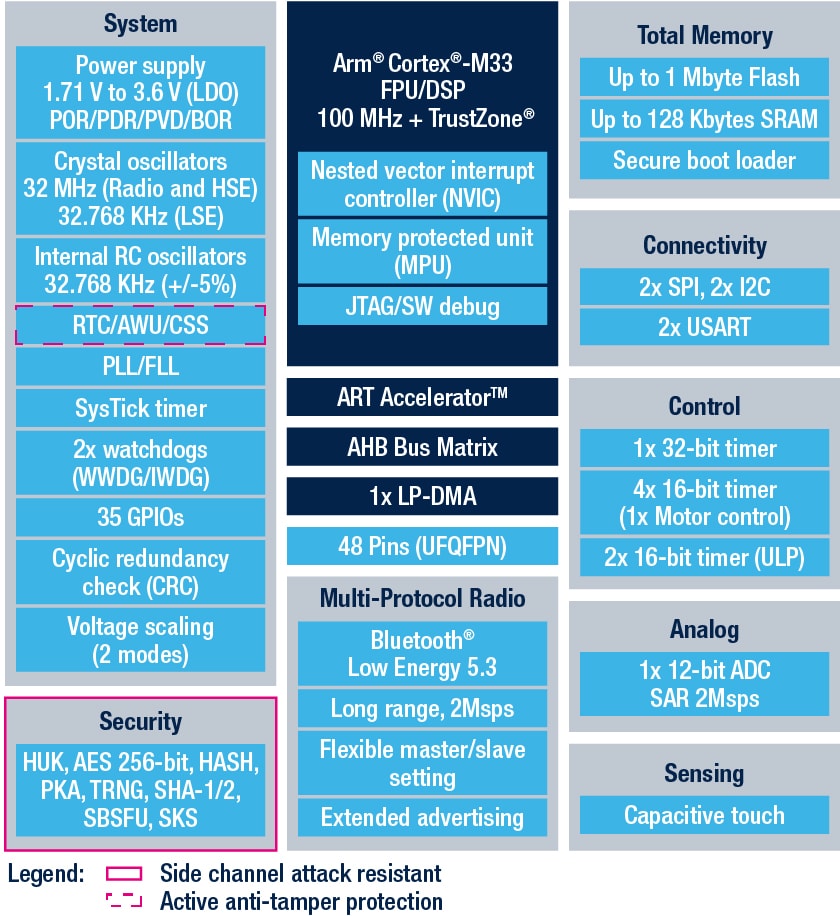
STM32WBUltra-low-power dual core Arm Cortex-M4 MCU 64 MHz, Cortex-M0+ 32 MHz with 512 Kbytes of Flash memory, Bluetooth LE 5.3, 802.15.4, Zigbee, Thread, Matter, USB, LCD, AES-256 | Development Boards, Kits, Programmers | 5 | Active | The STM32WB55xx and STM32WB35xx multiprotocol wireless and ultra-low-power devices embed a powerful and ultra-low-power radio compliant with the Bluetooth®Low Energy SIG specification 5.4 and with IEEE 802.15.4-2011. They contain a dedicated Arm®Cortex®-M0+ for performing all the real-time low layer operation.
The devices are designed to be extremely low-power and are based on the high-performance Arm®Cortex®-M4 32-bit RISC core operating at a frequency of up to 64 MHz. This core features a Floating point unit (FPU) single precision that supports all Arm®single-precision data-processing instructions and data types. It also implements a full set of DSP instructions and a memory protection unit (MPU) that enhances application security.
Enhanced inter-processor communication is provided by the IPCC with six bidirectional channels. The HSEM provides hardware semaphores used to share common resources between the two processors.
The devices embed high-speed memories (up to 1 Mbyte of flash memory for STM32WB55xx, up to 512 Kbytes for STM32WB35xx, up to 256 Kbytes of SRAM for STM32WB55xx, 96 Kbytes for STM32WB35xx), a Quad-SPI flash memory interface (available on all packages) and an extensive range of enhanced I/Os and peripherals.
Direct data transfer between memory and peripherals and from memory to memory is supported by fourteen DMA channels with a full flexible channel mapping by the DMAMUX peripheral.
The devices feature several mechanisms for embedded flash memory and SRAM: readout protection, write protection and proprietary code readout protection. Portions of the memory can be secured for Cortex®-M0+ exclusive access.
The two AES encryption engines, PKA, and RNG enable lower layer MAC and upper layer cryptography. A customer key storage feature may be used to keep the keys hidden.
The devices offer a fast 12-bit ADC and two ultra-low-power comparators associated with a high accuracy reference voltage generator.
These devices embed a low-power RTC, one advanced 16-bit timer, one general-purpose32-bit timer, two general-purpose 16-bit timers, and two 16-bit low-power timers.
In addition, up to 18 capacitive sensing channels are available for STM32WB55xx (not on UFQFPN48 package). The STM32WB55xx also embed an integrated LCD driver up to 8x40 or 4x44, with internal step-up converter.
The STM32WB55xx and STM32WB35xx also feature standard and advanced communication interfaces, namely one USART (ISO 7816, IrDA, Modbus, and Smartcard mode), one low- power UART (LPUART), two I2Cs (SMBus/PMBus), two SPIs (one for STM32WB35xx) up to 32 MHz, one serial audio interface (SAI) with two channels and three PDMs, one USB 2.0 FS device with embedded crystal-less oscillator, supporting BCD and LPM and one Quad-SPI with execute-in-place (XIP) capability.
The STM32WB55xx and STM32WB35xx operate in the -40 to +105 °C (+125 °C junction) and -40 to +85 °C (+105 °C junction) temperature ranges from a 1.71 to 3.6 V power supply. A comprehensive set of power-saving modes enables the design of low-power applications.
The devices include independent power supplies for analog input for ADC.
The STM32WB55xx and STM32WB35xx integrate a high efficiency SMPS step-down converter with automatic bypass mode capability when the VDDfalls below VBORx(x = 1, 2, 3, 4) voltage level (default is 2.0 V). It includes independent power supplies for analog input for ADC and comparators, as well as a 3.3 V dedicated supply input for USB.
A VBATdedicated supply allows the devices to back up the LSE 32.768 kHz oscillator, the RTC and the backup registers, thus enabling the STM32WB55xx and STM32WB35xx to supply these functions even if the main VDDis not present through a CR2032-like battery, a Supercap or a small rechargeable battery.
The STM32WB55xx offer four packages, from 48 to 129 pins. The STM32WB35xx offer one package, 48 pins. |
| RF Transceiver ICs | 3 | Active | ||
STM32WB09KEUltra-low-power, Arm Cortex-M0+ MCU 64 MHz with 512 Kbytes of Flash memory, 64 Kbytes of RAM, Bluetooth LE 5.4 | RF and Wireless | 2 | Active | The STM32WB09xE is an ultra-low power programmable Bluetooth® Low Energy wireless SoC solution. It embeds STMicroelectronics’ state-of-art 2.4 GHz RF radio peripherals, optimized for ultra-low-power consumption and excellent radio performance, for unparalleled battery lifetime.
It is compliant with Bluetooth® Low Energy SIG core specification version 5.4 addressing point-to-point connectivity and Bluetooth® Mesh networking and allows large-scale device networks to be established in a reliable way. The STM32WB09xE is also suitable for 2.4 GHz proprietary radio wireless communication to address ultra-low latency applications.
The STM32WB09xE embeds an Arm® Cortex®-M0+ microprocessor that can operate up to 64 MHz and also the radio core coprocessor (DMA based) for Bluetooth® Low Energy timing critical operations.
In addition, the STM32WB09xE provides enhanced security hardware support by dedicated hardware functions: true random number generator (TRNG) supporting NIST special publication 800-90B, security c0-processor for 128-bit AES encryption, CRC calculation unit, 64-bit unique ID, flash memory read and write protection, and a public key accelerator (PKA).
The PKA supports: modular arithmetic including exponentiation with maximum modulo size of 3136 bits, elliptic curves over prime field scalar multiplication, ECDSA signature, ECDSA verification with maximum modulo size of 521 bits CRC calculation unit, security level allowing constant time operations.
The STM32WB09xE can be configured to support standalone or network processor applications. In the first configuration, the STM32WB09xE operates as a single device running the application code and the Bluetooth® Low Energy stack.
The STM32WB09xE embeds the following high-speed memory types: 512-Kbyte flash memory, 64-Kbyte RAM, 1-Kbyte one-time-programmable (OTP) memory area, and 7-Kbyte ROM (ST reserved area).
Direct data transfer between memory and peripherals and from memory-to-memory is supported by eight DMA channels with a full flexible channel mapping by the DMAMUX peripheral.
The STM32WB09xE embeds a 12-bit ADC, allowing measurements of up to eight external sources and up to three internal sources, including battery monitoring and a temperature sensor.
The STM32WB09xE has a low-power RTC and one advanced 16-bit timer.
The STM32WB09xE features standard and advanced communication interfaces: 1x SPI-I2, LPUART, 1x USART supporting ISO 7816 (SmartCard mode), IrDA and Modbus mode, 2x I2C supporting SMBus/PMBus.
The STM32WB09xE operates in the -40 to +105 °C (+125 °C junction) temperature range from a 1.7 V to 3.6 V power supply. A comprehensive set of power-saving modes enables the design of low-power applications.
The STM32WB09xE integrates a high efficiency SMPS step-down converter and an integrated PDR circuitry with a fixed threshold that generates a device reset when the VDD drops under 1.65 V.
The STM32WB09xE is available in two package types: VFQFPN32 and WLCSP36. Both versions support up to 20 I/Os. |
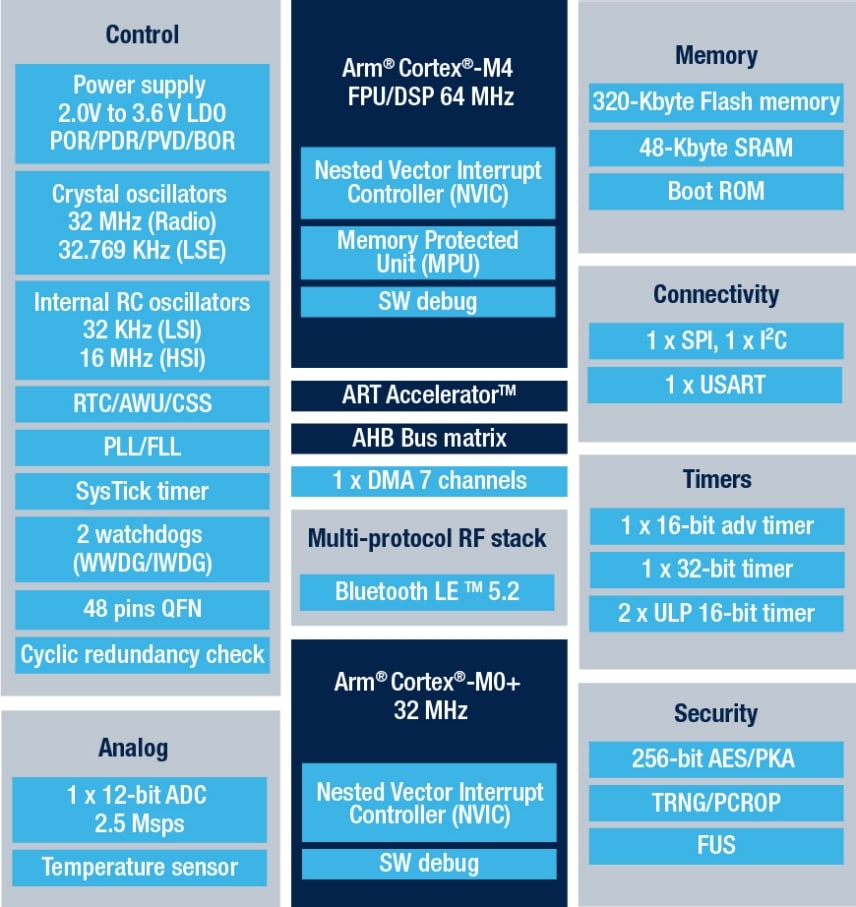
STM32WB10CCUltra-low-power dual core Arm Cortex-M4 MCU 64 MHz, Cortex-M0+ 32 MHz with 320 Kbytes of Flash memory, Bluetooth LE 5.4 | RF Transceiver ICs | 1 | Active | The STM32WB10CC multiprotocol wireless and ultra-low-power device embeds a powerful and ultra-low-power radio compliant with the Bluetooth®Low Energy SIG specification 5.4. It contains a dedicated Arm®Cortex®-M0+ for performing all the real-time low layer operation.
The device is designed to be extremely low-power and is based on the high-performance Arm®Cortex®-M4 32-bit RISC core operating at a frequency of up to 64 MHz. This core features a Floating point unit (FPU) single precision that supports all Arm®single-precision data-processing instructions and data types. It also implements a full set of DSP instructions and a memory protection unit (MPU) that enhances application security.
Enhanced inter-processor communication is provided by the IPCC with six bidirectional channels. The HSEM provides hardware semaphores used to share common resources between the two processors.
The device embeds high-speed memories (320 Kbytes of flash memory, 48 Kbytes of SRAM) and an extensive range of enhanced I/Os and peripherals.
Direct data transfer between memory and peripherals and from memory to memory is supported by seven DMA channels with a full flexible channel mapping by the DMAMUX peripheral.
The device features several mechanisms for embedded flash memory and SRAM: readout protection, write protection and proprietary code readout protection. Portions of the memory can be secured for Cortex®-M0+ exclusive access.
The AES encryption engine, PKA, and RNG enable upper layer cryptography.
The device offers a fast 12-bit ADC.
The device embeds a low-power RTC, one advanced 16-bit timer, one general-purpose32-bit timer, and two 16-bit low-power timers.
In addition, up to three capacitive sensing channels are available.
The STM32WB10CC also features standard and advanced communication interfaces, namely one USART (ISO 7816, IrDA, Modbus, and Smartcard mode), one I2C (SMBus/PMBus), one SPI up to 32 MHz.
The STM32WB10CC operates in the -10 to +85 °C (+105 °C junction) temperature range from a 2.0 to 3.6 V power supply. A comprehensive set of power-saving modes enables the design of low-power applications.
The device includes independent power supplies for analog input for ADC.
A VBATdedicated supply allows the device to back up the LSE 32.768 kHz oscillator, the RTC and the backup registers, thus enabling the STM32WB10CC to supply these functions even if the main VDDis not present through a CR2032-like battery, a Supercap or a small rechargeable battery.
The STM32WB10CC is available in a 48-pin UFQFPN package. |
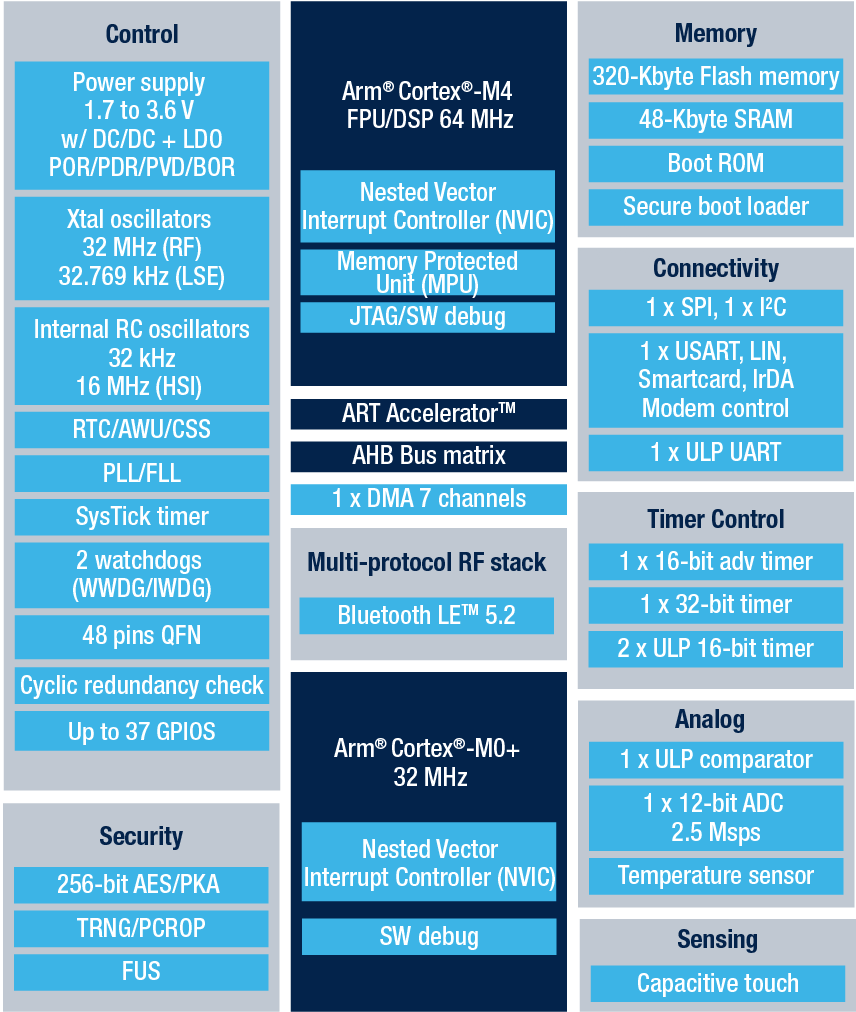
STM32WB15CCUltra-low-power dual core Arm Cortex-M4 MCU 64 MHz, Cortex-M0+ 32 MHz with 320 Kbytes of Flash memory, Bluetooth LE 5.3, AES-256 | RF Transceiver ICs | 5 | Active | The STM32WB15CC multiprotocol wireless and ultra-low-power device embeds a powerful and ultra-low-power radio compliant with the Bluetooth®Low Energy SIG specification 5.4. It contains a dedicated Arm®Cortex®-M0+ for performing all the real-time low layer operation.
The device is designed to be extremely low-power and is based on the high-performance Arm®Cortex®-M4 32-bit RISC core operating at a frequency of up to 64 MHz. This core features a Floating point unit (FPU) single precision that supports all Arm®single-precision data-processing instructions and data types. It also implements a full set of DSP instructions and a memory protection unit (MPU) that enhances application security.
Enhanced inter-processor communication is provided by the IPCC with six bidirectional channels. The HSEM provides hardware semaphores used to share common resources between the two processors.
The device embeds high-speed memories (320 Kbytes of flash memory, 48 Kbytes of SRAM) and an extensive range of enhanced I/Os and peripherals.
Direct data transfer between memory and peripherals and from memory to memory is supported by seven DMA channels with a full flexible channel mapping by the DMAMUX peripheral.
The device feature several mechanisms for embedded flash memory and SRAM: readout protection, write protection and proprietary code readout protection. Portions of the memory can be secured for Cortex®-M0+ exclusive access.
The AES encryption engine, PKA, and RNG enable upper layer cryptography.
The device offers a fast 12-bit ADC and one ultra-low-power comparator.
The device embeds a low-power RTC, one advanced 16-bit timer, one general-purpose32-bit timer, and two 16-bit low-power timers.
In addition, up to eight capacitive sensing channels are available.
The STM32WB15CC also features standard and advanced communication interfaces, namely one USART (ISO 7816, IrDA, Modbus, and Smartcard mode), one low- power UART (LPUART), one I2C (SMBus/PMBus), one SPI up to 32 MHz.
The STM32WB15CC operates in the -40 to +85 °C (+105 °C junction) and -40 to +105 °C (+125 °C junction) temperature ranges from a 1.71 to 3.6 V power supply. A comprehensive set of power-saving modes enables the design of low-power applications.
The STM32WB15CC integrates a high efficiency SMPS step-down converter with automatic bypass mode capability when the VDDfalls below VBORx(x = 1, 2, 3, 4) voltage level (default is 2.0 V). It includes independent power supplies for analog input for ADC and comparator.
A VBATdedicated supply allows the device to back up the LSE 32.768 kHz oscillator, the RTC and the backup registers, thus enabling the STM32WB15CC to supply these functions even if the main VDDis not present through a CR2032-like battery, a Supercap or a small rechargeable battery.
The STM32WB15CC offers two packages, 48 or 49 pins. |