STM32U575CIUltra-low-power with FPU Arm Cortex-M33 MCU with TrustZone, 160 MHz with 2 Mbytes of Flash memory | Microcontrollers | 1 | Active | The STM32U575xx devices belong to an ultra-low-power microcontrollers family (STM32U5 series) based on the high-performance Arm®Cortex®-M33 32-bit RISC core. They operate at a frequency of up to 160 MHz.
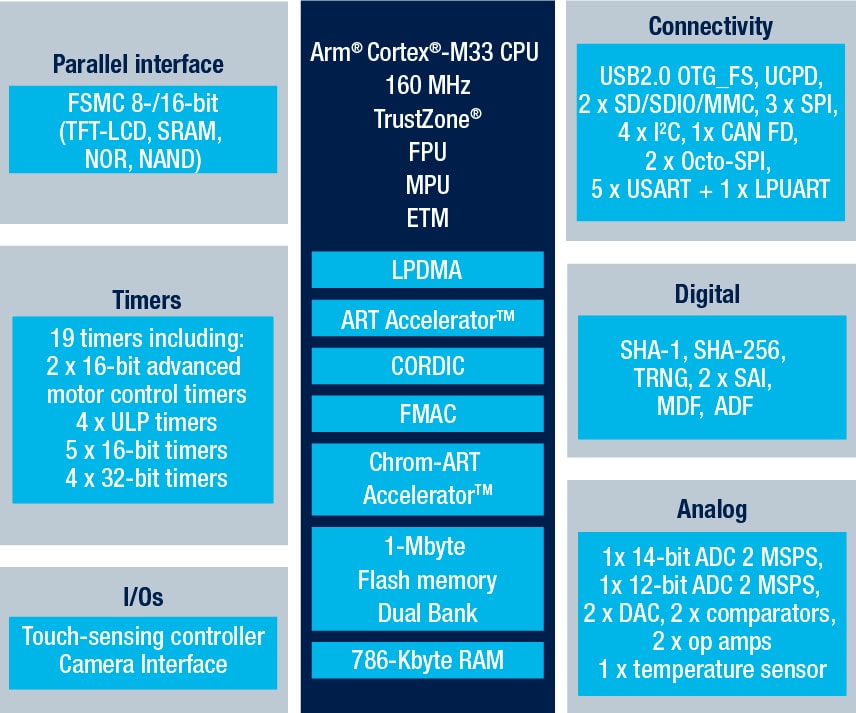
The Cortex®-M33 core features a single-precision FPU (floating-point unit), that supports all the Arm®single-precision data-processing instructions and all the data types.
The Cortex®-M33 core also implements a full set of DSP (digital signal processing) instructions and a MPU (memory protection unit) that enhances the application security.
The devices embed high-speed memories (up to 2 Mbytes of flash memory and 786 Kbytes of SRAM), an FSMC (flexible external memory controller) for static memories (for devices with packages of 90 pins and more), two Octo-SPI flash memory interfaces (at least one Quad-SPI available on all packages) and an extensive range of enhanced I/Os and peripherals connected to three APB buses, three AHB buses and a 32-bit multi-AHB bus matrix.
The devices offer security foundation compliant with the TBSA (trusted-based security architecture) requirements from Arm®. It embeds the necessary security features to implement a secure boot, secure data storage and secure firmware update. Besides these capabilities, the devices incorporate a secure firmware installation feature that allows the customer to secure the provisioning of the code during its production. A flexible lifecycle is managed thanks to multiple levels of readout protection and debug unlock with password. Firmware hardware isolation is supported thanks to securable peripherals, memories and I/Os, and privilege configuration of peripherals and memories.
The devices feature several protection mechanisms for embedded flash memory and SRAM: readout protection, write protection, secure, and hide protection areas.
The devices embed several peripherals reinforcing security: a HASH hardware accelerator, and a true random number generator.
The devices offer active tamper detection and protection against transient and environmental perturbation attacks, thanks to several internal monitoring generating secret data erase in case of attack. This helps to fit the PCI requirements for point of sales applications.
The devices offer one fast 14-bit ADC (2.5 Msps), one 12-bit ADC (2.5 Msps), two comparators, two operational amplifiers, two DAC channels, an internal voltage reference buffer, a low-power RTC, four 32-bit general-purpose timers, two 16-bit PWM timers dedicated to motor control, three 16-bit general-purpose timers, two 16-bit basic timers and four 16-bit low-power timers.
The devices support an MDF (multifunction digital filter) with six filters dedicated to the connection of external sigma-delta modulators. Another low-power digital filter dedicated to audio signals is embedded (ADF), with one filter supporting sound-activity detection. The devices embed also a Chrom-ART Accelerator dedicated to graphic applications, and mathematical accelerators (a trigonometric functions accelerator plus a filter mathematical accelerator). In addition, up to 22 capacitive sensing channels are available.
The devices also feature standard and advanced communication interfaces such as: four I2Cs, three SPIs, three USARTs, two UARTs, one low-power UART, two SAIs, one digital camera interface (DCMI), two SDMMCs, one FDCAN, one USB OTG full-speed, one USB Type-C /USB Power Delivery controller, and one generic synchronous 8-/16-bit PSSI (parallel data input/output slave interface).
The devices operate in the –40 to +85 °C (+105 °C junction) and –40 to +125 °C (+130 °C junction) temperature ranges from a 1.71 to 3.6 V power supply.
A comprehensive set of power-saving modes allow the design of low-power applications. Many peripherals (including communication, analog, timers, and audio peripherals) can be functional and autonomous down to Stop mode with direct memory access, thanks to LPBAM support (low-power background autonomous mode).
Some independent power supplies are supported like an analog independent supply input for ADC, DACs, OPAMPs and comparators, a 3.3 V dedicated supply input for USB and up to 14 I/Os that can be supplied independently down to 1.08 V. A VBAT input is available for connecting a backup battery in order to preserve the RTC functionality and to backup 3232-bit registers and 2-Kbyte SRAM.
The devices offer eight packages from 48 to 169 pins. |
| Evaluation Boards | 1 | Active | The STM32U575I-EV Evaluation board is designed as a complete demonstration and development platform for the STMicroelectronics Arm®Cortex®-M33 core‑based microcontroller with Arm®TrustZone®and the Armv8-M mainline security extension.
The STM32U575I-EV Evaluation board is based on an ultra-low-power STM32U575AII6Q microcontroller with 2 Mbytes of Flash memory and 786 Kbytes of SRAM, one external memory interface supporting an LCD interface, two Octo-SPI memory interfaces, one USB Type-C®2.0 FS device and host with Power Delivery controller interface (UCPD) compliant with USB Type-C®r1.2 and USB PD specification r3.0, one camera interface, one SDMMC interface, one 14-bit and one 12-bit ADCs, two 12-bit DACs, two operational amplifiers, two ultra‑low‑power comparators, four digital filters for sigma‑delta modulation, up to 16 timers, touchkey capability, and SWD, JTAG, and ETM interface debugging support.
The full range of hardware features on the STM32U575I-EV Evaluation board helps the user to develop applications and evaluate all the peripherals, such as USB Type-C®connector with USB PD, motor control connector, CAN FD transceiver, USB 2.0 FS, RS-232, audio DAC, microphone ADC, dot-matrix TFT LCD, IrDA, IR LED, IR receiver, LDR, SRAM, camera interface, Octo-SPI Flash memory, microSD™ card, sigma-delta modulators, Smartcard slot, I2C, and EEPROM.
The daughterboard and extension connectors provide an easy way to connect a daughterboard or wrapping board for the user's specific application.
Furthermore, the onboard STLINK-V3E debugger provides out‑of‑the‑box loading and debugging capabilities, as well as a USB Virtual COM port bridge. |
STM32U575OGUltra-low-power with FPU Arm Cortex-M33 MCU with TrustZone, 160 MHz with 1 Mbyte of Flash memory | Microcontrollers | 1 | Active | The STM32U575xx devices belong to an ultra-low-power microcontrollers family (STM32U5 series) based on the high-performance Arm®Cortex®-M33 32-bit RISC core. They operate at a frequency of up to 160 MHz.
The Cortex®-M33 core features a single-precision FPU (floating-point unit), that supports all the Arm®single-precision data-processing instructions and all the data types.
The Cortex®-M33 core also implements a full set of DSP (digital signal processing) instructions and a MPU (memory protection unit) that enhances the application security.
The devices embed high-speed memories (up to 2 Mbytes of flash memory and 786 Kbytes of SRAM), an FSMC (flexible external memory controller) for static memories (for devices with packages of 90 pins and more), two Octo-SPI flash memory interfaces (at least one Quad-SPI available on all packages) and an extensive range of enhanced I/Os and peripherals connected to three APB buses, three AHB buses and a 32-bit multi-AHB bus matrix.
The devices offer security foundation compliant with the TBSA (trusted-based security architecture) requirements from Arm®. It embeds the necessary security features to implement a secure boot, secure data storage and secure firmware update. Besides these capabilities, the devices incorporate a secure firmware installation feature that allows the customer to secure the provisioning of the code during its production. A flexible lifecycle is managed thanks to multiple levels of readout protection and debug unlock with password. Firmware hardware isolation is supported thanks to securable peripherals, memories and I/Os, and privilege configuration of peripherals and memories.
The devices feature several protection mechanisms for embedded flash memory and SRAM: readout protection, write protection, secure, and hide protection areas.
The devices embed several peripherals reinforcing security: a HASH hardware accelerator, and a true random number generator.
The devices offer active tamper detection and protection against transient and environmental perturbation attacks, thanks to several internal monitoring generating secret data erase in case of attack. This helps to fit the PCI requirements for point of sales applications.
The devices offer one fast 14-bit ADC (2.5 Msps), one 12-bit ADC (2.5 Msps), two comparators, two operational amplifiers, two DAC channels, an internal voltage reference buffer, a low-power RTC, four 32-bit general-purpose timers, two 16-bit PWM timers dedicated to motor control, three 16-bit general-purpose timers, two 16-bit basic timers and four 16-bit low-power timers.
The devices support an MDF (multifunction digital filter) with six filters dedicated to the connection of external sigma-delta modulators. Another low-power digital filter dedicated to audio signals is embedded (ADF), with one filter supporting sound-activity detection. The devices embed also a Chrom-ART Accelerator dedicated to graphic applications, and mathematical accelerators (a trigonometric functions accelerator plus a filter mathematical accelerator). In addition, up to 22 capacitive sensing channels are available.
The devices also feature standard and advanced communication interfaces such as: four I2Cs, three SPIs, three USARTs, two UARTs, one low-power UART, two SAIs, one digital camera interface (DCMI), two SDMMCs, one FDCAN, one USB OTG full-speed, one USB Type-C /USB Power Delivery controller, and one generic synchronous 8-/16-bit PSSI (parallel data input/output slave interface).
The devices operate in the –40 to +85 °C (+105 °C junction) and –40 to +125 °C (+130 °C junction) temperature ranges from a 1.71 to 3.6 V power supply.
A comprehensive set of power-saving modes allow the design of low-power applications. Many peripherals (including communication, analog, timers, and audio peripherals) can be functional and autonomous down to Stop mode with direct memory access, thanks to LPBAM support (low-power background autonomous mode).
Some independent power supplies are supported like an analog independent supply input for ADC, DACs, OPAMPs and comparators, a 3.3 V dedicated supply input for USB and up to 14 I/Os that can be supplied independently down to 1.08 V. A VBAT input is available for connecting a backup battery in order to preserve the RTC functionality and to backup 3232-bit registers and 2-Kbyte SRAM.
The devices offer eight packages from 48 to 169 pins. |
STM32U575OIUltra-low-power with FPU Arm Cortex-M33 MCU with TrustZone, 160 MHz with 2 Mbytes of Flash memory | Microcontrollers | 1 | Active | The STM32U575xx devices belong to an ultra-low-power microcontrollers family (STM32U5 series) based on the high-performance Arm®Cortex®-M33 32-bit RISC core. They operate at a frequency of up to 160 MHz.
The Cortex®-M33 core features a single-precision FPU (floating-point unit), that supports all the Arm®single-precision data-processing instructions and all the data types.
The Cortex®-M33 core also implements a full set of DSP (digital signal processing) instructions and a MPU (memory protection unit) that enhances the application security.
The devices embed high-speed memories (up to 2 Mbytes of flash memory and 786 Kbytes of SRAM), an FSMC (flexible external memory controller) for static memories (for devices with packages of 90 pins and more), two Octo-SPI flash memory interfaces (at least one Quad-SPI available on all packages) and an extensive range of enhanced I/Os and peripherals connected to three APB buses, three AHB buses and a 32-bit multi-AHB bus matrix.
The devices offer security foundation compliant with the TBSA (trusted-based security architecture) requirements from Arm®. It embeds the necessary security features to implement a secure boot, secure data storage and secure firmware update. Besides these capabilities, the devices incorporate a secure firmware installation feature that allows the customer to secure the provisioning of the code during its production. A flexible lifecycle is managed thanks to multiple levels of readout protection and debug unlock with password. Firmware hardware isolation is supported thanks to securable peripherals, memories and I/Os, and privilege configuration of peripherals and memories.
The devices feature several protection mechanisms for embedded flash memory and SRAM: readout protection, write protection, secure, and hide protection areas.
The devices embed several peripherals reinforcing security: a HASH hardware accelerator, and a true random number generator.
The devices offer active tamper detection and protection against transient and environmental perturbation attacks, thanks to several internal monitoring generating secret data erase in case of attack. This helps to fit the PCI requirements for point of sales applications.
The devices offer one fast 14-bit ADC (2.5 Msps), one 12-bit ADC (2.5 Msps), two comparators, two operational amplifiers, two DAC channels, an internal voltage reference buffer, a low-power RTC, four 32-bit general-purpose timers, two 16-bit PWM timers dedicated to motor control, three 16-bit general-purpose timers, two 16-bit basic timers and four 16-bit low-power timers.
The devices support an MDF (multifunction digital filter) with six filters dedicated to the connection of external sigma-delta modulators. Another low-power digital filter dedicated to audio signals is embedded (ADF), with one filter supporting sound-activity detection. The devices embed also a Chrom-ART Accelerator dedicated to graphic applications, and mathematical accelerators (a trigonometric functions accelerator plus a filter mathematical accelerator). In addition, up to 22 capacitive sensing channels are available.
The devices also feature standard and advanced communication interfaces such as: four I2Cs, three SPIs, three USARTs, two UARTs, one low-power UART, two SAIs, one digital camera interface (DCMI), two SDMMCs, one FDCAN, one USB OTG full-speed, one USB Type-C /USB Power Delivery controller, and one generic synchronous 8-/16-bit PSSI (parallel data input/output slave interface).
The devices operate in the –40 to +85 °C (+105 °C junction) and –40 to +125 °C (+130 °C junction) temperature ranges from a 1.71 to 3.6 V power supply.
A comprehensive set of power-saving modes allow the design of low-power applications. Many peripherals (including communication, analog, timers, and audio peripherals) can be functional and autonomous down to Stop mode with direct memory access, thanks to LPBAM support (low-power background autonomous mode).
Some independent power supplies are supported like an analog independent supply input for ADC, DACs, OPAMPs and comparators, a 3.3 V dedicated supply input for USB and up to 14 I/Os that can be supplied independently down to 1.08 V. A VBAT input is available for connecting a backup battery in order to preserve the RTC functionality and to backup 3232-bit registers and 2-Kbyte SRAM.
The devices offer eight packages from 48 to 169 pins. |
STM32U575QGUltra-low-power with FPU Arm Cortex-M33 MCU with TrustZone, 160 MHz with 1 Mbyte of Flash memory | Microcontrollers | 2 | Active | The STM32U575xx devices belong to an ultra-low-power microcontrollers family (STM32U5 series) based on the high-performance Arm®Cortex®-M33 32-bit RISC core. They operate at a frequency of up to 160 MHz.
The Cortex®-M33 core features a single-precision FPU (floating-point unit), that supports all the Arm®single-precision data-processing instructions and all the data types.
The Cortex®-M33 core also implements a full set of DSP (digital signal processing) instructions and a MPU (memory protection unit) that enhances the application security.
The devices embed high-speed memories (up to 2 Mbytes of flash memory and 786 Kbytes of SRAM), an FSMC (flexible external memory controller) for static memories (for devices with packages of 90 pins and more), two Octo-SPI flash memory interfaces (at least one Quad-SPI available on all packages) and an extensive range of enhanced I/Os and peripherals connected to three APB buses, three AHB buses and a 32-bit multi-AHB bus matrix.
The devices offer security foundation compliant with the TBSA (trusted-based security architecture) requirements from Arm®. It embeds the necessary security features to implement a secure boot, secure data storage and secure firmware update. Besides these capabilities, the devices incorporate a secure firmware installation feature that allows the customer to secure the provisioning of the code during its production. A flexible lifecycle is managed thanks to multiple levels of readout protection and debug unlock with password. Firmware hardware isolation is supported thanks to securable peripherals, memories and I/Os, and privilege configuration of peripherals and memories.
The devices feature several protection mechanisms for embedded flash memory and SRAM: readout protection, write protection, secure, and hide protection areas.
The devices embed several peripherals reinforcing security: a HASH hardware accelerator, and a true random number generator.
The devices offer active tamper detection and protection against transient and environmental perturbation attacks, thanks to several internal monitoring generating secret data erase in case of attack. This helps to fit the PCI requirements for point of sales applications.
The devices offer one fast 14-bit ADC (2.5 Msps), one 12-bit ADC (2.5 Msps), two comparators, two operational amplifiers, two DAC channels, an internal voltage reference buffer, a low-power RTC, four 32-bit general-purpose timers, two 16-bit PWM timers dedicated to motor control, three 16-bit general-purpose timers, two 16-bit basic timers and four 16-bit low-power timers.
The devices support an MDF (multifunction digital filter) with six filters dedicated to the connection of external sigma-delta modulators. Another low-power digital filter dedicated to audio signals is embedded (ADF), with one filter supporting sound-activity detection. The devices embed also a Chrom-ART Accelerator dedicated to graphic applications, and mathematical accelerators (a trigonometric functions accelerator plus a filter mathematical accelerator). In addition, up to 22 capacitive sensing channels are available.
The devices also feature standard and advanced communication interfaces such as: four I2Cs, three SPIs, three USARTs, two UARTs, one low-power UART, two SAIs, one digital camera interface (DCMI), two SDMMCs, one FDCAN, one USB OTG full-speed, one USB Type-C /USB Power Delivery controller, and one generic synchronous 8-/16-bit PSSI (parallel data input/output slave interface).
The devices operate in the –40 to +85 °C (+105 °C junction) and –40 to +125 °C (+130 °C junction) temperature ranges from a 1.71 to 3.6 V power supply.
A comprehensive set of power-saving modes allow the design of low-power applications. Many peripherals (including communication, analog, timers, and audio peripherals) can be functional and autonomous down to Stop mode with direct memory access, thanks to LPBAM support (low-power background autonomous mode).
Some independent power supplies are supported like an analog independent supply input for ADC, DACs, OPAMPs and comparators, a 3.3 V dedicated supply input for USB and up to 14 I/Os that can be supplied independently down to 1.08 V. A VBAT input is available for connecting a backup battery in order to preserve the RTC functionality and to backup 3232-bit registers and 2-Kbyte SRAM.
The devices offer eight packages from 48 to 169 pins. |
STM32U575QIUltra-low-power with FPU Arm Cortex-M33 MCU with TrustZone, 160 MHz with 2 Mbytes of Flash memory | Integrated Circuits (ICs) | 2 | Active | The STM32U575xx devices belong to an ultra-low-power microcontrollers family (STM32U5 series) based on the high-performance Arm®Cortex®-M33 32-bit RISC core. They operate at a frequency of up to 160 MHz.
The Cortex®-M33 core features a single-precision FPU (floating-point unit), that supports all the Arm®single-precision data-processing instructions and all the data types.
The Cortex®-M33 core also implements a full set of DSP (digital signal processing) instructions and a MPU (memory protection unit) that enhances the application security.
The devices embed high-speed memories (up to 2 Mbytes of flash memory and 786 Kbytes of SRAM), an FSMC (flexible external memory controller) for static memories (for devices with packages of 90 pins and more), two Octo-SPI flash memory interfaces (at least one Quad-SPI available on all packages) and an extensive range of enhanced I/Os and peripherals connected to three APB buses, three AHB buses and a 32-bit multi-AHB bus matrix.
The devices offer security foundation compliant with the TBSA (trusted-based security architecture) requirements from Arm®. It embeds the necessary security features to implement a secure boot, secure data storage and secure firmware update. Besides these capabilities, the devices incorporate a secure firmware installation feature that allows the customer to secure the provisioning of the code during its production. A flexible lifecycle is managed thanks to multiple levels of readout protection and debug unlock with password. Firmware hardware isolation is supported thanks to securable peripherals, memories and I/Os, and privilege configuration of peripherals and memories.
The devices feature several protection mechanisms for embedded flash memory and SRAM: readout protection, write protection, secure, and hide protection areas.
The devices embed several peripherals reinforcing security: a HASH hardware accelerator, and a true random number generator.
The devices offer active tamper detection and protection against transient and environmental perturbation attacks, thanks to several internal monitoring generating secret data erase in case of attack. This helps to fit the PCI requirements for point of sales applications.
The devices offer one fast 14-bit ADC (2.5 Msps), one 12-bit ADC (2.5 Msps), two comparators, two operational amplifiers, two DAC channels, an internal voltage reference buffer, a low-power RTC, four 32-bit general-purpose timers, two 16-bit PWM timers dedicated to motor control, three 16-bit general-purpose timers, two 16-bit basic timers and four 16-bit low-power timers.
The devices support an MDF (multifunction digital filter) with six filters dedicated to the connection of external sigma-delta modulators. Another low-power digital filter dedicated to audio signals is embedded (ADF), with one filter supporting sound-activity detection. The devices embed also a Chrom-ART Accelerator dedicated to graphic applications, and mathematical accelerators (a trigonometric functions accelerator plus a filter mathematical accelerator). In addition, up to 22 capacitive sensing channels are available.
The devices also feature standard and advanced communication interfaces such as: four I2Cs, three SPIs, three USARTs, two UARTs, one low-power UART, two SAIs, one digital camera interface (DCMI), two SDMMCs, one FDCAN, one USB OTG full-speed, one USB Type-C /USB Power Delivery controller, and one generic synchronous 8-/16-bit PSSI (parallel data input/output slave interface).
The devices operate in the –40 to +85 °C (+105 °C junction) and –40 to +125 °C (+130 °C junction) temperature ranges from a 1.71 to 3.6 V power supply.
A comprehensive set of power-saving modes allow the design of low-power applications. Many peripherals (including communication, analog, timers, and audio peripherals) can be functional and autonomous down to Stop mode with direct memory access, thanks to LPBAM support (low-power background autonomous mode).
Some independent power supplies are supported like an analog independent supply input for ADC, DACs, OPAMPs and comparators, a 3.3 V dedicated supply input for USB and up to 14 I/Os that can be supplied independently down to 1.08 V. A VBAT input is available for connecting a backup battery in order to preserve the RTC functionality and to backup 3232-bit registers and 2-Kbyte SRAM.
The devices offer eight packages from 48 to 169 pins. |
STM32U575RGUltra-low-power with FPU Arm Cortex-M33 MCU with TrustZone, 160 MHz with 1 Mbyte of Flash memory | Integrated Circuits (ICs) | 3 | Active | The STM32U575xx devices belong to an ultra-low-power microcontrollers family (STM32U5 series) based on the high-performance Arm®Cortex®-M33 32-bit RISC core. They operate at a frequency of up to 160 MHz.
The Cortex®-M33 core features a single-precision FPU (floating-point unit), that supports all the Arm®single-precision data-processing instructions and all the data types.
The Cortex®-M33 core also implements a full set of DSP (digital signal processing) instructions and a MPU (memory protection unit) that enhances the application security.
The devices embed high-speed memories (up to 2 Mbytes of flash memory and 786 Kbytes of SRAM), an FSMC (flexible external memory controller) for static memories (for devices with packages of 90 pins and more), two Octo-SPI flash memory interfaces (at least one Quad-SPI available on all packages) and an extensive range of enhanced I/Os and peripherals connected to three APB buses, three AHB buses and a 32-bit multi-AHB bus matrix.
The devices offer security foundation compliant with the TBSA (trusted-based security architecture) requirements from Arm®. It embeds the necessary security features to implement a secure boot, secure data storage and secure firmware update. Besides these capabilities, the devices incorporate a secure firmware installation feature that allows the customer to secure the provisioning of the code during its production. A flexible lifecycle is managed thanks to multiple levels of readout protection and debug unlock with password. Firmware hardware isolation is supported thanks to securable peripherals, memories and I/Os, and privilege configuration of peripherals and memories.
The devices feature several protection mechanisms for embedded flash memory and SRAM: readout protection, write protection, secure, and hide protection areas.
The devices embed several peripherals reinforcing security: a HASH hardware accelerator, and a true random number generator.
The devices offer active tamper detection and protection against transient and environmental perturbation attacks, thanks to several internal monitoring generating secret data erase in case of attack. This helps to fit the PCI requirements for point of sales applications.
The devices offer one fast 14-bit ADC (2.5 Msps), one 12-bit ADC (2.5 Msps), two comparators, two operational amplifiers, two DAC channels, an internal voltage reference buffer, a low-power RTC, four 32-bit general-purpose timers, two 16-bit PWM timers dedicated to motor control, three 16-bit general-purpose timers, two 16-bit basic timers and four 16-bit low-power timers.
The devices support an MDF (multifunction digital filter) with six filters dedicated to the connection of external sigma-delta modulators. Another low-power digital filter dedicated to audio signals is embedded (ADF), with one filter supporting sound-activity detection. The devices embed also a Chrom-ART Accelerator dedicated to graphic applications, and mathematical accelerators (a trigonometric functions accelerator plus a filter mathematical accelerator). In addition, up to 22 capacitive sensing channels are available.
The devices also feature standard and advanced communication interfaces such as: four I2Cs, three SPIs, three USARTs, two UARTs, one low-power UART, two SAIs, one digital camera interface (DCMI), two SDMMCs, one FDCAN, one USB OTG full-speed, one USB Type-C /USB Power Delivery controller, and one generic synchronous 8-/16-bit PSSI (parallel data input/output slave interface).
The devices operate in the –40 to +85 °C (+105 °C junction) and –40 to +125 °C (+130 °C junction) temperature ranges from a 1.71 to 3.6 V power supply.
A comprehensive set of power-saving modes allow the design of low-power applications. Many peripherals (including communication, analog, timers, and audio peripherals) can be functional and autonomous down to Stop mode with direct memory access, thanks to LPBAM support (low-power background autonomous mode).
Some independent power supplies are supported like an analog independent supply input for ADC, DACs, OPAMPs and comparators, a 3.3 V dedicated supply input for USB and up to 14 I/Os that can be supplied independently down to 1.08 V. A VBAT input is available for connecting a backup battery in order to preserve the RTC functionality and to backup 3232-bit registers and 2-Kbyte SRAM.
The devices offer eight packages from 48 to 169 pins. |
STM32U575RIUltra-low-power with FPU Arm Cortex-M33 MCU with TrustZone, 160 MHz with 2 Mbytes of Flash memory | Microcontrollers | 3 | Active | The STM32U575xx devices belong to an ultra-low-power microcontrollers family (STM32U5 series) based on the high-performance Arm®Cortex®-M33 32-bit RISC core. They operate at a frequency of up to 160 MHz.
The Cortex®-M33 core features a single-precision FPU (floating-point unit), that supports all the Arm®single-precision data-processing instructions and all the data types.
The Cortex®-M33 core also implements a full set of DSP (digital signal processing) instructions and a MPU (memory protection unit) that enhances the application security.
The devices embed high-speed memories (up to 2 Mbytes of flash memory and 786 Kbytes of SRAM), an FSMC (flexible external memory controller) for static memories (for devices with packages of 90 pins and more), two Octo-SPI flash memory interfaces (at least one Quad-SPI available on all packages) and an extensive range of enhanced I/Os and peripherals connected to three APB buses, three AHB buses and a 32-bit multi-AHB bus matrix.
The devices offer security foundation compliant with the TBSA (trusted-based security architecture) requirements from Arm®. It embeds the necessary security features to implement a secure boot, secure data storage and secure firmware update. Besides these capabilities, the devices incorporate a secure firmware installation feature that allows the customer to secure the provisioning of the code during its production. A flexible lifecycle is managed thanks to multiple levels of readout protection and debug unlock with password. Firmware hardware isolation is supported thanks to securable peripherals, memories and I/Os, and privilege configuration of peripherals and memories.
The devices feature several protection mechanisms for embedded flash memory and SRAM: readout protection, write protection, secure, and hide protection areas.
The devices embed several peripherals reinforcing security: a HASH hardware accelerator, and a true random number generator.
The devices offer active tamper detection and protection against transient and environmental perturbation attacks, thanks to several internal monitoring generating secret data erase in case of attack. This helps to fit the PCI requirements for point of sales applications.
The devices offer one fast 14-bit ADC (2.5 Msps), one 12-bit ADC (2.5 Msps), two comparators, two operational amplifiers, two DAC channels, an internal voltage reference buffer, a low-power RTC, four 32-bit general-purpose timers, two 16-bit PWM timers dedicated to motor control, three 16-bit general-purpose timers, two 16-bit basic timers and four 16-bit low-power timers.
The devices support an MDF (multifunction digital filter) with six filters dedicated to the connection of external sigma-delta modulators. Another low-power digital filter dedicated to audio signals is embedded (ADF), with one filter supporting sound-activity detection. The devices embed also a Chrom-ART Accelerator dedicated to graphic applications, and mathematical accelerators (a trigonometric functions accelerator plus a filter mathematical accelerator). In addition, up to 22 capacitive sensing channels are available.
The devices also feature standard and advanced communication interfaces such as: four I2Cs, three SPIs, three USARTs, two UARTs, one low-power UART, two SAIs, one digital camera interface (DCMI), two SDMMCs, one FDCAN, one USB OTG full-speed, one USB Type-C /USB Power Delivery controller, and one generic synchronous 8-/16-bit PSSI (parallel data input/output slave interface).
The devices operate in the –40 to +85 °C (+105 °C junction) and –40 to +125 °C (+130 °C junction) temperature ranges from a 1.71 to 3.6 V power supply.
A comprehensive set of power-saving modes allow the design of low-power applications. Many peripherals (including communication, analog, timers, and audio peripherals) can be functional and autonomous down to Stop mode with direct memory access, thanks to LPBAM support (low-power background autonomous mode).
Some independent power supplies are supported like an analog independent supply input for ADC, DACs, OPAMPs and comparators, a 3.3 V dedicated supply input for USB and up to 14 I/Os that can be supplied independently down to 1.08 V. A VBAT input is available for connecting a backup battery in order to preserve the RTC functionality and to backup 3232-bit registers and 2-Kbyte SRAM.
The devices offer eight packages from 48 to 169 pins. |
STM32U575VGUltra-low-power with FPU Arm Cortex-M33 MCU with TrustZone, 160 MHz with 1 Mbyte of Flash memory | Embedded | 4 | Active | The STM32U575xx devices belong to an ultra-low-power microcontrollers family (STM32U5 series) based on the high-performance Arm®Cortex®-M33 32-bit RISC core. They operate at a frequency of up to 160 MHz.
The Cortex®-M33 core features a single-precision FPU (floating-point unit), that supports all the Arm®single-precision data-processing instructions and all the data types.
The Cortex®-M33 core also implements a full set of DSP (digital signal processing) instructions and a MPU (memory protection unit) that enhances the application security.
The devices embed high-speed memories (up to 2 Mbytes of flash memory and 786 Kbytes of SRAM), an FSMC (flexible external memory controller) for static memories (for devices with packages of 90 pins and more), two Octo-SPI flash memory interfaces (at least one Quad-SPI available on all packages) and an extensive range of enhanced I/Os and peripherals connected to three APB buses, three AHB buses and a 32-bit multi-AHB bus matrix.
The devices offer security foundation compliant with the TBSA (trusted-based security architecture) requirements from Arm®. It embeds the necessary security features to implement a secure boot, secure data storage and secure firmware update. Besides these capabilities, the devices incorporate a secure firmware installation feature that allows the customer to secure the provisioning of the code during its production. A flexible lifecycle is managed thanks to multiple levels of readout protection and debug unlock with password. Firmware hardware isolation is supported thanks to securable peripherals, memories and I/Os, and privilege configuration of peripherals and memories.
The devices feature several protection mechanisms for embedded flash memory and SRAM: readout protection, write protection, secure, and hide protection areas.
The devices embed several peripherals reinforcing security: a HASH hardware accelerator, and a true random number generator.
The devices offer active tamper detection and protection against transient and environmental perturbation attacks, thanks to several internal monitoring generating secret data erase in case of attack. This helps to fit the PCI requirements for point of sales applications.
The devices offer one fast 14-bit ADC (2.5 Msps), one 12-bit ADC (2.5 Msps), two comparators, two operational amplifiers, two DAC channels, an internal voltage reference buffer, a low-power RTC, four 32-bit general-purpose timers, two 16-bit PWM timers dedicated to motor control, three 16-bit general-purpose timers, two 16-bit basic timers and four 16-bit low-power timers.
The devices support an MDF (multifunction digital filter) with six filters dedicated to the connection of external sigma-delta modulators. Another low-power digital filter dedicated to audio signals is embedded (ADF), with one filter supporting sound-activity detection. The devices embed also a Chrom-ART Accelerator dedicated to graphic applications, and mathematical accelerators (a trigonometric functions accelerator plus a filter mathematical accelerator). In addition, up to 22 capacitive sensing channels are available.
The devices also feature standard and advanced communication interfaces such as: four I2Cs, three SPIs, three USARTs, two UARTs, one low-power UART, two SAIs, one digital camera interface (DCMI), two SDMMCs, one FDCAN, one USB OTG full-speed, one USB Type-C /USB Power Delivery controller, and one generic synchronous 8-/16-bit PSSI (parallel data input/output slave interface).
The devices operate in the –40 to +85 °C (+105 °C junction) and –40 to +125 °C (+130 °C junction) temperature ranges from a 1.71 to 3.6 V power supply.
A comprehensive set of power-saving modes allow the design of low-power applications. Many peripherals (including communication, analog, timers, and audio peripherals) can be functional and autonomous down to Stop mode with direct memory access, thanks to LPBAM support (low-power background autonomous mode).
Some independent power supplies are supported like an analog independent supply input for ADC, DACs, OPAMPs and comparators, a 3.3 V dedicated supply input for USB and up to 14 I/Os that can be supplied independently down to 1.08 V. A VBAT input is available for connecting a backup battery in order to preserve the RTC functionality and to backup 3232-bit registers and 2-Kbyte SRAM.
The devices offer eight packages from 48 to 169 pins. |
STM32U575VIUltra-low-power with FPU Arm Cortex-M33 MCU with TrustZone, 160 MHz with 2 Mbytes of Flash memory | Embedded | 2 | Active | The STM32U575xx devices belong to an ultra-low-power microcontrollers family (STM32U5 series) based on the high-performance Arm®Cortex®-M33 32-bit RISC core. They operate at a frequency of up to 160 MHz.
The Cortex®-M33 core features a single-precision FPU (floating-point unit), that supports all the Arm®single-precision data-processing instructions and all the data types.
The Cortex®-M33 core also implements a full set of DSP (digital signal processing) instructions and a MPU (memory protection unit) that enhances the application security.
The devices embed high-speed memories (up to 2 Mbytes of flash memory and 786 Kbytes of SRAM), an FSMC (flexible external memory controller) for static memories (for devices with packages of 90 pins and more), two Octo-SPI flash memory interfaces (at least one Quad-SPI available on all packages) and an extensive range of enhanced I/Os and peripherals connected to three APB buses, three AHB buses and a 32-bit multi-AHB bus matrix.
The devices offer security foundation compliant with the TBSA (trusted-based security architecture) requirements from Arm®. It embeds the necessary security features to implement a secure boot, secure data storage and secure firmware update. Besides these capabilities, the devices incorporate a secure firmware installation feature that allows the customer to secure the provisioning of the code during its production. A flexible lifecycle is managed thanks to multiple levels of readout protection and debug unlock with password. Firmware hardware isolation is supported thanks to securable peripherals, memories and I/Os, and privilege configuration of peripherals and memories.
The devices feature several protection mechanisms for embedded flash memory and SRAM: readout protection, write protection, secure, and hide protection areas.
The devices embed several peripherals reinforcing security: a HASH hardware accelerator, and a true random number generator.
The devices offer active tamper detection and protection against transient and environmental perturbation attacks, thanks to several internal monitoring generating secret data erase in case of attack. This helps to fit the PCI requirements for point of sales applications.
The devices offer one fast 14-bit ADC (2.5 Msps), one 12-bit ADC (2.5 Msps), two comparators, two operational amplifiers, two DAC channels, an internal voltage reference buffer, a low-power RTC, four 32-bit general-purpose timers, two 16-bit PWM timers dedicated to motor control, three 16-bit general-purpose timers, two 16-bit basic timers and four 16-bit low-power timers.
The devices support an MDF (multifunction digital filter) with six filters dedicated to the connection of external sigma-delta modulators. Another low-power digital filter dedicated to audio signals is embedded (ADF), with one filter supporting sound-activity detection. The devices embed also a Chrom-ART Accelerator dedicated to graphic applications, and mathematical accelerators (a trigonometric functions accelerator plus a filter mathematical accelerator). In addition, up to 22 capacitive sensing channels are available.
The devices also feature standard and advanced communication interfaces such as: four I2Cs, three SPIs, three USARTs, two UARTs, one low-power UART, two SAIs, one digital camera interface (DCMI), two SDMMCs, one FDCAN, one USB OTG full-speed, one USB Type-C /USB Power Delivery controller, and one generic synchronous 8-/16-bit PSSI (parallel data input/output slave interface).
The devices operate in the –40 to +85 °C (+105 °C junction) and –40 to +125 °C (+130 °C junction) temperature ranges from a 1.71 to 3.6 V power supply.
A comprehensive set of power-saving modes allow the design of low-power applications. Many peripherals (including communication, analog, timers, and audio peripherals) can be functional and autonomous down to Stop mode with direct memory access, thanks to LPBAM support (low-power background autonomous mode).
Some independent power supplies are supported like an analog independent supply input for ADC, DACs, OPAMPs and comparators, a 3.3 V dedicated supply input for USB and up to 14 I/Os that can be supplied independently down to 1.08 V. A VBAT input is available for connecting a backup battery in order to preserve the RTC functionality and to backup 3232-bit registers and 2-Kbyte SRAM.
The devices offer eight packages from 48 to 169 pins. |