S
STMicroelectronics
| Series | Category | # Parts | Status | Description |
|---|---|---|---|---|
| Part | Spec A | Spec B | Spec C | Spec D | Description |
|---|---|---|---|---|---|



| Series | Category | # Parts | Status | Description |
|---|---|---|---|---|
| Part | Spec A | Spec B | Spec C | Spec D | Description |
|---|---|---|---|---|---|
| Part | Category | Description |
|---|---|---|
 STMicroelectronics STEVAL-ISA068V1Obsolete | Development Boards Kits Programmers | EVAL BOARD FOR ST1S32 |
 STMicroelectronics 74VCXHQ163245TTRObsolete | Integrated Circuits (ICs) | IC TRANSLATION TXRX 2.7V 48TSSOP |
 STMicroelectronics | Development Boards Kits Programmers | VNQ9050LAJ EVALUATION BOARD |
 STMicroelectronics LSM303DLHCTRObsolete | Sensors Transducers | IMU ACCEL/MAG 3-AXIS I2C 14LGA |
 STMicroelectronics M93C56-WMN6TObsolete | Integrated Circuits (ICs) | EEPROM SERIAL-MICROWIRE 2K-BIT 256 X 8/128 X 16 3.3V/5V 8-PIN SO N T/R |
STMicroelectronics | Integrated Circuits (ICs) | STM32U |
 STMicroelectronics TS831-3IZObsolete | Integrated Circuits (ICs) | IC SUPERVISOR 1 CHANNEL TO92-3 |
 STMicroelectronics STMPE1208SQTRObsolete | Integrated Circuits (ICs) | IC I/O EXPANDER I2C 12B 40QFN |
 STMicroelectronics STM32L1-MAGNETObsolete | Development Boards Kits Programmers | IAR EXPERIMENT STM32 L1 EVAL BRD |
 STMicroelectronics VNB35N07Obsolete | Integrated Circuits (ICs) | IC PWR DRIVER N-CHAN 1:1 D2PAK |
| Series | Category | # Parts | Status | Description |
|---|---|---|---|---|
| Power Management (PMIC) | 1 | Obsolete | ||
| LED Drivers | 1 | Obsolete | ||
STCH02Offline PWM quasi resonant controller for ultra-low standby power supplies | AC DC Converters, Offline Switches | 2 | Obsolete | The STCH02 is a PWM quasi resonant controller specifically designed for ultra-low standby power supplies.
The built-in HV start-up cell with zero power consumption, the fully integrated blocks for primary side constant current output regulation and the advanced power management make this IC the best choice to build a high efficiency and ultra-low standby consumption power supply, with high overall and excellent dynamic performances. |
STCH0345W / 12V power supply based on STCH03 QR flyback controller and SRK1000B adaptive synchronous rectification controller | AC DC Converters, Offline Switches | 4 | Active | The STCH03 current-mode controller is designed for an offline quasi-resonant ZVS (zero-voltage-switching at switch turn-on) flyback converter.
It combines a high-performance low-voltage PWM controller chip and a 650V HV start-up cell in the same package.
Constant output voltage (CV) regulation loop is achieved by secondary side feedback, the output voltage information is transfered via an optocoupler on the FB pin of the STCH03 to get the selected output voltage.
The device features a unique characteristic: it is capable of providing constant output current regulation (CC) using primary-sensing feedback. This eliminates the need for dedicated current reference IC, as well as the current sensor, still maintaining quite accurate output current regulation.
The quasi-resonant operation is achieved by means of a transformer demagnetization sensing input that triggers the turn-on of the MOSFET, connected on the ZCD pin. This input serves also as both output voltage monitor, to achieve mains-independent CC regulation (line voltage feedforward), and to implement OVP and UVP.
The maximum switching frequency is top-limited below 154 kHz, so that at the medium-light load a special function automatically lowers the operating frequency whilst still maintaining the operation as close to ZVS as possible. At the very light load, the device enters a controlled burst-mode operation that, along with the zero-power high-voltage start-up circuit, the extremely low quiescent current of the device, helps minimize the residual input consumption, thus meeting the requirements of the most stringent standards.
During the burst-mode operation the VDDsupply voltage has to be guaranteed by optimum application design. In any case, an innovative adaptive UVLO helps to minimize the issues related to the fluctuations of the auxiliary biasing voltage with the output load, due to parasitic capacitance of the transformer and further reducing the IC's bias consumption.
In addition to these functions that optimize power handling under different operating conditions, the device also offers the output overvoltage protection (OVP), overtemperature protection (OTP), hiccup-mode protection that is invoked when the transformer saturates or the secondary diode fails short and the output undervoltage protection (UVP) that limits the average output current in case of the output short-circuit. All the protections are auto-restart mode, except the OVP protection, that can be internally selected to be auto-restart or latched mode.
The embedded leading-edge blanking on the current sense input for greater noise immunity completes the equipment of this device. |
| Clock/Timing | 1 | Obsolete | ||
| Programmable Timers and Oscillators | 1 | Obsolete | ||
STCMB1Transition mode (TM) PFC with X-cap discharge and LLC resonant combo controller | PMIC | 2 | Active | The STCMB1 device embodies a transition mode (TM) PFC, a high voltage double-ended controller for LLC resonant half-bridge, an 800 V-rated high voltage section and the glue logic that supervises the operation of these three blocks.
The PFC section uses a proprietary constant on-time control methodology that does not require a sinusoidal input reference, thereby reducing the system cost and external component count.
It includes also a complete set of protections: a cycle-by-cycle overcurrent (OCP), an output overvoltage (OVP), a feedback failure (FFP, latch-mode), an ac brown-out, boost inductor saturation and inrush current detection both at the start-up and after mains sags or missing cycles.
The half-bridge (HB) section provides two complementary outputs that drive the high-side and low-side MOSFET 180° out-of-phase. The deadtime inserted between the turn-off of an either switch and the turn-on of the other is automatically adjusted to ensure zero voltage switching and higher efficiency from low to full load.
A proprietary control method, timeshift control - TSC, improves dynamic behavior and input ripple rejection resulting in a cleaner output voltage.
At the light-load the IC can be forced to enter a controlled burst mode operation where both the HB and the PFC work intermittently synchronized one to another. This helps to reduce the average switching frequency, thus keeping converter input consumption as low as possible.
At the start-up, in addition to the traditional soft-start based on the frequency-shift, a proprietary hard switching prevention (HSP) function controls the half-bridge to prevent hard switching in the initial cycles. Additionally, the HSP function prevents the converter from working in or too close to the capacitive mode to ensure soft-switching.
The HB is provided with a two-level OCP. The first level is with the frequency shift and delayed shutdown with an automatic restart. A fast shutdown with an automatic restart occurs if this first-level protection cannot limit the primary current. Finally, the device embeds the logic circuitry to coordinate the operation of the PFC, HB and HV start-up generator; in particular: the power-on/off sequencing, X-capacitor discharge, fault handling and synchronous burst mode operation. For the application debug purposes it is possible to externally disable one section at a time and have the other section working standalone. |
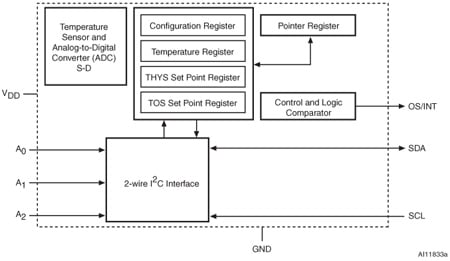
STCN75Digital temperature sensor IC, thermal watchdog, high-precision | Evaluation Boards | 4 | Active | The STCN75 is a high-precision digital CMOS temperature sensor IC with a sigma-delta temperature-to-digital converter and an I2C-compatible serial digital interface. It is targeted for general applications such as personal computers, system thermal management, electronics equipment, and industrial controllers, and is packaged in the industry-standard 8-lead TSSOP package.
The device contains a bandgap temperature sensor and 9-bit ADC which monitor and digitize the temperature to a resolution up to 0.5 °C. The STCN75 is typically accurate to (±3 °C - max) over the full temperature measurement range of –55 °C to 125 °C with ±2 °C accuracy in the –25 °C to +100 °C range. The STCN75 is pin-for-pin and software compatible with the TCN75.
The STCN75 is specified for operating at supply voltages from 2.7 V to 5.5 V. Operating at 3.3 V, the supply current is typically (125 μA).
The onboard sigma-delta analog-to-digital converter (ADC) converts the measured temperature to a digital value that is calibrated in degrees centigrade; for Fahrenheit applications a lookup table or conversion routine is required.
The STCN75 is factory-calibrated and requires no external components to measure temperature. |
STCS050.5A MAX CONSTANT CURRENT LED DRIVER | Power Management (PMIC) | 1 | Active | The STCS05 is a BiCMOS constant current source designed to provide a precise constant current starting from a varying input voltage source. The main target is to replace discrete components solution for driving LEDs in low voltage applications such as 5 V, 12 V or 24 V giving benefits in terms of precision, integration and reliability.
The current is set with external resistor up to 0.5A with a ± 10 % precision; a dedicated pin allows implementing PWM dimming.
An open-drain pin output provides information on load disconnection condition. |
| Power Management (PMIC) | 1 | Active | ||