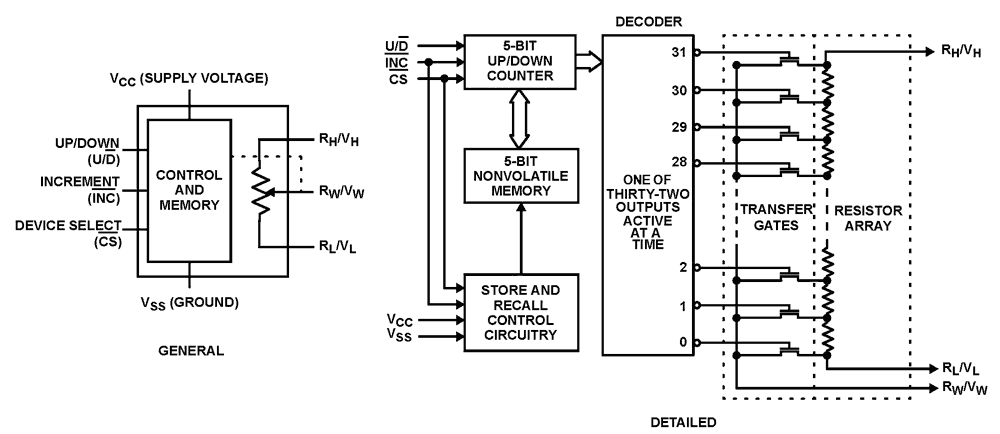
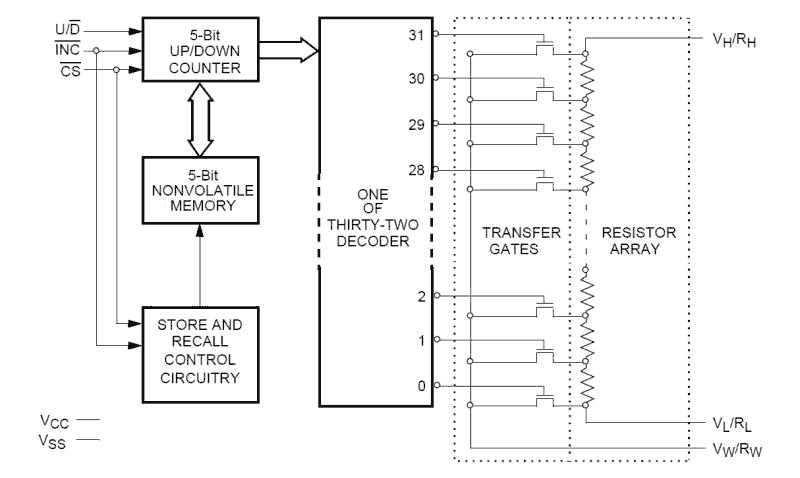
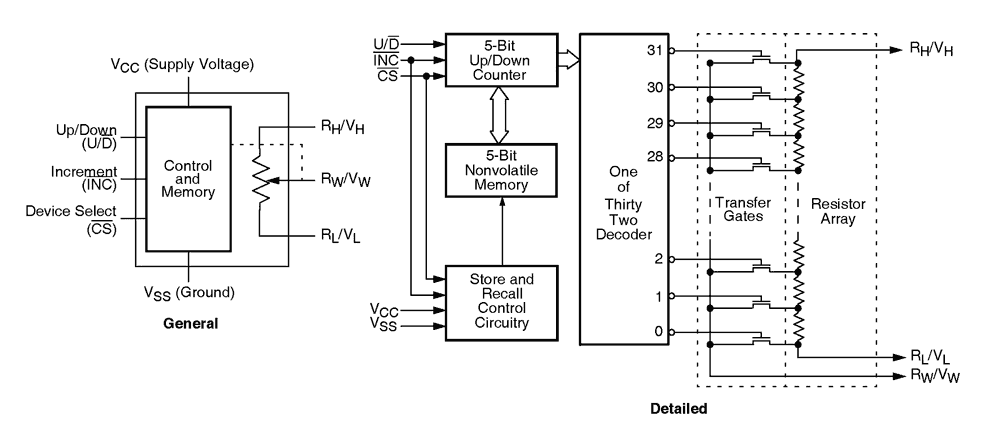
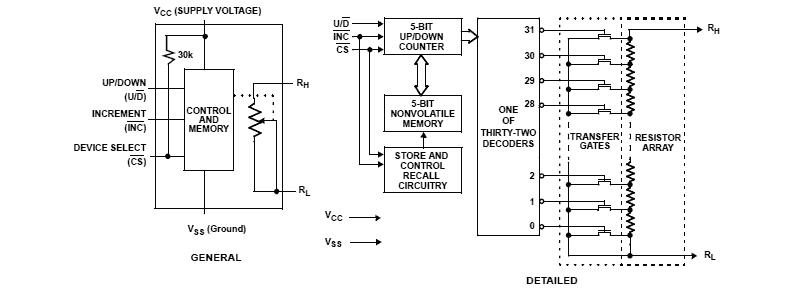
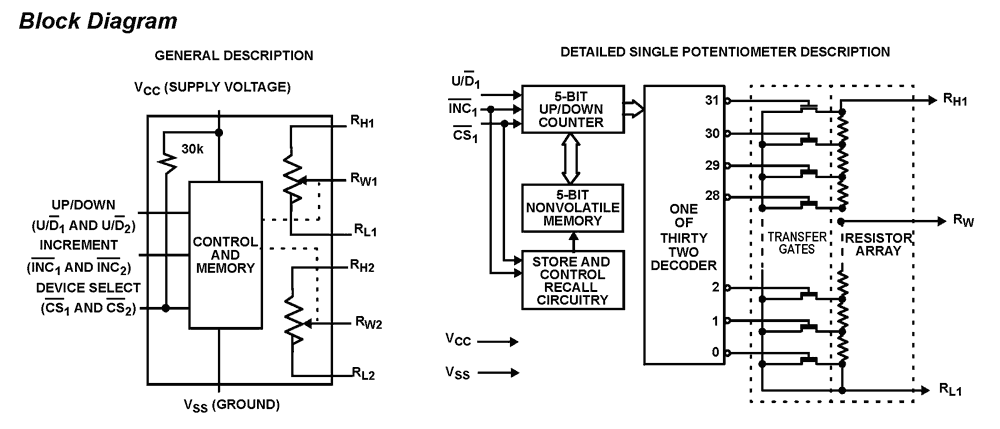
X9313Digitally Controlled Potentiometer (XDCP™), Linear, 32 Taps, 3 Wire Interface, Terminal Voltages ± VCC | Integrated Circuits (ICs) | 90 | Active | The Intersil X9313 is a digitally controlled potentiometer (XDCP). The device consists of a resistor array, wiper switches, a control section, and nonvolatile memory. The wiper position is controlled by a 3-wire interface. The potentiometer is implemented by a resistor array composed of 31 resistive elements and a wiper switching network. Between each element and at either end are tap points accessible to the wiper terminal. The position of the wiper element is controlled by the CS, U/D, and INC inputs. The position of the wiper can be stored in nonvolatile memory and then be recalled upon a subsequent power-up operation. The device can be used as a three-terminal potentiometer or as a two-terminal variable resistor in a wide variety of applications including: |
X9314Single Digitally Controlled Potentiometer (XDCP™) | Data Acquisition | 14 | Active | The Intersil X9314 is a solid state nonvolatile potentiometer and is ideal for digitally controlled resistance trimming. The X9314 is a resistor array composed of 31 resistive elements. Between each element and at either end are tap points accessible to the wiper element. The position of the wiper element is controlled by the CS, U/D, and INC inputs. The position of the wiper can be stored in nonvolatile memory and then be recalled upon a subsequent power-up operation. The XDCP can be used as a three-terminal potentiometer or as a two-terminal variable resistor in a wide variety of applications including control, parameter adjustments, and signal processing. |
X9315Digitally Controlled Potentiometer (XDCP™) | Integrated Circuits (ICs) | 67 | Active | The Intersil X9315 is a digitally controlled potentiometer (XDCP). The device consists of a resistor array, wiper switches, a control section, and nonvolatile memory. The wiper position is controlled by a 3-wire interface. The potentiometer is implemented by a resistor array composed of 31 resistive elements and a wiper switching network. Between each element and at either end are tap points accessible to the wiper terminal. The position of the wiper element is controlled by the CS, U/D, and INC inputs. The position of the wiper can be stored in nonvolatile memory and then be recalled upon a subsequent power-up operation. The device can be used as a three-terminal potentiometer or as a two-terminal variable resistor in a wide variety of applications. |
| Digital Potentiometers | 3 | Obsolete | |
| Data Acquisition | 2 | Obsolete | |
| Integrated Circuits (ICs) | 7 | Obsolete | |
| Data Acquisition | 103 | Active | |
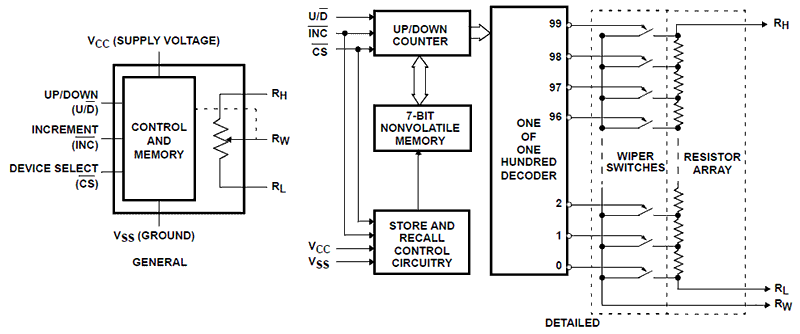
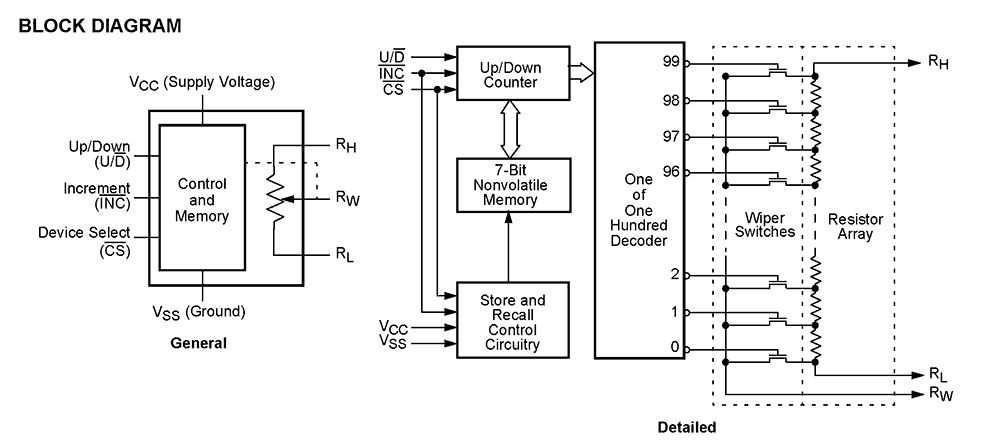
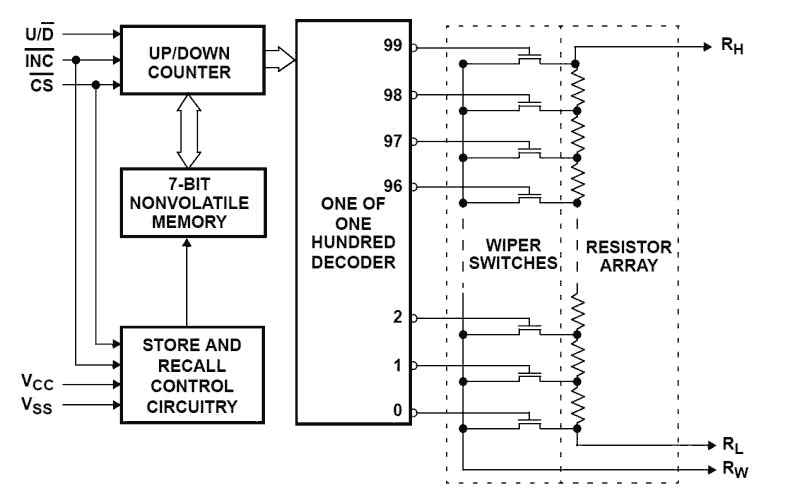
X9318Digitally Controlled Potentiometer (XDCP™) | Data Acquisition | 11 | Active | The Intersil X9318 is a digitally controlled potentiometer (XDCP). The device consists of a resistor array, wiper switches, a control section, and nonvolatile memory. The wiper position is controlled by a 3-wire interface. The potentiometer is implemented by a resistor array composed of 99 resistive elements and a wiper switching network. Between each element and at either end are tap points accessible to the wiper terminal. The position of the wiper element is controlled by the CS, U/D, and INC inputs. The position of the wiper can be stored in nonvolatile memory and then be recalled upon a subsequent power-up operation. The device can be used as a three-terminal potentiometer for voltage control or as a two-terminal variable resistor for current control in a wide variety of applications. |
| Digital Potentiometers | 11 | Obsolete | |
X93256Dual Digitally Controlled Potentiometers (XDCPs™) | Digital Potentiometers | 5 | Obsolete | The Intersil X93256 is a dual digitally controlled potentiometer (XDCP). The device consists of two resistor arrays, wiper switches, a control section, and nonvolatile memory. The wiper positions are controlled by individual Up/Down interfaces. A potentiometer is implemented by a resistor array composed of 31 resistive elements and a wiper switching network. The position of each wiper element is controlled by a set of independent CS, U/D, and INC inputs. The position of the wiper can be stored in nonvolatile memory and then be recalled upon a subsequent power-up operation. Each potentiometer is connected as a three-terminal variable resistor and can be used in a wide variety of applications including: |