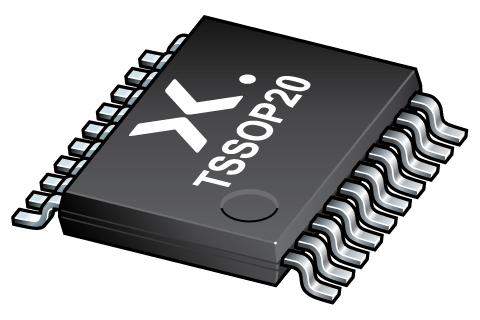
74HCT374PWOctal D-type flip-flop; positive edge-trigger; 3-state | Logic | 1 | Active | The 74HC374; 74HCT374 is an octal positive-edge triggered D-type flip-flop with 3-state outputs. The device features a clock (CP) and output enable (OE) inputs. The flip-flops will store the state of their individual D-inputs that meet the set-up and hold time requirements on the LOW-to-HIGH clock (CP) transition. A HIGH onOEcauses the outputs to assume a high-impedance OFF-state. Operation of theOEinput does not affect the state of the flip-flops. Inputs also include clamp diodes, this enables the use of current limiting resistors to interface inputs to voltages in excess of VCC. |
74HCT377Octal D-type flip-flop with data enable; positive-edge trigger | Integrated Circuits (ICs) | 6 | Active | The 74HC377-Q100; 74HCT377-Q100 is an octal positive-edge triggered D-type flip-flop. The device features clock (CP) and data enable (E) inputs. WhenEis LOW, the outputs Qn assume the state of their corresponding Dn inputs that meet the set-up and hold time requirements on the LOW-to-HIGH clock (CP) transition. InputEmust be stable one set-up time prior to the LOW-to-HIGH transition for predictable operation. Inputs include clamp diodes that enable the use of current limiting resistors to interface inputs to voltages in excess of VCC. |
| Integrated Circuits (ICs) | 2 | Active | |
| Logic | 1 | Active | The 74HC390; 74HCT390 is a dual 4-bit decade ripple counter divided into four separately clocked sections. The counters have two divide-by-2 sections and two divide-by-5 sections. These sections share an asynchronous master reset input (nMR) and can be used in a BCD decade or bi-quinary configuration. If master reset inputs (1MR and 2MR) are used to simultaneously clear all 8 bits of the counter, a number of counting configurations are possible within one package. The separate clocks (nCP0 and nCP1) of each section allow ripple counter or frequency division applications of divide-by-2, 4, 5, 10, 20, 25, 50 or 100. Each section is triggered by the HIGH-to-LOW transition of the clock inputs (nCP0 and nCP1). For BCD decade operation, the nQ0 output is connected to the nCP1 input of the divide-by-5 section. For bi-quinary decade operation, the nQ3 output is connected to the nCP0 input and nQ0 becomes the decade output. A HIGH on the nMR input overrides the clocks and sets the four outputs LOW. This device features reduced input threshold levels to allow interfacing to TTL logic levels. Inputs also include clamp diodes, this enables the use of current limiting resistors to interface inputs to voltages in excess of VCC. |
| Logic | 1 | Active | The 74HC390; 74HCT390 is a dual 4-bit decade ripple counter divided into four separately clocked sections. The counters have two divide-by-2 sections and two divide-by-5 sections. These sections share an asynchronous master reset input (nMR) and can be used in a BCD decade or bi-quinary configuration. If master reset inputs (1MR and 2MR) are used to simultaneously clear all 8 bits of the counter, a number of counting configurations are possible within one package. The separate clocks (nCP0 and nCP1) of each section allow ripple counter or frequency division applications of divide-by-2, 4, 5, 10, 20, 25, 50 or 100. Each section is triggered by the HIGH-to-LOW transition of the clock inputs (nCP0 and nCP1). For BCD decade operation, the nQ0 output is connected to the nCP1 input of the divide-by-5 section. For bi-quinary decade operation, the nQ3 output is connected to the nCP0 input and nQ0 becomes the decade output. A HIGH on the nMR input overrides the clocks and sets the four outputs LOW. This device features reduced input threshold levels to allow interfacing to TTL logic levels. Inputs also include clamp diodes, this enables the use of current limiting resistors to interface inputs to voltages in excess of VCC. |
74HCT393Dual 4-bit binary ripple counter | Logic | 5 | Active | The 74HC393-Q100; 74HCT393-Q100 is a dual 4-stage binary ripple counter. Each counter features a clock input (nCP), an overriding asynchronous master reset input (nMR) and 4 buffered parallel outputs (nQ0 to nQ3). The counter advances on the HIGH-to-LOW transition of nCP. A HIGH on nMR clears the counter stages and forces the outputs LOW, independent of the state of nCP. Inputs include clamp diodes. This enables the use of current limiting resistors to interface inputs to voltages in excess of VCC. |
| Counters, Dividers | 1 | Active | The 74HC393; 74HCT393 is a dual 4-stage binary ripple counter. Each counter features a clock input (nCP), an overriding asynchronous master reset input (nMR) and 4 buffered parallel outputs (nQ0 to nQ3). The counter advances on the HIGH-to-LOW transition of nCP. A HIGH on nMR clears the counter stages and forces the outputs LOW, independent of the state of nCP. Inputs include clamp diodes. This enables the use of current limiting resistors to interface inputs to voltages in excess of VCC. |
| Integrated Circuits (ICs) | 1 | Active | The 74HC393-Q100; 74HCT393-Q100 is a dual 4-stage binary ripple counter. Each counter features a clock input (nCP), an overriding asynchronous master reset input (nMR) and 4 buffered parallel outputs (nQ0 to nQ3). The counter advances on the HIGH-to-LOW transition of nCP. A HIGH on nMR clears the counter stages and forces the outputs LOW, independent of the state of nCP. Inputs include clamp diodes. This enables the use of current limiting resistors to interface inputs to voltages in excess of VCC. |
| Counters, Dividers | 1 | Active | The 74HC393; 74HCT393 is a dual 4-stage binary ripple counter. Each counter features a clock input (nCP), an overriding asynchronous master reset input (nMR) and 4 buffered parallel outputs (nQ0 to nQ3). The counter advances on the HIGH-to-LOW transition of nCP. A HIGH on nMR clears the counter stages and forces the outputs LOW, independent of the state of nCP. Inputs include clamp diodes. This enables the use of current limiting resistors to interface inputs to voltages in excess of VCC. |
| Logic | 1 | Active | The 74HC393-Q100; 74HCT393-Q100 is a dual 4-stage binary ripple counter. Each counter features a clock input (nCP), an overriding asynchronous master reset input (nMR) and 4 buffered parallel outputs (nQ0 to nQ3). The counter advances on the HIGH-to-LOW transition of nCP. A HIGH on nMR clears the counter stages and forces the outputs LOW, independent of the state of nCP. Inputs include clamp diodes. This enables the use of current limiting resistors to interface inputs to voltages in excess of VCC. |