MAX242871Gbps Parallel-to-Serial MII Converter | Integrated Circuits (ICs) | 2 | Active | The MAX24287 is a flexible, low-cost Ethernet interface conversion IC. The parallel interface can be configured for GMII, RGMII, TBI, RTBI, or 10/100 MII, while the serial interface can be configured for 1.25Gbps SGMII or 1000BASE-X operation. In SGMII mode, the device interfaces directly to Ethernet switch ICs, ASIC MACs, and 1000BASE-T electrical SFP modules. In 1000BASE-X mode, the device interfaces directly to 1Gbps 1000BASE-X SFP optical modules. The MAX24287 performs automatic translation of link speed and duplex auto-negotiation between parallel MII MDIO and the serial interface.
This device is ideal for interfacing single-channel GMII/MII devices such as microprocessors, FPGAs, network processors, Ethernet-over-SONET or -PDH mappers, and TDM-over-packet circuit emulation devices. The device also provides a convenient solution to interface such devices with electrical or optical Ethernet SFP modules.
### Applications/Uses
* Any System with a Need to Interface a Component with a Parallel MII Interface (GMII, RGMII, TBI RTBI, 10/100 MII) to a Component with an SGMII or 1000BASE-X Interface
* Switches and Routers
* Telecom Equipment |
MAX24288IEEE 1588 Clock and Packet Timestamper and 1Gbps Parallel-to-Serial MII Converter | Integrated Circuits (ICs) | 2 | Active | The MAX24288 is a flexible, low-cost IEEE 1588 clock and timestamper with an SGMII or 1000BASE-X serial interface and a parallel MII interface that can be configured for GMII, RGMII, or 10/100 MII. The device provides all required hardware support for high-accuracy time and frequency synchronization using the IEEE 1588 Precision Time Protocol. In both the transmit and receive directions 1588 packets are identified and timestamped with high precision. System software makes use of these timestamps to determine the time offset between the system and its timing master. Software can then correct any time error by steering the device's 1588 clock subsystem appropriately. The device provides the necessary I/O to time-synchronize with a 1588 master elsewhere in the same system or to be the master to which slave components can synchronize.
In addition, the MAX24288 is a full-featured, 10/100/1000 Mbps parallel-to-serial MII converter. It provides full SGMII revision 1.8 compliance and also interfaces directly to 1Gbps 1000BASE-X SFP optical modules.
### Applications/Uses
* 1588-Enabled Equipment with 1G Ethernet Ports
* Industrial and Factory Automation Equipment
* Medical Equipment
* Pseudowire Circuit Emulation Equipment
* Switches, Routers, DSLAMs, PON Equipment
* Test and Measurement Systems
* Wireless Base Stations and Controllers |
| Integrated Circuits (ICs) | 1 | Active | |
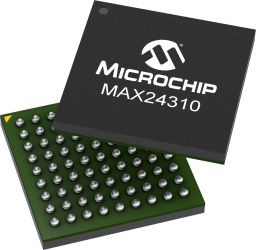
| Application Specific Clock/Timing | 1 | Active | The MAX24310 is an flexible, high-performance timing and clock synthesizer ICs that include a DPLL and two independent APLLs. When locked to one of two input clock signals, the device performs any-to-any frequency conversion. From any input clock frequency 1Hz to 750MHz the device can produce frequency-locked APLL output frequencies up to 750MHz and as many as 10 output clock signals that are integer divisors of the APLL frequencies. Input jitter can be attenuated by an internal low-bandwidth DPLL. The DPLL also provides truly hitless switching between input clocks and a high-resolution holdover capability. Input switching can be manual or automatic. Using only a low-cost crystal or oscillator, the device can also serve as frequency synthesizer IC. Output jitter is typically 0.18 to 0.3ps RMS for an APLL-only integer multiply and 0.25 to 0.4ps RMS for APLL-only fractional multiply or DPLL+APLL operation.
For telecom systems, the device has all required features and functions to serve as a central timing function or as a line card timing IC. With a suitable oscillator the device meets the requirements of Stratum 2, 3E, 3, 4E, and 4; G.812 Types I to IV; G.813; and G.8262.
**[Click here for secure documentation](https://www.microsemi.com/product-directory/synce/4602-max24305-max24310#resources)** |
| Clock Generators, PLLs, Frequency Synthesizers | 1 | Active | |
| Clock Generators, PLLs, Frequency Synthesizers | 1 | Active | |
| Clock/Timing | 1 | Active | |
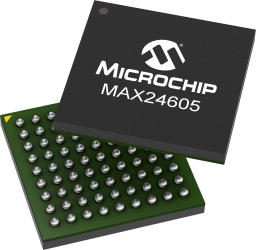
MAX246055 Output Clock Multiplier / Jitter Attenuator | Clock/Timing | 1 | Active | The MAX24605 is a flexible, high-performance clock multiplier and jitter attenuator ICs that include a DPLL and two independent APLLs. When locked to one of two input clock signals, the device performs any-to-any frequency conversion. From any input clock frequency 2kHz to 750MHz the devices can produce frequency-locked APLL output frequencies up to 750MHz and as many as 5 output clock signals that are integer divisors of the APLL frequencies. Input jitter can be attenuated by an internal low-bandwidth DPLL. The DPLL also provides glitchless switching between input clocks and numerically controlled oscillator capability. Input switching can be manual or automatic. Using only a low-cost crystal or oscillator, the device can also serve as frequency synthesizer IC. Output jitter is typically 0.18 to 0.3ps RMS for an APLL-only integer multiply and 0.25 to 0.4ps RMS for APLL-only fractional multiply or DPLL+APLL operation. |
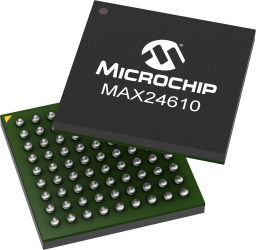
MAX2461010 Output Clock Multiplier /Jitter Attenuator | Clock/Timing | 1 | Active | The MAX24605 is a flexible, high-performance clock multiplier and jitter attenuator ICs that include a DPLL and two independent APLLs. When locked to one of two input clock signals, the device performs any-to-any frequency conversion. From any input clock frequency 2kHz to 750MHz the devices can produce frequency-locked APLL output frequencies up to 750MHz and as many as 10 output clock signals that are integer divisors of the APLL frequencies. Input jitter can be attenuated by an internal low-bandwidth DPLL. The DPLL also provides glitchless switching between input clocks and numerically controlled oscillator capability. Input switching can be manual or automatic. Using only a low-cost crystal or oscillator, the device can also serve as frequency synthesizer IC. Output jitter is typically 0.18 to 0.3ps RMS for an APLL-only integer multiply and 0.25 to 0.4ps RMS for APLL-only fractional multiply or DPLL+APLL operation. |
| Clock/Timing | 1 | Active | |