USB5826C6-Port USB SS / Hi-Speed Hub Controller | Integrated Circuits (ICs) | 4 | Active | Microchip’s USB5826 [SmartHub](https://www.microchip.com/en-us/products/interface-and-connectivity/usb/usb-hubs/smarthub-ics)™ is a 6 port, SuperSpeed (SS), low power, configurable USB3.2 Gen1 hub and fully compliant with USB-IF's USB 3.2 Gen1 specification. The USB5826 also supports Hi-Speed (HS), Full Speed (FS) and Low Speed (LS) USB signaling, offering complete coverage of all defined USB operating speeds. The new SuperSpeed hubs operate in parallel with the USB 2.0 controller, so 5 Gbps SuperSpeed data transfers are not affected by slower USB 2.0 traffic.
**This "C" version contains the latest silicon. All new USB5826 designs should move to this newer "C" version.**
Microchip SmartHub's are defined as USB hubs that integrates system levels functions typically associated with a separate MCU or processor. The USB5826 SmartHub enables communication to other peripherals in addition to USB. The USB5826's I/O Bridging capability allows the host to seamlessly interface to peripherals via I²C, SPI or GPIOs over USB. The USB5826 also enable a downstream device to take control of the host system by swapping roles and becoming the host port. USB5816 based systems can also switch between two different hosts if required. This role changing technology is called FlexConnect and can be initiated through hardware or software commands.
New technologies like the USB Type-C connector and power delivery are changing the USB landscape. Designed to simplify the latest USB hub designs, the USB5826 has built in Billboard support giving you the option to offload this function from the power delivery controller onto the hub. In addition, the hub can expand beyond six ports through PortSplitting which allows for embedded applications to only use the interface needed for internal USB connections.
MPLAB® Connect Configurator, Microchip’s proprietary software utility, can be used to program on-chip, One Time Programmable (OTP) ROM for the USB5826 which stores required register settings to ensure the desired start up configuration at power on. All LED, GPIOs and port control signal pins are under firmware control, allowing for maximum operational flexibility. However, for even more simplicity, the USB5826 can be configured through a series of external low-cost resistor bootstraps. A handful of bootstrap pins are available on the USB5826 to enable standard configurations for GPIOs and downstream ports. No OTP programming required.
Microchip's complimentary and confidential [MicroCHECK](https://www.microchip.com/en-us/support/design-help/design-check-services) design review service, which offers insight from the initial concept to the final PCB layout, is available to customers who are using our products in their projects. You can confidently submit your design materials in a secure and private setting, and our expert engineers will provide individualized feedback to enhance your design. MicroCHECK design review service is subject to Microchip's [Program Terms and Conditions](https://www.microchip.com/en-us/support/design-help/design-check-services/design-check-services-program-terms-and-conditions) and requires a myMicrochip account. |
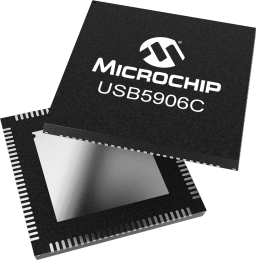
USB5906C6-Port USB SS / Hi-Speed SmartHub Controller | Interface | 5 | Active | Microchip’s USB5906C [SmartHub](https://www.microchip.com/en-us/products/interface-and-connectivity/usb/usb-hubs/smarthub-ics)™ is a 6 port, SuperSpeed (SS), low power, configurable USB3.2 Gen1 hub and fully compliant with USB-IF's USB3.2 Gen1 specification. The USB5906C also supports Hi-Speed (HS), Full Speed (FS) and Low Speed (LS) USB signaling, offering complete coverage of all defined USB operating speeds. The new SuperSpeed hubs operate in parallel with the USB 2.0 controller, so 5 Gbps SuperSpeed data transfers are not affected by slower USB 2.0 traffic.
**This "C" version contains the latest silicon. All new USB5906 designs should move to this newer "C" version.**
Microchip SmartHub's are defined as USB hubs that integrates system levels functions typically associated with a separate MCU or processor. The USB5906C SmartHub enables communication to other peripherals in addition to USB. The USB5906C's I/O Bridging capability allows the host to seamlessly interface to peripherals via I²C, SPI or GPIOs over USB. The USB5906C also enable a downstream device to take control of the host system by swapping roles and becoming the host port. USB5906C based systems can also switch between two different hosts if required. This role changing technology is called FlexConnect and can be initiated through hardware or software commands.
New technologies like the USB Type-C connector and power delivery are changing the USB landscape. Designed to simplify the latest USB hub designs, the USB5906C has built in Billboard support giving you the option to offload this function from the power delivery controller onto the hub. In addition, the hub can expand beyond six ports through PortSplitting which allows for embedded applications to only use the interface needed for internal USB connections.
MPLAB® Connect Configurator, Microchip’s proprietary software utility, can be used to program on-chip, One Time Programmable (OTP) ROM for the USB5906C which stores required register settings to ensure the desired start up configuration at power on. All LED, GPIOs and port control signal pins are under firmware control, allowing for maximum operational flexibility. However, for even more simplicity, the USB5906C can be configured through a series of external low-cost resistor bootstraps. A handful of bootstrap pins are available on the USB5906C to enable standard configurations for GPIOs and downstream ports. No OTP programming required.
Microchip's complimentary and confidential [MicroCHECK](https://www.microchip.com/en-us/support/design-help/design-check-services) design review service, which offers insight from the initial concept to the final PCB layout, is available to customers who are using our products in their projects. You can confidently submit your design materials in a secure and private setting, and our expert engineers will provide individualized feedback to enhance your design. MicroCHECK design review service is subject to Microchip's [Program Terms and Conditions](https://www.microchip.com/en-us/support/design-help/design-check-services/design-check-services-program-terms-and-conditions) and requires a myMicrochip account. |
USB5916C6-Port USB SS / Hi-Speed SmartHub Controller | Interface | 5 | Active | Microchip’s USB5916C [SmartHub](https://www.microchip.com/en-us/products/interface-and-connectivity/usb/usb-hubs/smarthub-ics)™ is a 6 port, SuperSpeed (SS), low power, configurable USB3.2 Gen1 hub and fully compliant with USB-IF's USB3.2 Gen1 specification. The USB5916C also supports Hi-Speed (HS), Full Speed (FS) and Low Speed (LS) USB signaling, offering complete coverage of all defined USB operating speeds. The new SuperSpeed hubs operate in parallel with the USB 2.0 controller, so 5 Gbps SuperSpeed data transfers are not affected by slower USB 2.0 traffic.
**This "C" version contains the latest silicon. All new USB5916 designs should move to this newer "C" version.**
Microchip SmartHub's are defined as USB hubs that integrates system levels functions typically associated with a separate MCU or processor. The USB5916C SmartHub enables communication to other peripherals in addition to USB. The USB5916C's I/O Bridging capability allows the host to seamlessly interface to peripherals via I²C, SPI or GPIOs over USB. The USB5916C also enable a downstream device to take control of the host system by swapping roles and becoming the host port. USB5916C based systems can also switch between two different hosts if required. This role changing technology is called FlexConnect and can be initiated through hardware or software commands.
New technologies like the USB Type-C connector and power delivery are changing the USB landscape. Designed to simplify the latest USB hub designs, the USB5916C has built in Billboard support giving you the option to offload this function from the power delivery controller onto the hub. In addition, the hub can expand beyond six ports through PortSplitting which allows for embedded applications to only use the interface needed for internal USB connections.
MPLAB® Connect Configurator, Microchip’s proprietary software utility, can be used to program on-chip, One Time Programmable (OTP) ROM for the USB5916C which stores required register settings to ensure the desired start up configuration at power on. All LED, GPIOs and port control signal pins are under firmware control, allowing for maximum operational flexibility. However, for even more simplicity, the USB5916C can be configured through a series of external low-cost resistor bootstraps. A handful of bootstrap pins are available on the USB5916C to enable standard configurations for GPIOs and downstream ports. No OTP programming required.
Microchip's complimentary and confidential [MicroCHECK](https://www.microchip.com/en-us/support/design-help/design-check-services) design review service, which offers insight from the initial concept to the final PCB layout, is available to customers who are using our products in their projects. You can confidently submit your design materials in a secure and private setting, and our expert engineers will provide individualized feedback to enhance your design. MicroCHECK design review service is subject to Microchip's [Program Terms and Conditions](https://www.microchip.com/en-us/support/design-help/design-check-services/design-check-services-program-terms-and-conditions) and requires a myMicrochip account. |
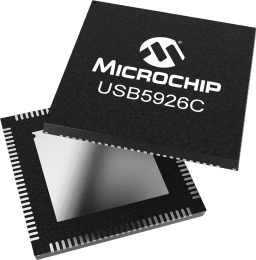
USB5926C6-Port USB SS / Hi-Speed SmartHub Controller | Controllers | 6 | Active | Microchip’s USB5926C [SmartHub](https://www.microchip.com/en-us/products/interface-and-connectivity/usb/usb-hubs/smarthub-ics)™ is a 6 port, SuperSpeed (SS), low power, configurable USB3.2 Gen1 hub and fully compliant with USB-IF's USB3.2 Gen1 specification. The USB5926C also supports Hi-Speed (HS), Full Speed (FS) and Low Speed (LS) USB signaling, offering complete coverage of all defined USB operating speeds. The new SuperSpeed hubs operate in parallel with the USB 2.0 controller, so 5 Gbps SuperSpeed data transfers are not affected by slower USB 2.0 traffic.
**This "C" version contains the latest silicon. All new USB5926 designs should move to this newer "C" version.**
Microchip SmartHub's are defined as USB hubs that integrates system levels functions typically associated with a separate MCU or processor. The USB5926C SmartHub enables communication to other peripherals in addition to USB. The USB5926C's I/O Bridging capability allows the host to seamlessly interface to peripherals via I²C, SPI or GPIOs over USB. The USB5926C also enable a downstream device to take control of the host system by swapping roles and becoming the host port. USB5926C based systems can also switch between two different hosts if required. This role changing technology is called FlexConnect and can be initiated through hardware or software commands.
New technologies like the USB Type-C connector and power delivery are changing the USB landscape. Designed to simplify the latest USB hub designs, the USB5926C has built in Billboard support giving you the option to offload this function from the power delivery controller onto the hub. In addition, the hub can expand beyond six ports through PortSplitting which allows for embedded applications to only use the interface needed for internal USB connections.
MPLAB® Connect Configurator, Microchip’s proprietary software utility, can be used to program on-chip, One Time Programmable (OTP) ROM for the USB5926C which stores required register settings to ensure the desired start up configuration at power on. All LED, GPIOs and port control signal pins are under firmware control, allowing for maximum operational flexibility. However, for even more simplicity, the USB5926C can be configured through a series of external low-cost resistor bootstraps. A handful of bootstrap pins are available on the USB5926C to enable standard configurations for GPIOs and downstream ports. No OTP programming required.
Microchip's complimentary and confidential [MicroCHECK](https://www.microchip.com/en-us/support/design-help/design-check-services) design review service, which offers insight from the initial concept to the final PCB layout, is available to customers who are using our products in their projects. You can confidently submit your design materials in a secure and private setting, and our expert engineers will provide individualized feedback to enhance your design. MicroCHECK design review service is subject to Microchip's [Program Terms and Conditions](https://www.microchip.com/en-us/support/design-help/design-check-services/design-check-services-program-terms-and-conditions) and requires a myMicrochip account. |
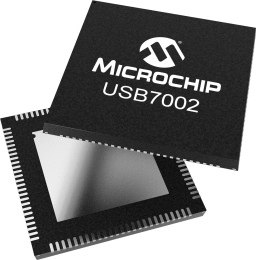
USB70024-Port SS / HS USB Type-C SmartHub | Development Boards, Kits, Programmers | 2 | Active | The Microchip USB7002 [SmartHub](https://www.microchip.com/en-us/products/interface-and-connectivity/usb/usb-hubs/smarthub-ics)™ IC is a low-power, OEM configurable, USB3.2 Gen 1 hub controller with 4 downstream ports and advanced features for embedded USB applications. The USB7002 is fully compliant with the Universal Serial Bus Revision 3.2 Specification and USB2.0 Link Power Management Addendum. The USB7002 supports 5 Gbps Super-Speed (SS), 480 Mbps Hi-Speed (HS), 12 Mbps Full-Speed (FS), and 1.5 Mbps Low-Speed (LS) USB downstream devices on all enabled downstream ports.
A SmartHub IC is defined as a USB hub that integrates system levels functions typically associated with a separate MCU or processor. The USB7002 SmartHub IC enables communication to other peripherals in addition to USB. This I/O Bridging capability allows the host to seamlessly interface to peripherals via I²C, SPI or GPIOs over USB. The USB7002 also enable a downstream device to take control of the host system by swapping roles and becoming the host port. The USB7002 can also switch between two different hosts if required. This role changing technology is called FlexConnect and can be initiated through hardware or software commands.
The USB7002 supports native Type-C connectivity on the upstream port and two of the downstream ports. The hub includes internal Type-C CC pin logic and an internal USB3.2 Gen 1 multiplexer to support both Type-C insertion orientations. The USB7002 also supports the legacy USB speeds (HS/FS/LS) through a dedicated USB2.0 hub controller that is the culmination of six generations of Microchip hub feature controller design and experience with proven reliability, interoperability, and device compatibility. The SuperSpeed hub controller operates in parallel with the USB2.0 controller, decoupling the 5 Gbps SS data transfers from bottlenecks due to the slower USB2.0 traffic.
The USB7002 supports downstream battery charging. The USB7002 integrated battery charger detection circuitry supports the USB-IF Battery Charging (BC1.2) detection method and most Apple® devices. The USB7002 provides the battery charging handshake and supports the following USB-IF BC1.2 charging profiles:
• DCP: Dedicated Charging Port (Power brick with no data)
• CDP: Charging Downstream Port (1.5A with data)
• SDP: Standard Downstream Port (0.5A with data)
• Custom profiles loaded via SPI EEPROM or OTP
MPLAB® Connect Configurator, Microchip’s proprietary software utility, can be used to program On-chip One Time Programmable (OTP) ROM for the USB7002 which stores required register settings to ensure the desired start up configuration at power on. All LED, GPIOs and port control signal pins are under firmware control, allowing for maximum operational flexibility. However, for even more simplicity, the USB7002 can be configured through a series of external low-cost resistor bootstraps. A handful of bootstrap pins are available on the USB7002 to enable standard configurations for GPIOs and downstream ports. No OTP programming required.
The USB7002 is also AEC-Q100 certified support traditional data transfer applications that require higher data rates than USB2.0 as well as Multi-Host applications like CarPlay and CarLife that enable the graphical user interface of a phone to be displayed on a vehicles' screen within a car.
**Unlike the USB7050/51/52/56, USB7002 applications DO NOT require application-specific firmware developed by Microchip support engineers. There is no native PD firmware included within the USB7002.**
Microchip's complimentary and confidential [MicroCHECK](https://www.microchip.com/en-us/support/design-help/design-check-services) design review service, which offers insight from the initial concept to the final PCB layout, is available to customers who are using our products in their projects. You can confidently submit your design materials in a secure and private setting, and our expert engineers will provide individualized feedback to enhance your design. MicroCHECK design review service is subject to Microchip's [Program Terms and Conditions](https://www.microchip.com/en-us/support/design-help/design-check-services/design-check-services-program-terms-and-conditions) and requires a myMicrochip account. |
USB70166-Port SS / HS USB Type-C Gen1 SmartHub | Integrated Circuits (ICs) | 2 | Active | The Microchip USB7016 [SmartHub](https://www.microchip.com/en-us/products/interface-and-connectivity/usb/usb-hubs/smarthub-ics)™ IC is a low-power, OEM configurable, USB3.2 Gen 1 hub controller with 6 downstream ports and advanced features for embedded USB applications. The USB7016 is fully compliant with the Universal Serial Bus Revision 3.2 Specification and USB2.0 Link Power Management Addendum. The USB7016 supports 5 Gbps Super-Speed (SS), 480 Mbps Hi-Speed (HS), 12 Mbps Full-Speed (FS), and 1.5 Mbps Low-Speed (LS) USB downstream devices on all enabled downstream ports.
A SmartHub IC is defined as a USB hub that integrates system levels functions typically associated with a separate MCU or processor. The USB7016 SmartHub IC enables communication to other peripherals in addition to USB. This I/O Bridging capability allows the host to seamlessly interface to peripherals via I²C, SPI or GPIOs over USB. The USB7016 also enable a downstream device to take control of the host system by swapping roles and becoming the host port. The USB7016 can also switch between two different hosts if required. This role changing technology is called FlexConnect and can be initiated through hardware or software commands.
The USB7016 supports native Type-C connectivity on one of the downstream ports. The hub includes internal Type-C CC pin logic and an internal USB3.2 Gen 1 multiplexer to support both Type-C insertion orientations. The USB7016 supports an additional 5 x Type A ports downstream - 3 x USB3.2 Gen1 and 2 x USB2.0. The hub also supports legacy USB speeds (HS/FS/LS) through a dedicated USB2.0 hub controller that is the culmination of six generations of Microchip hub feature controller design and experience with proven reliability, interoperability, and device compatibility. The SuperSpeed hub controller operates in parallel with the USB 2.0 controller, decoupling the 5 Gbps SS data transfers from bottlenecks due to the slower USB 2.0 traffic.
The USB7016 supports downstream battery charging and integrated battery charger detection circuitry supporting the USB-IF Battery Charging (BC1.2) detection method and most Apple® devices. The USB7016 provides the battery charging handshake and supports the following USB-IF BC1.2 charging profiles:
**•** DCP: Dedicated Charging Port (Power brick with no data)
**•** CDP: Charging Downstream Port (1.5A with data)
**•** SDP: Standard Downstream Port (0.5A with data)
**•** Custom profiles loaded via SPI EEPROM or OTP
MPLAB® Connect Configurator, Microchip’s proprietary software utility, can be used to program On-chip One Time Programmable (OTP) ROM for the USB7016 which stores required register settings to ensure the desired start up configuration at power on. All LED, GPIOs and port control signal pins are under firmware control, allowing for maximum operational flexibility. However, for even more simplicity, the USB7016 can be configured through a series of external low-cost resistor bootstraps. A handful of bootstrap pins are available on the USB7016 to enable standard configurations for GPIOs and downstream ports. No OTP programming required.
**Unlike the USB7050/51/52/56, USB7016 applications DO NOT require application-specific firmware developed by Microchip support engineers. There is no native PD firmware included within the USB7016.**
Microchip's complimentary and confidential [MicroCHECK](https://www.microchip.com/en-us/support/design-help/design-check-services) design review service, which offers insight from the initial concept to the final PCB layout, is available to customers who are using our products in their projects. You can confidently submit your design materials in a secure and private setting, and our expert engineers will provide individualized feedback to enhance your design. MicroCHECK design review service is subject to Microchip's [Program Terms and Conditions](https://www.microchip.com/en-us/support/design-help/design-check-services/design-check-services-program-terms-and-conditions) and requires a myMicrochip account. |
| Interface | 2 | Obsolete | |
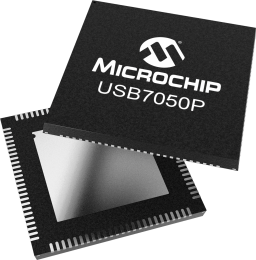
USB7050P4-Port USB 3.2 Gen 1 SmartHub Controller | Integrated Circuits (ICs) | 4 | Active | The Microchip USB7050P [SmartHub](https://www.microchip.com/en-us/products/interface-and-connectivity/usb/usb-hubs/smarthub-ics)™ IC is a low-power, OEM configurable, USB 3.2 Gen 1 hub controller with 4 downstream ports and advanced features for embedded USB applications. The USB7050P is fully compliant with the Universal Serial Bus Revision 3.2 Specification and USB 2.0 Link Power Management Addendum supporting 5 Gbps Super-Speed (SS), 480 Mbps Hi-Speed (HS), 12 Mbps Full-Speed (FS), and 1.5 Mbps Low-Speed (LS) USB downstream devices on all enabled downstream ports.
The USB7050P has been configured to support 3rd party USB Power Delivery with up to 100W of power on the upstream and two of the downstream USB Type-C ports. All the USB7050P USB Type-C ports include internal USB 3.2 Gen 1 multiplexers; no external multiplexer is required for Type-C support. The USB7050P is USB-IF certified as a USB3.2 Gen1 hub (TID).
Targeted for PD (Power Delivery) application, the USB7050P provides the developer control access to the internal USB Type-C™ MUXes.
A SmartHub IC is defined as a USB hub that integrates system levels functions typically associated with a separate MCU or processor. Like the rest of the USB70xx family, the USB7050P SmartHub IC enables communication to other peripherals in addition to USB. Called "I/O Bridging," this capability allows the host to seamlessly interface to peripherals via I2C, SPI or GPIOs over USB. The USB7050P can also enable a downstream device to take control of the USB downstream ports by swapping roles and becoming the host port of the Hub. The USB7050P can also switch between two different hosts if required. This role changing technology, called FlexConnect, can be initiated through hardware or software commands.
The USB7050P also supports legacy USB speeds (HS/FS/LS) through a dedicated USB 2.0 hub controller that is the culmination of six generations of Microchip hub feature controller design and experience with proven reliability, interoperability, and device compatibility. The SuperSpeed hub controller operates in parallel with the USB 2.0 controller, decoupling the 5 Gbps SS data transfers from bottlenecks due to the slower USB 2.0 traffic.
The USB7050P supports downstream battery charging and integrated battery charger detection circuitry supporting the USB-IF Battery Charging (BC1.2) detection method and most Apple® devices. The USB7050P provides the battery charging handshake and supports the following USB-IF BC1.2 charging profiles:
* DCP: Dedicated Charging Port (Power brick with no data)
* CDP: Charging Downstream Port (1.5A with data)
* SDP: Standard Downstream Port (0.5A with data)
* Custom profiles loaded via SPI EEPROM or OTP
MPLAB® Connect Configurator, Microchip’s proprietary software utility, can be used to program On-chip One Time Programmable (OTP) ROM for the USB7050P which stores required register settings to ensure the desired start up configuration at power on. All LED, GPIOs and port control signal pins are under firmware control, allowing for maximum operational flexibility. However, for even more simplicity, the USB7050P can be configured through a series of external low-cost resistor bootstraps. A handful of bootstrap pins are available to enable standard configurations for GPIOs and downstream ports. No OTP programming required.
The USB7050P is also AEC-Q100 certified support traditional data transfer applications that require higher data rates than USB2.0 as well as Multi-Host applications like CarPlay and CarLife that enable the graphical user interface of a phone to be displayed on a vehicle's screen within a car.
Microchip's complimentary and confidential [MicroCHECK](https://www.microchip.com/en-us/support/design-help/design-check-services) design review service, which offers insight from the initial concept to the final PCB layout, is available to customers who are using our products in their projects. You can confidently submit your design materials in a secure and private setting, and our expert engineers will provide individualized feedback to enhance your design. MicroCHECK design review service is subject to Microchip's [Program Terms and Conditions](https://www.microchip.com/en-us/support/design-help/design-check-services/design-check-services-program-terms-and-conditions) and requires a myMicrochip account. |
| Integrated Circuits (ICs) | 2 | Obsolete | |
| Integrated Circuits (ICs) | 4 | Obsolete | |