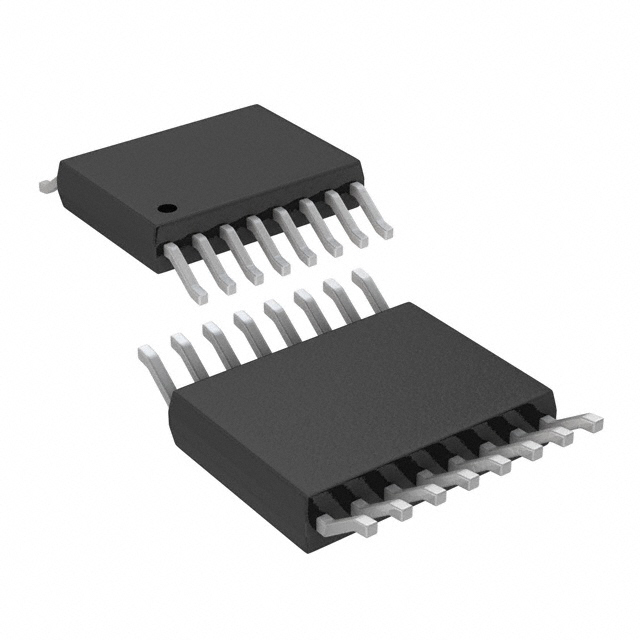
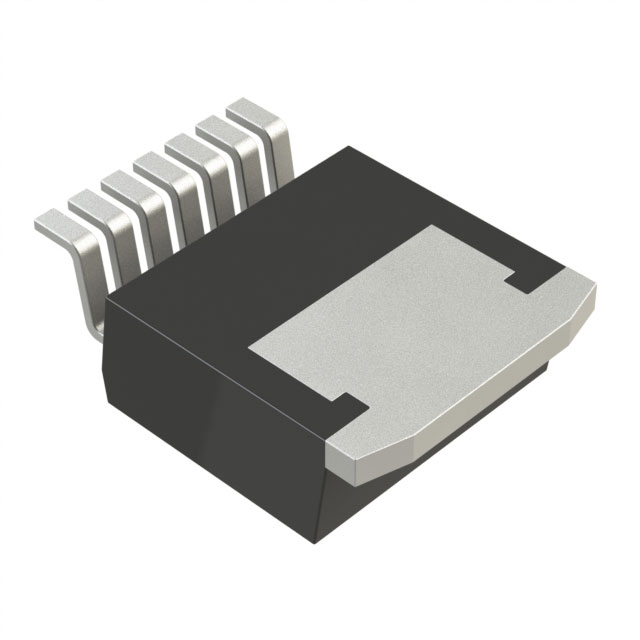
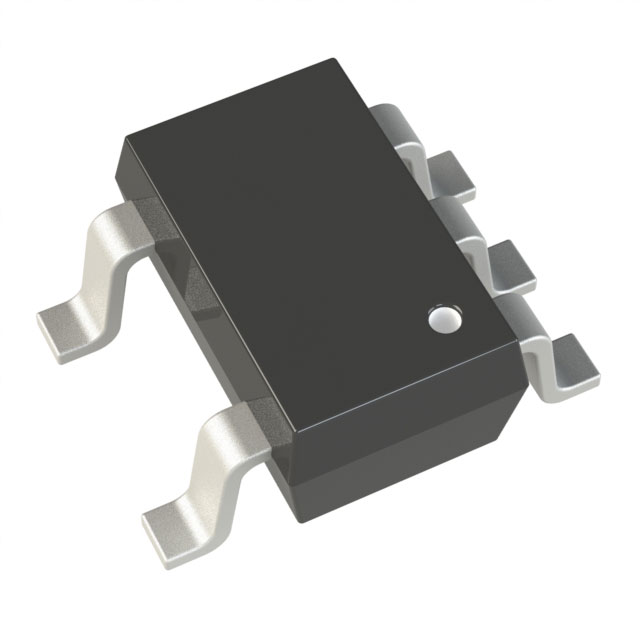
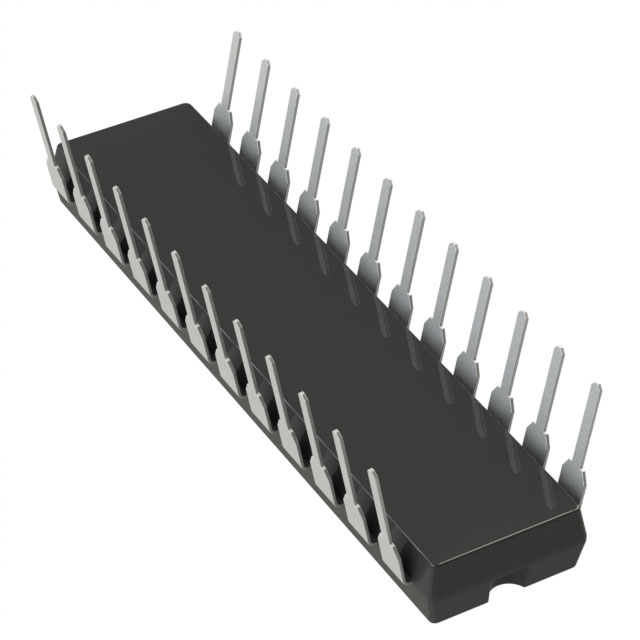
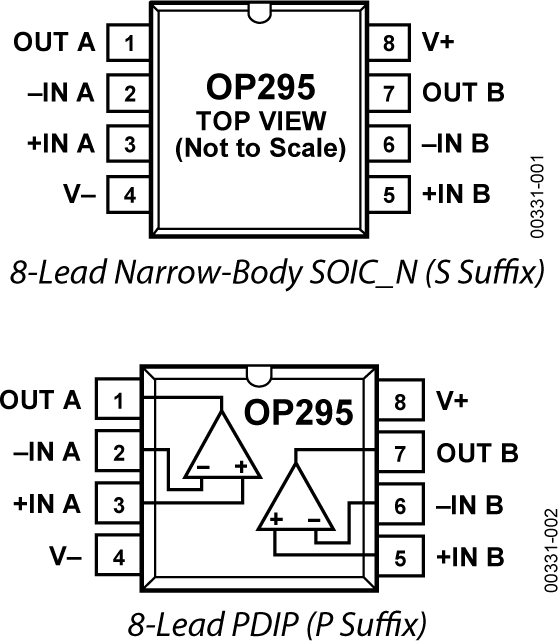
OP295Rail-to-Rail Dual Op Amp | Linear | 1 | Obsolete | Rail-to-rail output swing combined with dc accuracy are the key features of the OP495 quad and OP295 dual CBCMOS operational amplifiers. By using a bipolar front end, lower noise and higher accuracy than those of CMOS designs have been achieved. Both input and output ranges include the negative supply, providing the user with zero-in/zero-out capability. For users of 3.3 V systems such as lithium batteries, the OP295/OP495 are specified for 3 V operation.Maximum offset voltage is specified at 300 μV for 5 V operation, and the open-loop gain is a minimum of 1000 V/mV. This yields performance that can be used to implement high accuracy systems, even in single-supply designs.The ability to swing rail-to-rail and supply 15 mA to the load makes the OP295/OP495 ideal drivers for power transistors and H bridges. This allows designs to achieve higher efficiencies and to transfer more power to the load than previously possible without the use of discrete components.For applications such as transformers that require driving inductive loads, increases in efficiency are also possible. Stability while driving capacitive loads is another benefit of this design over CMOS rail-to-rail amplifiers. This is useful for driving coax cable or large FET transistors. The OP295/OP495 are stable with loads in excess of 300 pF.The OP295 and OP495 are specified over the extended indus-trial (−40°C to +125°C) temperature range. The OP295 is available in 8-lead PDIP and 8-lead SOIC_N surface-mount packages. The OP495 is available in 14-lead PDIP and 16-lead SOIC_W surface-mount packages.ApplicationsBattery-operated instrumentationServo amplifiersActuator drivesSensor conditionersPower supply control |
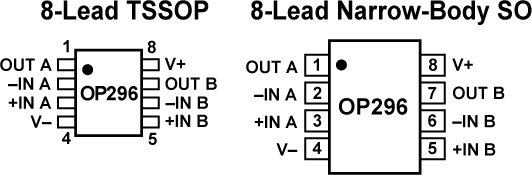
OP296Micropower, RRIO Dual Op Amp | Integrated Circuits (ICs) | 2 | Active | The OP196 family of CBCMOS operational amplifiers features micropower operation and rail-to-rail input and output ranges.The extremely low power requirements and guaranteed operation from +3 V to +12 V make these amplifiers perfectly suited to monitor battery usage and to control battery charging. Their dynamic performance, including 26 nV/(root)Hz voltage noise density, recommends them for battery-powered audio applications. Capacitive loads to 200 pF are handled without oscillation.The OP196/OP296/OP496 are specified over the HOT extended industrial (-40°C to +125°C) temperature range. +3 V operation is specified over the 0°C to +125°C temperature range. The single OP196 and the dual OP296 are available in 8-pin plastic DIP and SO-8 surface mount packages. The quad OP496 is available in 14-pin plastic DIP and narrow SO-14 surface mount packages. Check factory for availability of the OP296 and OP496 in the TSSOP package. |
OP297Low Bias Current Precision (Dual) Operational Amplifier | Instrumentation, Op Amps, Buffer Amps | 2 | Obsolete | The OP297 is the first dual op amp to pack precision performance into the space-saving, industry standard 8-pin SO package. Its combination of precision with low power and extremely low input bias current makes the dual OP297 useful in a wide variety of applications.Precision performance of the OP297 includes very low offset, under 50µV, and low drift, below 0.6µV/°C. Open-loop gain exceeds 2000V/mV insuring high linearity in every application. Errors due to common-mode signals are eliminated by the OP297's common-mode rejection of over 120 dB. The OP297's power supply rejection of over 120dB minimizes offset voltage changes experienced in battery powered systems. Supply current of the OP297 is under 625µA per amplifier and it can operate with supply voltages as low a ±2V.The OP297 utilizes a super-beta input stage with bias current cancellation to maintain picoamp bias currents at all temperatures. This is in contrast to FET input op amps whose bias currents start in the picoamp range of 25°C, but double for every 10°C rise in temperature, to reach the nanoamp range above 85°C. Input bias current of the OP297 is under 100pA at 25°C and is under 450pA over the military temperature range.Combining precision, low power and low bias current, the OP297 is ideal for a number of applications including instrumentation amplifiers, log amplifiers, phot-diode preamplifiers and long-term integrators. For a single device, see the OP97; for a quad, see the OP497. |
OP37-LTCLow Noise, Precision, High Speed Operational Amplifier (AVCL≥5) | Linear | 7 | Active | The OP-27/OP-37 series of operational amplifiers combine outstanding noise performance with excellent precision and high speed specifications. The wideband noise is only 3nV/√Hz, and with the 1/f noise corner at 2.7Hz, low noise is maintained for all low frequency instrumentation applications. Precision DC specifications match or exceed the best available op amps: offset voltage is 10µV, drift with temperature and time are 0.2µV/°C and 0.2uv/month, respactively; common mode rejection is 126dB, voltage gain is two million. The unity gain compensated OP-27 is an order of magnatude faster than other precision op amps. The decompensated OP-37 is even faster at a gain-bandwidth product of 63MHz an 17V/usec slew rate. These characteristics plus our advanced process and test techniques make the OP-27/OP-37 an excellent choice for performance and reliability in all low noise, precision amplifier applications. In addition, ADI's OP-37 is completely latch-up free in high gain, large capacitive feedback configurations. The acurate, microvolt, low noise signal handling capabilities of the OP-27/OP-37 are taken advantage of in the multiplexed thermocouple application shown.For applications requiring higher performance see the LT1007 and LT1037 data sheets.ApplicationsLow Level Transducer AmplifierPrecision Threshold DetectorsTape Head PreamplifiersMicrophone PreamplifiersDirect Couple Audio Gain Stages |
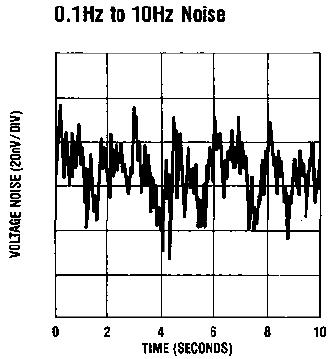
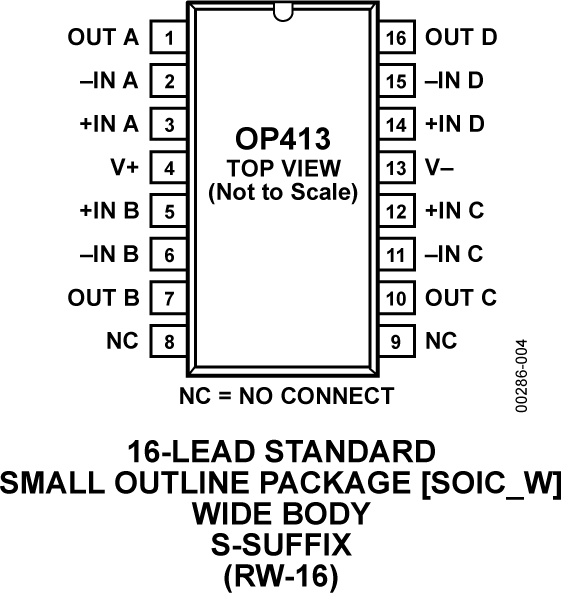
OP413Low Noise, Low Drift Single-Supply Operational Amplifier (Quad) | Integrated Circuits (ICs) | 3 | Active | The OPx13 family of single-supply operational amplifiers features both low noise and drift. It has been designed for systems with internal calibration. Often these processor-based systems are capable of calibrating corrections for offset and gain, but they cannot correct for temperature drifts and noise. Optimized for these parameters, the OPx13 family can be used to take advantage of superior analog performance combined with digital correction. Many systems using internal calibration operate from unipolar supplies, usually either 5 V or 12 V. The OPx13 family is designed to operate from single supplies from 4 V to 36 V and to maintain its low noise and precision performance.The OPx13 family is unity gain stable and has a typical gain bandwidth product of 3.4 MHz. Slew rate is in excess of 1 V/μs. Noise density is a very low 4.7 nV/√Hz, and noise in the 0.1 Hz to 10 Hz band is 120 nV p-p. Input offset voltage is guaranteed and offset drift is guaranteed to be less than 0.8 μV/°C. Input common-mode range includes the negative supply and to within 1 V of the positive supply over the full supply range. Phase reversal protection is designed into the OPx13 family for cases where input voltage range is exceeded. Output voltage swings also include the negative supply and go to within 1 V of the positive rail. The output is capable of sinking and sourcing current throughout its range and is specified with 600 Ω loads.Digital scales and other strain gage applications benefit from the very low noise and low drift of the OPx13 family. Other applications include use as a buffer or amplifier for both analog-to-digital (ADC) and digital-to-analog (DAC) sigma-delta converters. Often these converters have high resolutions requiring the lowest noise amplifier to utilize their full potential. Many of these converters operate in either single-supply or low-supply voltage systems, and attaining the greater signal swing possible increases system performance.The OPx13 family is specified for single 5 V and dual ±15 V operation over the XIND—extended industrial temperature range (–40°C to +85°C). They are available in PDIP and SOIC surface-mount packages.ApplicationsDigital scalesMultimediaStrain gagesBattery-powered instrumentationTemperature transducer amplifier |
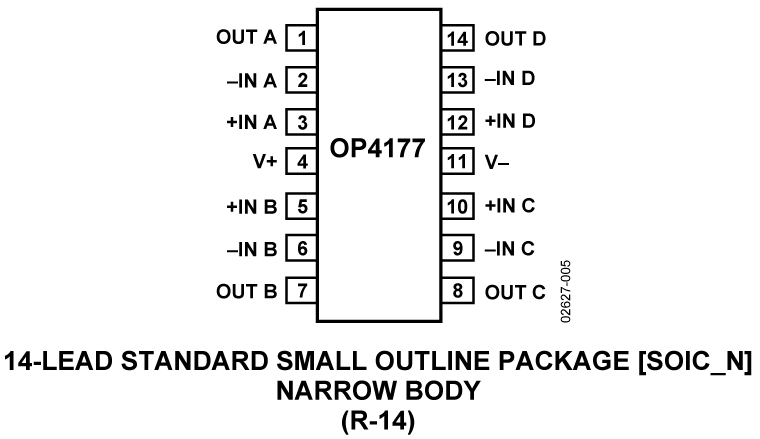
OP4177Precision Low Noise, Low Input Bias Current Quad Operational Amplifier | Integrated Circuits (ICs) | 2 | Obsolete | The OPx177 family consists of very high precision, single, dual, and quad amplifiers featuring extremely low offset voltage and drift, low input bias current, low noise, and low power consump-tion. Outputs are stable with capacitive loads of over 1000 pF with no external compensation. Supply current is less than 500 μA per amplifier at 30 V. Internal 500 Ω series resistors protect the inputs, allowing input signal levels several volts beyond either supply without phase reversal.Unlike previous high voltage amplifiers with very low offset voltages, the OP1177 (single) and OP2177 (dual) amplifiers are available in tiny 8-lead surface-mount MSOP and 8-lead narrow SOIC packages. The OP4177 (quad) is available in TSSOP and 14-lead narrow SOIC packages. Moreover, specified performance in the MSOP and the TSSOP is identical to performance in the SOIC package. MSOP and TSSOP are available in tape and reel only.The OPx177 family offers the widest specified temperature range of any high precision amplifier in surface-mount packaging. All versions are fully specified for operation from −40°C to +125°C for the most demanding operating environments.Applications for these amplifiers include precision diode power measurement, voltage and current level setting, and level detection in optical and wireless transmission systems. Additional applications include line-powered and portable instrumentation and controls—thermocouple, RTD, strain-bridge, and other sensor signal conditioning—and precision filters.ApplicationsWireless base station control circuitsOptical network control circuitsInstrumentationSensors and controlsThermocouplesResistor thermal detectors (RTDs)Strain bridgesShunt current measurementsPrecision filters |
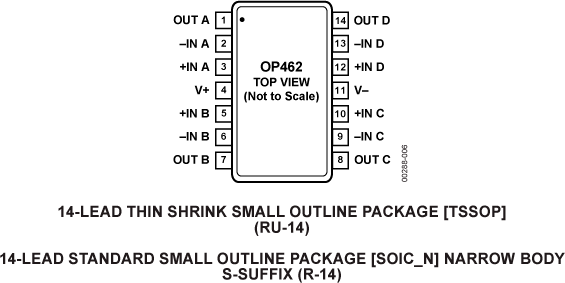
OP46215 MHzRail-to-Rail Quad Op Amp | Instrumentation, Op Amps, Buffer Amps | 3 | Active | The OP162 (single), OP262 (dual), and OP462 (quad) rail-to-rail 15 MHz amplifiers feature the extra speed new designs require, with the benefits of precision and low power operation. With their incredibly low offset voltage of 45 µV (typical) and low noise, they are perfectly suited for precision filter applications and instrumentation. The low supply current of 500 µA (typical) is critical for portable or densely packed designs. In addition, the rail-to-rail output swing provides greater dynamic range and control than standard video amplifiers.These products operate from single supplies as low as 2.7 V to dual supplies of ±6 V. The fast settling times and wide output swings recommend them for buffers to sampling A/D converters. The output drive of 30 mA (sink and source) is needed for many audio and display applications; more output current can be supplied for limited durations. The OPx62 family is specified over the extended industrial temperature range (–40°C to +125°C). The single OP162 amplifiers are available in 8-lead SOIC package. The dual OP262 amplifiers are available in 8 lead SOIC and TSSOP packages. The quad OP462 amplifiers are available in 14-lead, narrow-body SOIC and TSSOP packages. |
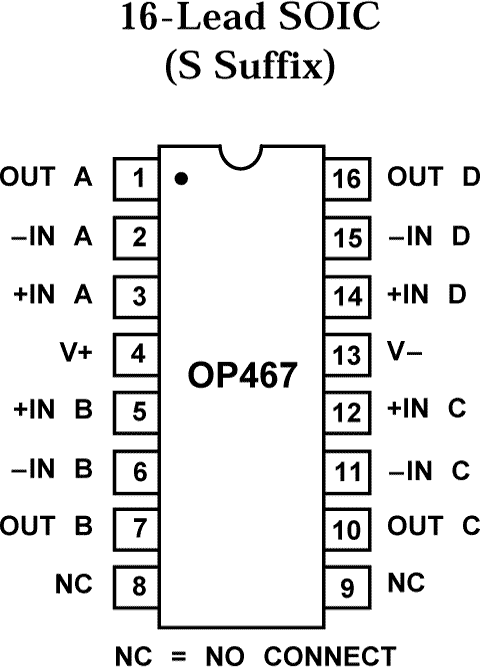
OP467Quad Precision, High Speed Operational Amplifier | Amplifiers | 1 | Active | The OP467 is a quad, high speed, precision operational amplifier. It offers the performance of a high speed op amp combined with the advantages of a precision op amp in a single package. The OP467 is an ideal choice for applications where, traditionally, more than one op amp was used to achieve this level of speed and precision.The internal compensation of the OP467 ensures stable unity-gain operation, and it can drive large capacitive loads without oscillation. With a gain bandwidth product of 28 MHz driving a 30 pF load, output slew rate is 170 V/μs, and settling time to 0.01% in less than 200 ns, the OP467 provides excellent dynamic accuracy in high speed data acquisition systems. The channel-to-channel separation is typically 60 dB at 10 MHz.The dc performance of the OP467 includes less than 0.5 mV of offset, a voltage noise density below 6 nV/√Hz, and a total supply current under 10 mA. The common-mode rejection ratio (CMRR) is typically 85 dB. The power supply rejection ratio (PSRR) is typically 107 dB. PSRR is maintained to better than 40 dB with input frequencies as high as 1 MHz. The low offset and drift plus high speed and low noise make the OP467 usable in applications such as high speed detectors and instrumentation.The OP467 is specified for operation from ±5 V to ±15 V over the extended industrial temperature range (−40°C to +85°C) and is available in a 14-lead PDIP, a 14-lead CERDIP, a 16-lead SOIC, and a 20-terminal LCC.Contact your local sales office for the MIL-STD-883 data sheet and availability.ApplicationsHigh speed image display driversHigh frequency active filtersFast instrumentation amplifiersHigh speed detectorsIntegratorsPhoto diode preamps |
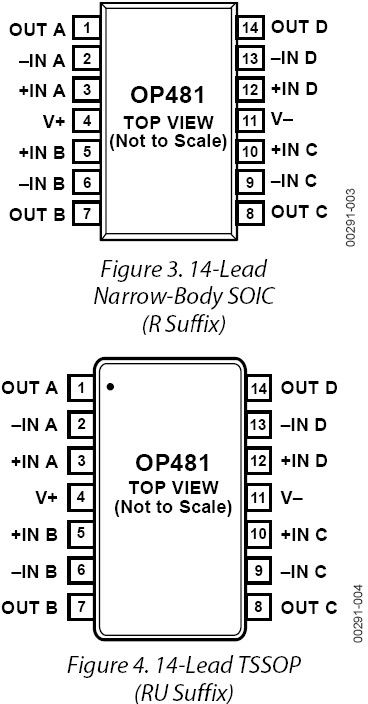
OP481Ultralow Power, Rail-to-Rail Output Operational Amplifier (Quad) | Linear | 1 | Obsolete | The OP281 and OP481 are dual and quad ultralow power single-supply amplifiers featuring rail-to-rail outputs. Each operates from supplies as low as 2.0 V and is specified at +3 V and +5 V single supplies as well as ±5 V dual supplies.Fabricated on Analog Devices’ CBCMOS process, the OP281/OP481 feature a precision bipolar input and an output that swings to within millivolts of the supplies, continuing to sink or source current up to a voltage equal to the supply voltage.Applications for these amplifiers include safety monitoring, portable equipment, battery and power supply control, and signal conditioning and interfacing for transducers in very low power systems.The output’s ability to swing rail-to-rail and not increase supply current when the output is driven to a supply voltage enables the OP281/OP481 to be used as comparators in very low power systems. This is enhanced by their fast saturation recovery time. Propagation delays are 250 μs.The OP281/OP481 are specified over the extended industrial temperature range (−40°C to +85°C). The OP281 dual amplifier is available in 8-lead SOIC surface-mount and TSSOP packages. The OP481 quad amplifier is available in narrow 14-lead SOIC and TSSOP packages.ApplicationsComparatorBattery-powered instrumentationSafety monitoringRemote sensorsLow voltage strain gage amplifiers |
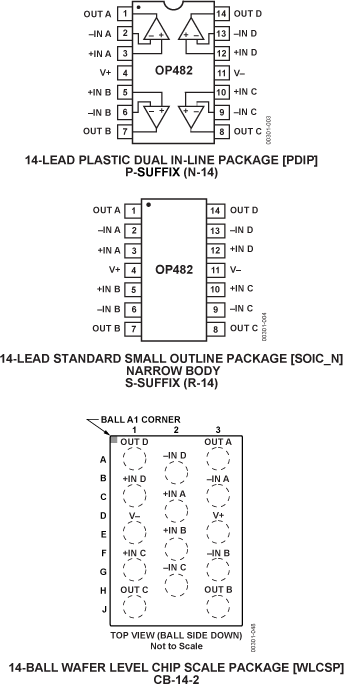
OP482Low Power, High Speed JFET Quad Operational Amplifier | Integrated Circuits (ICs) | 3 | Active | The OP282/OP482 dual and quad operational amplifiers feature excellent speed at exceptionally low supply currents. Slew rate exceeds 7 V/µs with supply current under 250 µA per amplifier. these unity gain stable amplifiers have a typical gain bandwidth of 4 MHz.The JFET input stage of the OP282/OP482 insures bias current is typically a few piocamps and below 500 pA over the full temperature range. Offset voltage is under 3 mV for the dual and under 4 mV for the quad.With a wide output swing, within 1.5 volts of each supply, low power consumption and high slew rate, the OP282/OP482 are ideal for battery-powered systems or power restricted applications. An input common-mode range that includes the positive supply makes the OP-282/OP-482 an excellent choice for high-side signal conditioning.The OP282/OP482 are specified over the extended industrial temperature range. Both dual and quad amplifiers are available in plastic and ceramic DIP plus SOIC surface mount packages. |