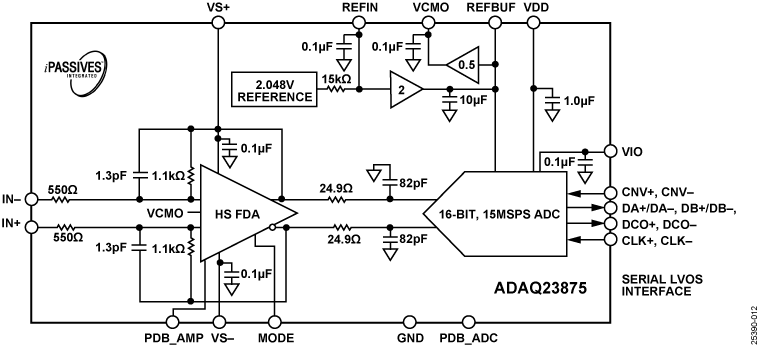
ADAQ2387516-Bit, 15 MSPS, μModule Data Acquisition Solution | Integrated Circuits (ICs) | 1 | Active | The ADAQ23875 is a precision, high speed, μModule®data acquisition solution that reduces the development cycle of a precision measurement systems by transferring the design burden of component selection, optimization, and layout from the designer to the device.Using system-in-package (SIP) technology, the ADAQ23875 reduces end system component count by combining multiple common signal processing and conditioning blocks in a single device, solving many design challenges. These blocks include a low noise, fully differential analog-to-digital converter (ADC) driver (FDA), a stable reference buffer, and a high speed, 16-bit, 15 MSPS successive approximation register (SAR) ADC.Using Analog Devices, Inc., iPassives®technology, the ADAQ23875 also incorporates crucial passive components with superior matching and drift characteristics to minimize temperature dependent error sources and to offer optimized performance (see Figure 1). The fast settling of the ADC driver stage, with fully differential or single-ended to differential input and no latency of the SAR ADC, provides a unique solution for high channel count multiplexed signal chain architectures and control loop applications.The small footprint, 9 mm × 9 mm CSP_BGA package enables smaller form factor instruments without sacrificing performance. Single, 5 V supply operation is possible while achieving optimum performance from the device. The ADAQ23875 features a serial low voltage differential signaling (LVDS) digital interface with one-lane or two-lane output modes, allowing the user to optimize the interface data rate for each application. The specified operation of the μModule is from −40°C to +85°C.APPLICATIONSATEData acquisitionHardware in the Loop (HiL)Power analyzersNondestructive test (acoustic emissions)Mass spectrometryTravelling wave fault locationMedical imaging and instrumentsUltrasonic flow meters |
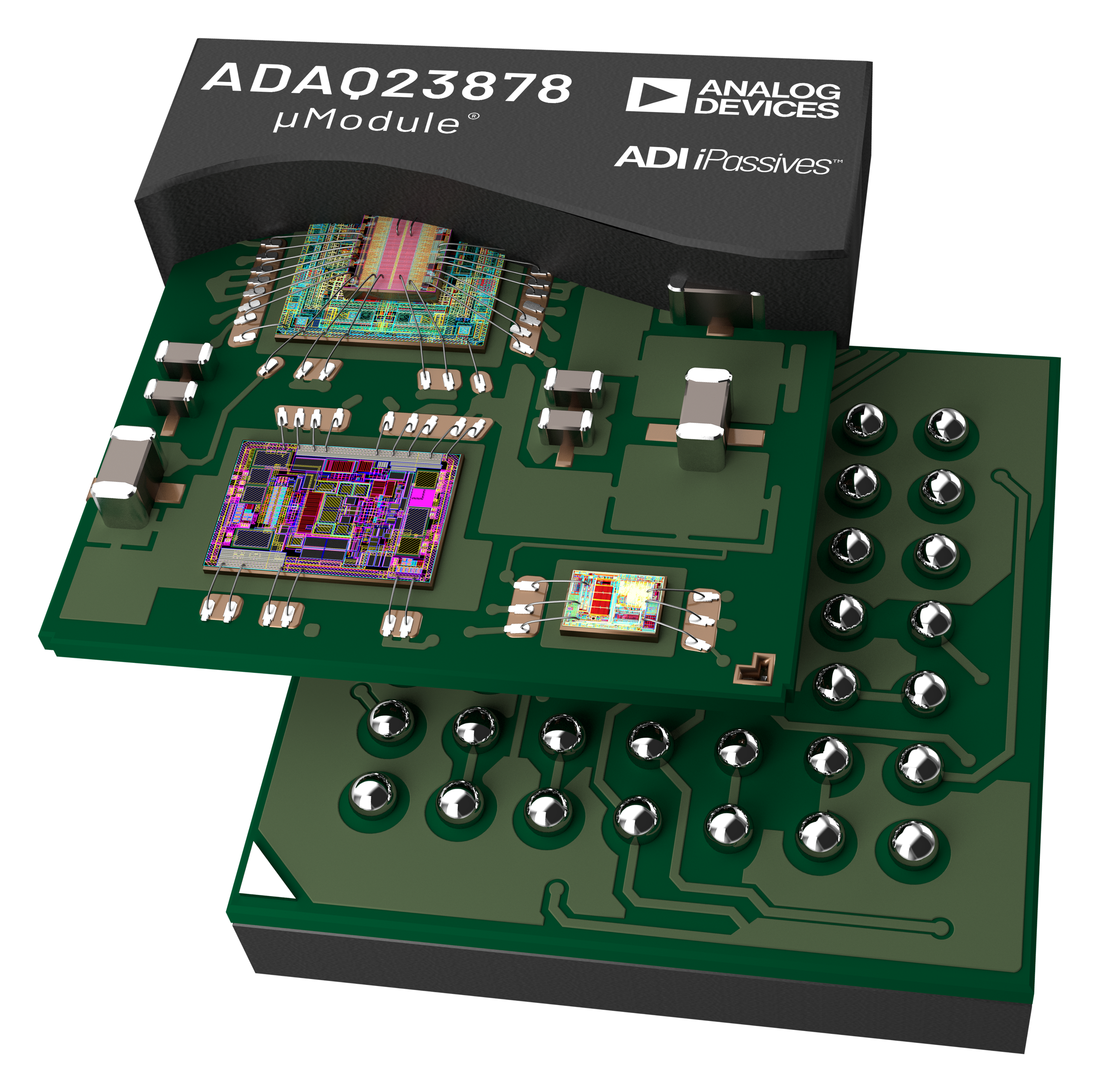
ADAQ2387818-Bit, 15 MSPS, μModule Data Acquisition Solution | ADCs/DACs - Special Purpose | 1 | Active | The ADAQ23878 is a precision, high speed, μModule®data acquisition solution that reduces the development cycle of a precision measurement systems by transferring the design burden of component selection, optimization, and layout from the designer to the device.Using System-in-Package (SIP) technology, the ADAQ23878 reduces end system component count by combining multiple common signal processing and conditioning blocks in a single device, including a low noise, fully differential ADC driver (FDA), a stable reference buffer, and a high speed, 18-bit, 15 MSPS successive approximation register (SAR) ADC.The ADAQ23878 also incorporates the critical passive components with superior matching and drift characteristics using Analog Devices, Inc., iPassive®technology to minimize temperature dependent error sources and to offer optimized performance. The fast settling of the ADC driver stage and no latency of the SAR ADC provide a unique solution for high channel count multiplexed signal chain architectures and control loop applications.The small footprint, 9 mm × 9 mm BGA package enables smaller form factor instruments without sacrificing performance. The system integration solves many design challenges while the device still provides the flexibility of a configurable ADC driver feedback loop to allow gain or attenuation adjustments, as well as fully differential or single-ended to differential input. A single 5 V supply operation is possible while achieving optimum performance from the device.The ADAQ23878 features a serial low voltage differential signaling (LVDS) digital interface with one-lane or two-lane output modes, allowing the user to optimize the interface data rate for each application. The specified operation of the ADAQ23878 is from −40°C to +85°C.APPLICATIONSAutomatic test equipmentData acquisitionHardware in the Loop (HiL)Power analyzersNon-destructive test (acoustic emissions)Mass spectrometryTravelling wave fault locationMedical imaging and instruments |
| Evaluation Boards | 1 | Active | |
ADAQ400318-Bit, 2 MSPS, μModule Data Acquisition Solution | Analog to Digital Converters (ADC) | 2 | Active | The ADAQ4003 is a μModule®precision data acquisition (DAQ), signal chain solution that reduces the development cycle of a precision measurement system by transferring the signal chain design challenge of component selection, optimization, and layout from the designer to the device.Using system-in-package (SIP) technology, the ADAQ4003 reduces end system component count by combining multiple common signal processing and conditioning blocks into a single device. These blocks include a high resolution 18-bit, 2 MSPS successive approximation register (SAR), analog-to-digital converter (ADC), a low noise, fully differential ADC driver amplifier (FDA), and a stable reference buffer.Using Analog Devices, Inc., iPassives®technology, the ADAQ4003 also incorporates crucial passive components with superior matching and drift characteristics to minimize temperature dependent error sources and to offer optimized performance (see Figure 1 in the data sheet). Housing this signal chain solution in a small, 7 mm × 7 mm, 0.80 mm pitch, 49-ball CSP_BGA enables compact form factor designs without sacrificing performance and simplifies end system bill of materials management. This level of system integration makes the ADAQ4003 much less sensitive to printed circuit board (PCB) layout while still providing flexibility to adapt to a wide range of signal levels.The serial peripheral interface (SPI)-compatible, serial user interface is compatible with 1.8 V, 2.5 V, 3 V, or 5 V logic, using a separate VIO supply. Specified operation of ADAQ4003 is from −40°C to +125°C.APPLICATIONSAutomatic test equipmentMachine automationProcess controlsMedical instrumentationDigital control loops |
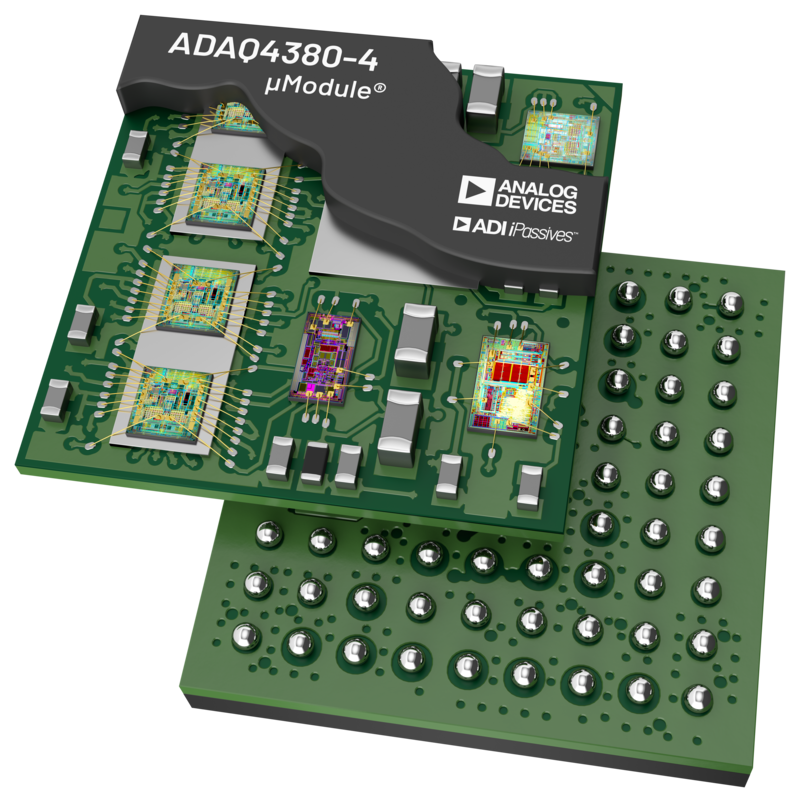
ADAQ4380-4Quad, 16-bit, 4 MSPS, Simultaneous Sampling, μModule Data Acquisition Solution | Data Acquisition | 1 | Active | The ADAQ4380-4 is a quad-channel precision data acquisition (DAQ) signal chain μModule solution that reduces the development cycle of a precision measurement system by transferring the signal chain design challenges of component selection, optimization, and layout from the designer to the device.Using system-in-package (SIP) technology, the ADAQ4380-4 reduces end system component count by combining multiple common signal processing and conditioning blocks into a single device. These blocks include a quad-channel, high resolution 16-bit, 4 MSPS simultaneous sampling SAR ADC, low noise, fully differential ADC driver amplifier, a 3.3 V precision voltage reference, low-noise buffer amplifiers, and low-dropout linear regulator.The ADAQ4380-4 has an on-chip oversampling blocks to improve the dynamic range and reduce noise at lower bandwidths. The oversampling can boost up to two bits of added resolution. It provides the flexibility of a configurable ADC driver feedback loop to allow four gain and attenuation adjustments, and accept both fully differential or single-ended to differential input configuration.Using Analog Devices, Inc. iPassives®technology, the ADAQ4380-4 incorporates critical passive components with superior matching and drift characteristics to minimize temperature dependent error sources and to offer optimized signal chain performance. Housed in a small 8 mm × 8 mm × 0.8 mm pitch, 81- ball CSP_BGA package, the ADAQ4380-4 enables compact design without sacrificing performance and simplifies end system bill of materials management. The ADAQ4380-4's optimum performance is guaranteed with a single 5 V supply operation, all the required bypass and decoupling capacitors are included inside the package. The level of ADAQ4380-4 system integration solves many design challenges, which enables a compact and simple solution for a multichannel application.The conversion result can clock out simultaneously through 4-wire mode for faster throughput or through 1-wire serial mode when slower throughput is allowed. The ADAQ4380-4 is compatible with 1.8 V, 2.5 V, and 3.3 V interfaces using the separate logic supply. The ADAQ4380-4 is specified to operate over a temperature range of −40°C to +105°C.ApplicationsLab Grade Battery Test SystemMotor Control Current SenseMotor Control Position FeedbackSonarPower Quality MonitoringData Acquisition SystemErbium-Doped Fiber Amplifier (EDFA) applicationsI and Q DemodulationTable 1. μMODULE®Data Acquisition SolutionsType500 kSPS1 MSPS to 2 MSPS4 MSPS14-bitADAQ4381-416-bitADAQ7988ADAQ4370-4ADAQ7980ADAQ4001ADAQ4380-418-bitADAQ4003 |
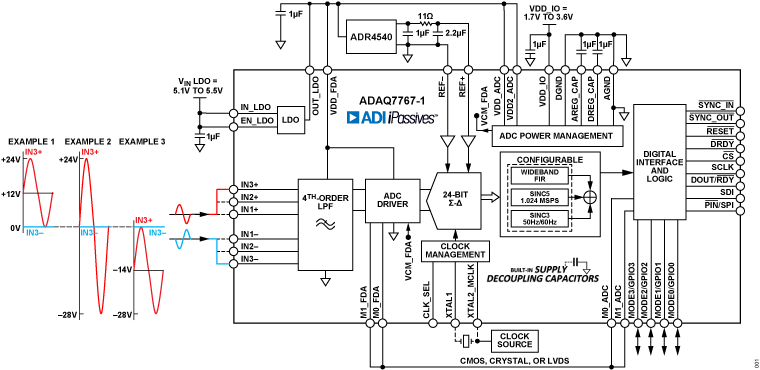
ADAQ7767-1Flexible Resistive Input, Anti-Alias, 24-Bit, 1 MSPS, μModule DAQ Solution | Data Acquisition | 1 | Active | The ADAQ7767-1 is a 24-bit precision data acquisition (DAQ) μModule®system that encapsulates signal conditioning, conversion, and processing blocks into one system in package (SiP) design that enables rapid development of highly compact, high performance precision DAQ systems..The ADAQ7767-1 consists of the following:A fourth order, low noise, linear phase anti-aliasing filter (AAF)A low noise, low distortion, high bandwidth, gain-selectable ADC driver plus an optional linearity boost bufferA high-performance medium bandwidth 24-bit sigma delta ADC with programmable digital filterA low noise, low dropout (LDO) linear regulatorReference buffersCritical passive components required for the signal chainThe ADAQ7767-1 supports a wide variety of input types, which include unipolar and bipolar single-ended, pseudo differential, and differential signals, with a maximum differential range of ±28.672 V and a common-mode voltage range of −16 V to +12 V using IN3. With the precision of Analog Devices iPASSIVES™ technology, the ADAQ7767-1 performs with excellent common-mode rejection ratio (CMRR). The three pairs of pin-selectable gain settings offer additional system dynamic range and improved signal chain noise performance with input signals of lower amplitude. In applications requiring high input impedance, the ADAQ7767-1 allows the customer to choose their preferred input amplifier.A fourth-order low-pass analog filter combined with the user-programmable digital filter ensures that the signal chain is protected against the high frequency noise and out of band tones presented at the input node from aliasing back into the band of interest. The analog low pass filter is carefully designed to achieve high phase linearity and maximum in-band magnitude response flatness. Constructed with iPASSIVES technology, the resistor network used within the analog low-pass filter possess superior resistance matching in both absolute values and over temperature. As a result, the signal chain performance is maintained with minimum drift over temperature, and the ADAQ7767-1 has an excellent device-to-device phase matching performance.A high-performance analog-to-digital (ADC) driver amplifier ensures the full settling of the ADC input at the maximum sampling rate. The driver circuit is designed to have minimum additive noise, error, and distortion while maintaining stability. The fully differential architecture helps maximizing the signal chain dynamic range.The ADC inside the ADAQ7767-1 is a high performance, 24-bit precision, single-channel, Σ-Δ converter with excellent AC performance and DC precision, and a throughput rate of 1 MSPS from a 16.384 MHz MCLK. The device includes an optional linearity boost buffer that can further improve the signal chain linearity.The ADAQ7767-1 is specified with an input reference voltage of 4.096 V, but the device can support reference voltages ranging from VDD_ADC down to 1 V.The ADAQ7767-1 has two types of reference buffers: a precharge reference buffer to ease the reference input driving requirement, or a full reference buffer to provide a high impedance reference input. Both buffers are optional and can be turned off through register configuration.The ADAQ7767-1 supports three clock input types: crystal, complementary metal-oxide semiconductor (CMOS), or low voltage differential signaling (LVDS).Three types of digital low pass filters are available on the ADAQ7767-1. The wideband, low ripple, finite impulse response (FIR) filter has a filter profile similar to an ideal brick wall filter, making it a great fit for doing frequency analysis. The sinc5 filter has a low latency path with a smooth step response while maintaining a good level of aliasing rejection. This filter supports an output data rate up to 1.024 MSPS from a 16.384 MHz MCLK, making the sinc5 filter ideal for low latency data capturing and time domain analysis. The sinc3 filter supports a wide decimation ratio and can produce output data rates down to 50 SPS from a 16.384 MHz controller clock signal (MCLK). This combined with the simultaneous 50 Hz/60 Hz rejection post filter makes the sinc3 filter especially useful for precision DC measurement. All three digital filters on the ADAQ7767-1 are FIR filters with linear phase response. The bandwidth of the filters, which directly corresponds to the bandwidth of the DAQ signal chain, are fully programmable through register configuration.The ADAQ7767-1 supports two device configuration methods. The user has the option to choose to configure the device via register write through its serial peripheral interface (SPI) or through a simple hardware pin strapping method to configure the device to operate under a number of predefined modes.A single SPI supports both the register access and the sample data readback functions. The ADAQ7767-1 always acts as a SPI target. Multiple interface modes are supported with a minimum of three input and output channels required to communicate with the device.The ADAQ7767-1 features a suite of internal diagnostic functions that can detect a broad range of errors during operation to help improve system reliability.The ADAQ7767-1 supply connections can be simplified by using its internal low dropout (LDO) regulator. Note that, 0.1 μF decoupling capacitors are also integrated to further reduce the number of discrete components.Each functional block of the device can be put into standby mode or power-down mode, enabling the ADAQ7767-1 to have a total power consumption less than 0.5 mW.The ADAQ7767-1 has an operating temperature range of −40°C to +105°C and is available in a 12 mm x 6 mm, 84-ball CSP_BGA package with 0.8 mm ball pitch, making it suitable for multiple-channel applications. The footprint of the ADAQ7767-1 is eight times smaller compared to the footprint of the same solution using discrete components.APPLICATIONSUniversal input measurement platformElectrical Test and MeasurementSound and Vibration, Acoustic and Material Science, research and developmentControl and Hardware in Loop VerificationCondition monitoring for predictive maintenanceAudio TestProtected by U.S. Patent 10,680,633 B1Protected by U.S. Patent 10,979,062 B2 |
| Analog to Digital Converters (ADCs) | 1 | Active | |
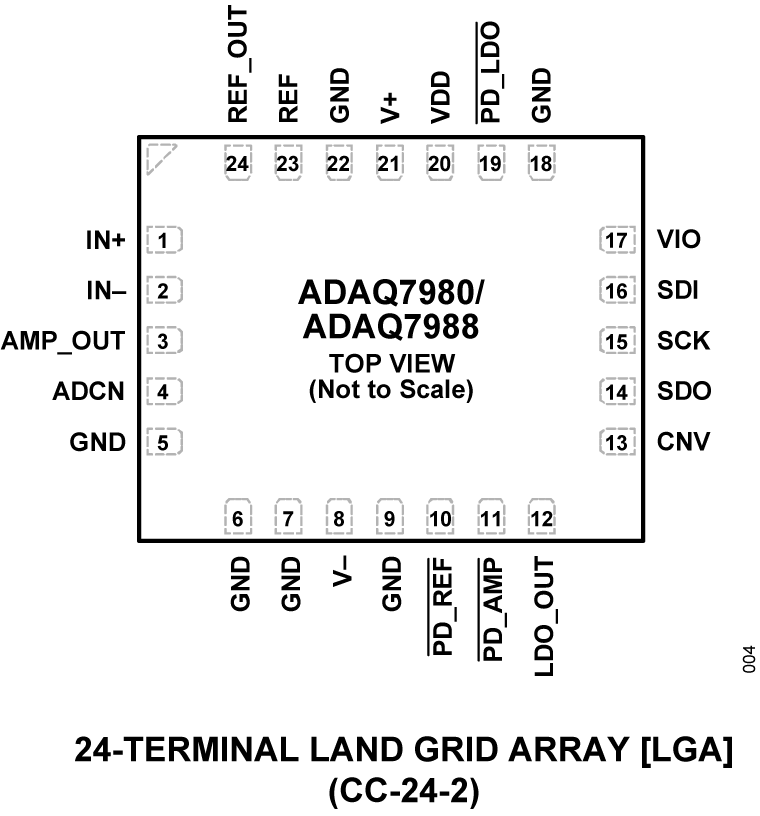
ADAQ798016-Bit, 1 MSPS, Integrated Data Acquisition Subsystem | Analog to Digital Converters (ADC) | 2 | Active | The ADAQ7980/ADAQ7988are 16-bit analog-to-digital converter (ADC) μModule®data acquisition systems that integrate four common signal processing and conditioning blocks into a system in package (SiP) design that supports a variety of applications. These devices contain the most critical passive components, eliminating many of the design challenges associated with traditional signal chains that use successive approximation register (SAR) ADCs. These passive components are crucial to achieving the specified device performance.The ADAQ7980/ADAQ7988 contain a high accuracy, low power, 16-bit SAR ADC, a low power, high bandwidth, high input impedance ADC driver, a low power, stable reference buffer, and an efficient power management block. Housed within a tiny, 5 mm × 4 mm LGA package, these products simplify the design process for data acquisition systems. The level of system integration of the ADAQ7980/ADAQ7988 solves many design challenges, while the devices still provide the flexibility of a configurable ADC driver feedback loop to allow gain and/or common-mode adjustments. A set of four device supplies provides optimal system performance; however, single-supply operation is possible with minimal impact on device operating specifications.The ADAQ7980/ADAQ7988 integrate within a compact, integrated circuit (IC)-like form factor key components commonly used in data acquisition signal chain designs. The μModule family transfers the design burden of component selection, optimization, and layout from designer to device, shortening overall design time, system troubleshooting, and ultimately improving time to market.The serial peripheral interface (SPI)-compatible serial interface features the ability to daisy-chain multiple devices on a single, 3-wire bus and provides an optional busy indicator. The user interface is compatible with 1.8 V, 2.5 V, 3 V, or 5 V logic.Specified operation of these devices is from −55°C to +125°C.APPLICATIONSAutomated test equipment (ATE)Battery powered instrumentationCommunicationsData acquisitionProcess controlMedical instruments |
| RF and Wireless | 2 | Active | |
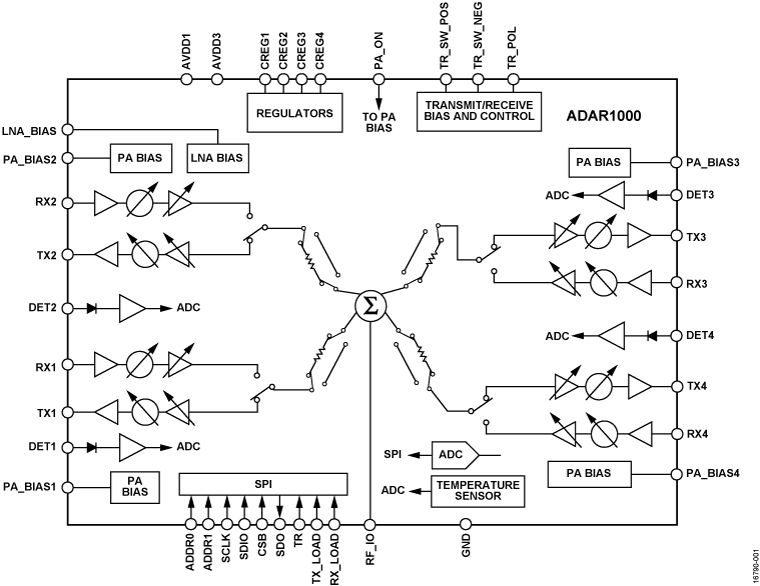
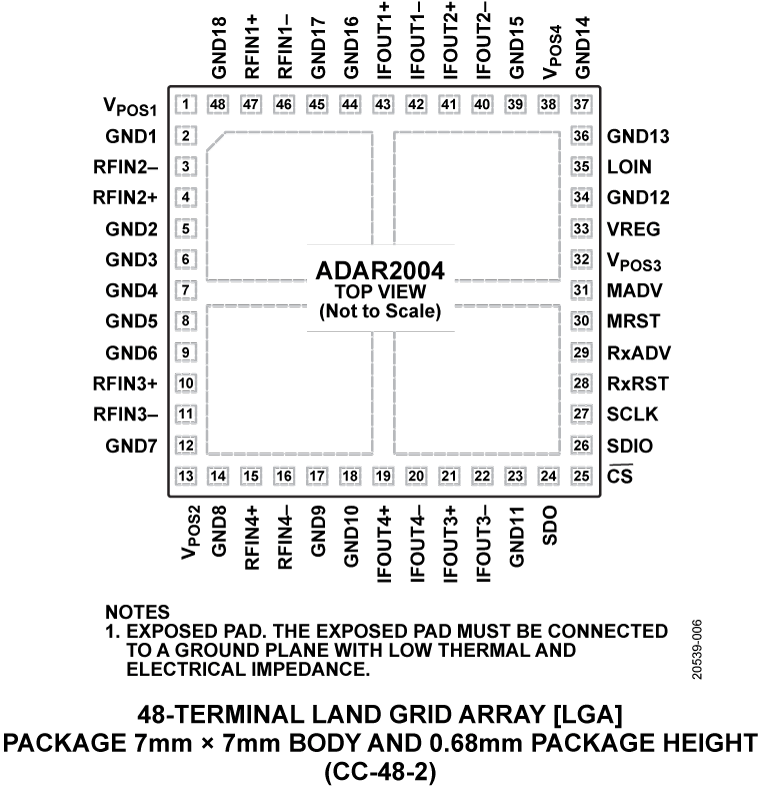
ADAR200410 GHz to 40 GHz, 4-Channel Rx Mixer with 4× LO Multiplier/Filter | RF Evaluation and Development Kits, Boards | 2 | Active | The ADAR2004 is a 4-channel receiver IC that is optimized for millimeter wave body scanning applications. Accepting differential input signals from 10 GHz to 40 GHz, the ADAR2004 provides a low intermediate frequency (IF) output up to 800 MHz. Each receive channel also has independent gain control.The mixer local oscillator (LO) path includes a 4× multiplier requiring an applied LO frequency between 2.4 GHz and 10.1 GHz. The 4× multiplier block includes a programmable filter that helps keep harmonics down before reaching the mixer.Two programmable state machines are included to facilitate simple configuration, control, and fast switching of the frequency multiplier, filter, and receiver sections. These sequencers are programmed through the serial peripheral interface (SPI) and are then operated by pulsed inputs (reset and advance).The ADAR2004 requires only a single 2.5 V supply with power consumption of 910 mW with all channels turned on.The ADAR2004 is available in a 7 × 7 mm, 48-terminal LGA package and is specified from −40°C to +85°C.APPLICATIONSMillimeter wave imagingSecurityMedicalIndustrialMultichannel receivers |