| Analog to Digital Converters (ADCs) Evaluation Boards | 14 | Active | |
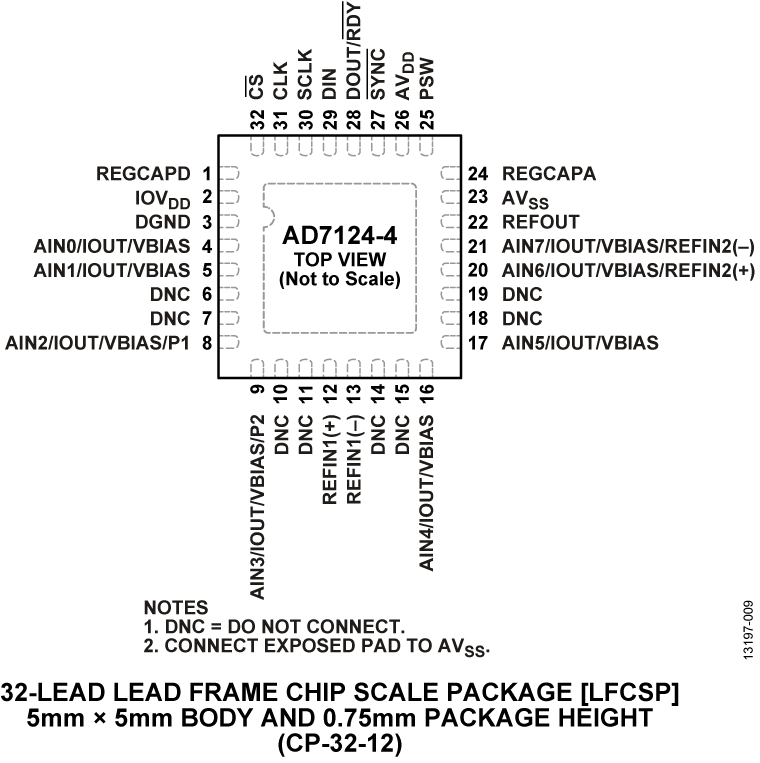
AD7124-44-Channel, Low Noise, Low Power, 24-Bit, Sigma-Delta ADC with PGA and Reference | Integrated Circuits (ICs) | 3 | Active | The AD7124-4 is a low power, low noise, completely integrated analog front end for high precision measurement applications. The device contains a low noise, 24-bit Σ-Δ analog-to-digital converter (ADC), and can be configured to have 4 differential inputs or 7 single-ended or pseudo differential inputs. The onchip low gain stage ensures that signals of small amplitude can be interfaced directly to the ADC.One of the major advantages of the AD7124-4 is that it gives the user the flexibility to employ one of three integrated power modes. The current consumption, range of output data rates, and rms noise can be tailored with the power mode selected. The device also offers a multitude of filter options, ensuring that the user has the highest degree of flexibility.The AD7124-4 can achieve simultaneous 50 Hz and 60 Hz rejection when operating at an output data rate of 25 SPS (single cycle settling), with rejection in excess of 80 dB achieved at lower output data rates.The AD7124-4 establishes the highest degree of signal chain integration. The device contains a precision, low noise, low drift internal band gap reference, and also accepts an external differential reference, which can be internally buffered. Other key integrated features include programmable low drift excitation current sources, burnout currents, and a bias voltage generator, which sets the common-mode voltage of a channel to AVDD/2. The low-side power switch enables the user to power down bridge sensors between conversions, ensuring the absolute minimal power consumption of the system. The device also allows the user the option of operating with either an internal clock or an external clock.The integrated channel sequencer allows several channels to be enabled simultaneously, and the AD7124-4 sequentially converts on each enabled channel, simplifying communication with the device. As many as 16 channels can be enabled at any time; a channel being defined as an analog input or a diagnostic such as a power supply check or a reference check. This unique feature allows diagnostics to be interleaved with conversions.The AD7124-4 also supports per channel configuration. The device allows eight configurations or setups. Each configuration consists of gain, filter type, output data rate, buffering, and reference source. The user can assign any of these setups on a channel by channel basis.The AD7124-4 also has extensive diagnostic functionality integrated as part of its comprehensive feature set. These diagnostics include a cyclic redundancy check (CRC), signal chain checks, and serial interface checks, which lead to a more robust solution. These diagnostics reduce the need for external components to implement diagnostics, resulting in reduced board space needs, reduced design cycle times, and cost savings. The failure modes effects and diagnostic analysis (FMEDA) of a typical application has shown a safe failure fraction (SFF) greater than 90% according to IEC 61508.The device operates with a single analog power supply from 2.7 V to 3.6 V or a dual 1.8 V power supply. The digital supply has a range of 1.65 V to 3.6 V. It is specified for a temperature range of −40°C to +105°C. The AD7124-4 is housed in a 32-lead LFCSP package or a 24-lead TSSOP package.ApplicationsTemperature measurementPressure measurementIndustrial process controlInstrumentation Smart transmittersSmart transmitters |
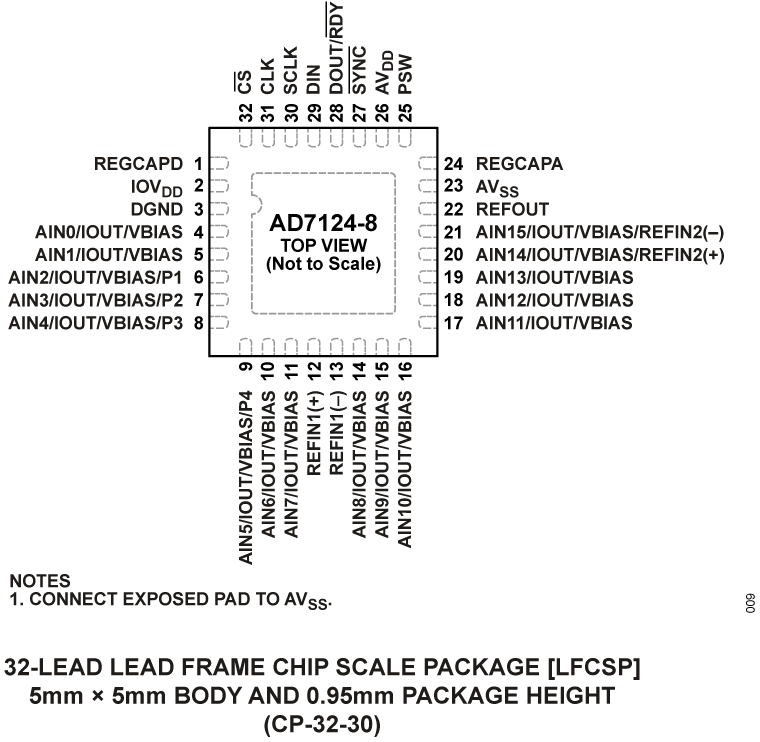
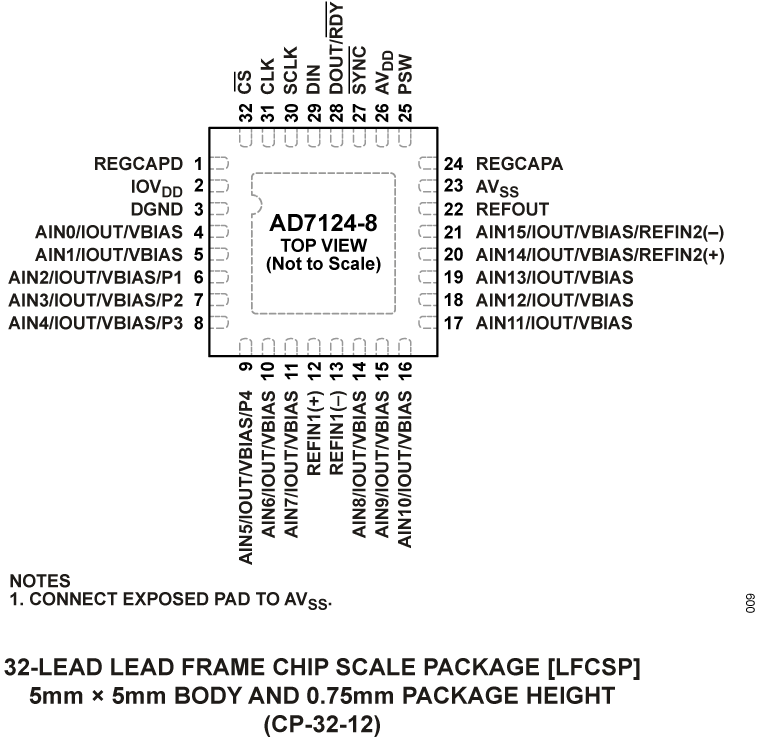
AD7124-88-Channel, Low Noise, Low Power, 24-Bit, Sigma-Delta ADC with PGA and Reference | Integrated Circuits (ICs) | 2 | Active | The AD7124-8 is a low power, low noise, completely integrated analog front end for high precision measurement applications. The AD7124-8 W grade is AEC-Q100 qualified for automotive applications. The device contains a low noise, 24-bit Σ-Δ analog-to-digital converter (ADC), and can be configured to have 8 differential inputs or 15 single-ended or pseudo differential inputs. The on-chip low gain stage ensures that signals of small amplitude can be interfaced directly to the ADC.One of the major advantages of the AD7124-8 is that it gives the user the flexibility to employ one of three integrated power modes. The current consumption, range of output data rates, and rms noise can be tailored with the power mode selected. The device also offers a multitude of filter options, ensuring that the user has the highest degree of flexibility.The AD7124-8 can achieve simultaneous 50 Hz and 60 Hz rejection when operating at an output data rate of 25 SPS (single cycle settling), with rejection in excess of 80 dB achieved at lower output data rates.The AD7124-8 establishes the highest degree of signal chain integration. The device contains a precision, low noise, low drift internal band gap reference and accepts an external differential reference, which can be internally buffered. Other key integrated features include programmable low drift excitation current sources, burnout currents, and a bias voltage generator, which sets the common-mode voltage of a channel to AVDD/2. The low-side power switch enables the user to power down bridge sensors between conversions, ensuring the absolute minimal power consumption of the system. The device also allows the user the option of operating with either an internal clock or an external clock.The integrated channel sequencer allows several channels to be enabled simultaneously, and the AD7124-8 sequentially converts on each enabled channel, simplifying communication with the device. As many as 16 channels can be enabled at any time, a channel being defined as an analog input or a diagnostic such as a power supply check or a reference check. This unique feature allows diagnostics to be interleaved with conversions. The AD7124-8 also supports per channel configuration. The device allows eight configurations or setups. Each configuration consists of gain, filter type, output data rate, buffering, and reference source. The user can assign any of these setups on a channel by channel basis.The AD7124-8 also has extensive diagnostic functionality integrated as part of its comprehensive feature set. These diagnostics include a cyclic redundancy check (CRC), signal chain checks, and serial interface checks, which lead to a more robust solution. These diagnostics reduce the need for external components to implement diagnostics, resulting in reduced board space needs, reduced design cycle times, and cost savings. The failure modes effects and diagnostic analysis (FMEDA) of a typical application has shown a safe failure fraction (SFF) greater than 90% according to IEC 61508.The device operates with a single analog power supply from 2.7 V to 3.6 V or a dual 1.8 V power supply. The digital supply has a range of 1.65 V to 3.6 V. It is specified for a temperature range of −40°C to +125°C. The AD7124-8 is housed in a 32-lead LFCSP package.APPLICATIONSTemperature measurementPressure measurementIndustrial process controlInstrumentationSmart transmitters |
| Integrated Circuits (ICs) | 6 | Active | |
| Data Acquisition | 4 | Active | |
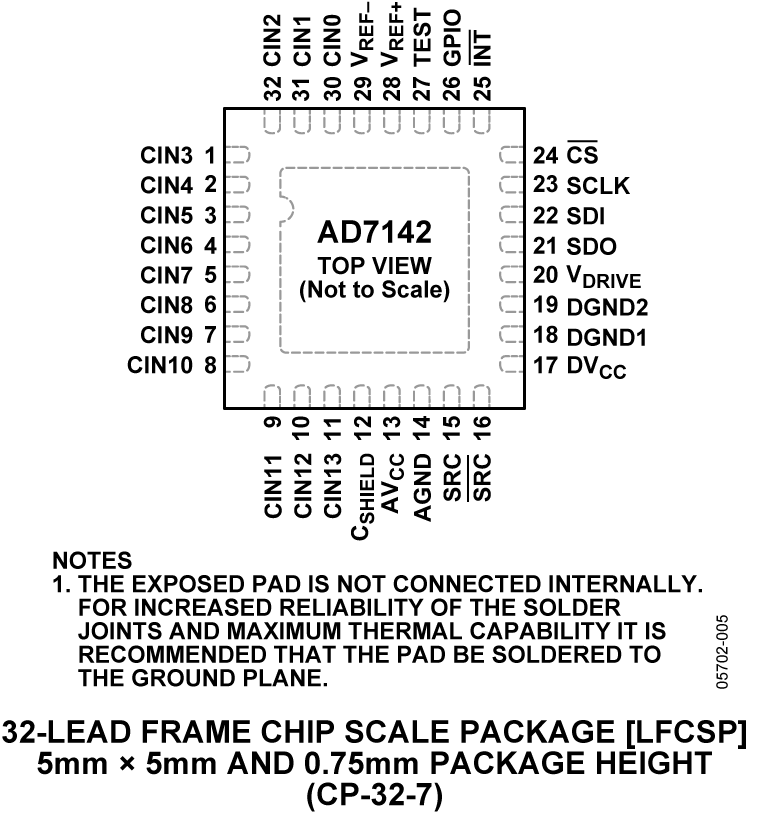
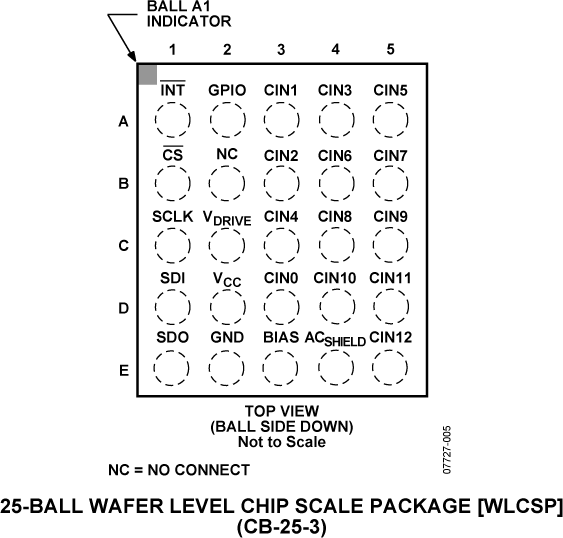
AD7147CapTouch®Programmable Controller for Single-Electrode Capacitance Sensors | Development Boards, Kits, Programmers | 16 | Active | The AD7147A CapTouch™controller is designed for use with capacitance sensors implementing functions such as buttons, scroll bars, and wheels. The sensors need only one PCB layer, enabling ultrathin applications.The AD7147A is an integrated CDC with on-chip environmental calibration. The CDC has 13 inputs channeled through a switch matrix to a 16-bit, 250 kHz sigma-delta (Σ-Δ) converter. The CDC is capable of sensing changes in the capacitance of the external sensors and uses this information to register a sensor activation. By programming the registers, the user has full control over the CDC setup.High resolution sensors require minor software to run on the host processor and may require two PCB layers.The AD7147A is designed for single electrode capacitance sensors (grounded sensors). There is an active shield output to minimize noise pickup in the sensor.The AD7147A has on-chip calibration logic to compensate for changes in the ambient environment. The calibration sequence is performed automatically and at continuous intervals as long as the sensors are not touched. This ensures that there are no false or non-registering touches on the external sensors due to a changing environment.The AD7147A has an SPI-compatible serial interface, and the AD7147A-1 has an I2C®-compatible serial interface. Both parts have an interrupt output, as well as a GPIO. There is a VDRIVEpin to set the voltage level for the serial interface independent of VCC.The AD7147A is available in a 25-ball, 2.3 mm × 2.1 mm WLCSP and operates from a 2.6 V to 3.6 V supply. The operating current consumption in low power mode is typically 28.96 μA for 13 sensors.APPLICATIONSCell phonesPersonal music and multimedia playersSmart handheld devicesTelevision, A/V, and remote controlsGaming consolesDigital still cameras |
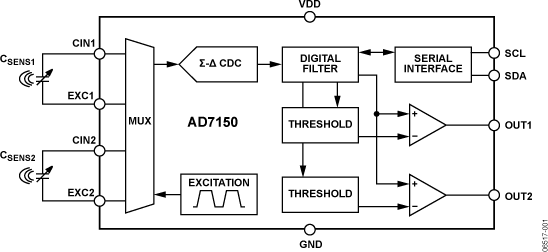
AD7150Ultra-Low Power, 2-Channel, Capacitance Converter for Proximity Sensing | Integrated Circuits (ICs) | 2 | Active | The AD7150 delivers a complete signal processing solution for capacitive proximity sensors, featuring an ultralow power converter with fast response time. TheAD7151is a single-channel, lower power alternative to the AD7150.The AD7150 uses Analog Devices, Inc., capacitance-to-digital converter (CDC) technology, which combines features important for interfacing to real sensors, such as high input sensitivity and high tolerance of both input parasitic ground capacitance and leakage current.The integrated adaptive threshold algorithm compensates for any variations in the sensor capacitance due to environmental factors like humidity and temperature or due to changes in the dielectric material over time.By default, the AD7150 operates in standalone mode using the fixed power-up settings and indicates detection on two digital outputs. Alternatively, the AD7150 can be interfaced to a microcontroller via the serial interface, the internal registers can be programmed with user-defined settings, and the data and status can be read from the part.The AD7150 operates with a 2.7 V to 3.6 V power supply. It is specified over the temperature range of −40°C to +85°C.APPLICATIONSProximity sensingContactless switchingPosition detectionLevel detection |
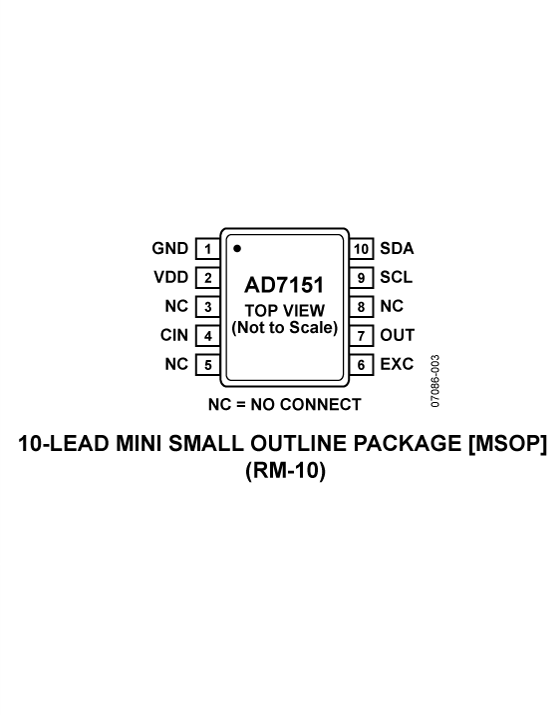
AD7151Ultra-Low Power, 1-Channel, Capacitance Converter for Proximity Sensing | Sensor and Detector Interfaces | 2 | Active | The AD7151 delivers a complete signal processing solution for capacitive proximity sensors, featuring an ultra-low power converter with fast response time. The AD7150 is a two-channel alternative to the AD7151.The AD7151 uses Analog Devices, Inc., capacitance-to-digital converter (CDC) technology, which combines features important for interfacing to real sensors, such as high input sensitivity and high tolerance of both input parasitic ground capacitance and leakage current.The integrated adaptive threshold algorithm compensates for any variations in the sensor capacitance due to environmental factors like humidity and temperature or due to changes in the dielectric material over time.By default, the AD7151 operates in standalone mode using the fixed power-up settings and indicates detection on a digital output. Alternatively, the AD7151 can be interfaced to a microcontroller via the serial interface, the internal registers can be programmed with user-defined settings, and the data and status can be read from the part.The AD7151 operates with a 2.7 V to 3.6 V power supply. It is specified over the temperature range −40°C to +85°C.APPLICATIONSProximity sensingContactless switchingPosition detectionLevel detection |
| Development Boards, Kits, Programmers | 3 | Active | |
AD717012-Bit Low Power Σ−Δ ADC | Data Acquisition | 2 | Active | The AD7170 is a very low power 12-bit analog-to-digital converter (ADC). It contains a precision 12-bit sigma-delta (Σ-Δ) ADC and an on-chip oscillator. Consuming only 135 μA, the AD7170 is particularly suitable for portable or battery operated products where very low power is a requirement. The AD7170 also has a power-down mode in which the device consumes 5 μA, thus increasing the battery life of the product.For ease-of-use, all the features of the AD7170 are controlled by dedicated pins. Each time a data read occurs, eight status bits are appended to the 12-bit conversion. These status bits contain a pattern sequence that can be used to confirm the validity of the serial transfer. The output data rate of the AD7170 is 125 Hz, whereas the settling time is 24 ms. The AD7170 has one differential input and a gain of 1. This is useful in applications where the user needs to use an external amplifier to implement system-specific filtering or gain requirements.The AD7170 operates with a power supply from 2.7 V to 5.25 V. It is available in a 10-lead LFCSP package.The AD7171 is a 16-bit version of the AD7170. It has the same feature set as the AD7170 and is pin-for-pin compatible.INTERFACE2-wire serial (read-only device)SPI compatibleSchmitt trigger on SCLKAPPLICATIONSPressure measurementIndustrial process controlPortable instrumentation |