| Battery Management | 10 | Active | The DS2438 remains in production, however, for new projects, we recommend ModelGauge m5MAX17215fuel gauge.The DS2438 smart battery monitor provides several functions that are desirable to carry in a battery pack: a means of tagging a battery pack with a unique serial number, a direct-to-digital temperature sensor which eliminates the need for thermistors in the battery pack, an A/D converter which measures the battery voltage and current, an integrated current accumulator which keeps a running total of all current going into and out of the battery, an elapsed time meter, and 40 bytes of nonvolatile EEPROM memory for storage of important parameters such as battery chemistry, battery capacity, charging methodology and assembly date. Information is sent to/from the DS2438 over a 1-Wire® interface, so that only one wire (and ground) needs to be connected from a central microprocessor to a DS2438. This means that battery packs need only have three output connectors: battery power, ground, and the 1-Wire interface.Because each DS2438 contains a unique silicon serial number, multiple DS2438s can exist on the same 1-Wire bus. This allows multiple battery packs to be charged or used in the system simultaneously.Applications for the smart battery monitor include portable computers, portable/cellular telephones, and handheld instrumentation battery packs in which it is critical to monitor real-time battery performance. Used in conjunction with a microcontroller in the host system, the DS2438 provides a complete smart battery pack solution that is fully chemistry-independent. The customization for a particular battery chemistry and capacity is realized in the code programmed into the microcontroller and DS2438 EEPROM, and only a software revision is necessary should a designer wish to change battery pack chemistry.ApplicationsCell PhonesDigital Still CamerasDigital Video CamerasPalmtops, Handy Terminals (incl. barcode)Pen Entry Palmtops, PDAs and OrganizersSmart Battery Packs/Chargers |
| Integrated Circuits (ICs) | 3 | Obsolete | |
| Memory | 2 | Active | |
DS2465DeepCover Secure Authenticator with SHA-256 Coprocessor and 1-Wire Master Function | Controllers | 8 | Active | DeepCover®embedded security solutions cloak sensitive data under multiple layers of advanced physical security to provide the most secure key storage possible.The DeepCover Secure Authenticator (DS2465) is a SHA-256 coprocessor with built-in 1-Wire®master that provides the SHA-256 and memory functionality required by a host system to communicate with and operate a 1-Wire SHA-256 slave. In addition, it performs protocol conversion between the I2C master and any attached 1-Wire SHA-256 slaves. For 1-Wire line driving, internal user-adjustable timers relieve the system host processor from generating time-critical 1-Wire waveforms, supporting both standard and overdrive 1-Wire communication speeds. The 1-Wire line can be powered down under software control. Strong pullup features support 1-Wire power delivery to 1-Wire devices such as EEPROMs. When not in use, the DS2465 can be put in sleep mode where power consumption is minimal.A DS2465 evaluation board is included in each of the authenticator evaluation kits below.ApplicationsAuthentication of ConsumablesSecure Feature Control |
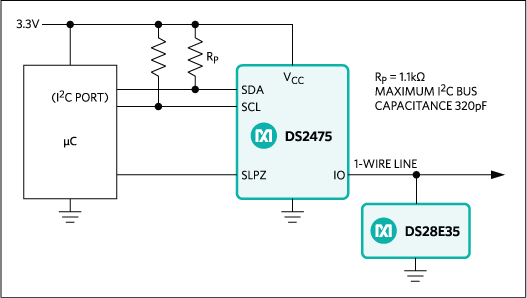
DS2475DeepCover ECDSA Coprocessor with 1-Wire Master | Specialized ICs | 1 | Unknown | DeepCover®embedded security solutions cloak sensitive data under multiple layers of advanced physical security to provide the most secure key storage possible.The DeepCover Elliptic Curve Digital Signature Algorithm (ECDSA) coprocessor with built-in 1-Wire®master (DS2475) enables the efficient implementation of public- key based authentication when combined with an ECDSA secure authenticator. Additionally, for operation with 1-Wire ECDSA authenticators, an I2C-to-1-Wire protocol conversion function relieves the system host processor from generating time-critical 1-Wire waveforms. The DS2475 interfaces directly to standard (100kHz max) or fast (400kHz max) I2C masters. When not in use, the DS2475 can be put in sleep mode where power consumption is minimal.ApplicationsAuthentication of AccessoriesAuthentication of ConsumablesPeripheral Authentication |
| Specialized ICs | 4 | Active | |
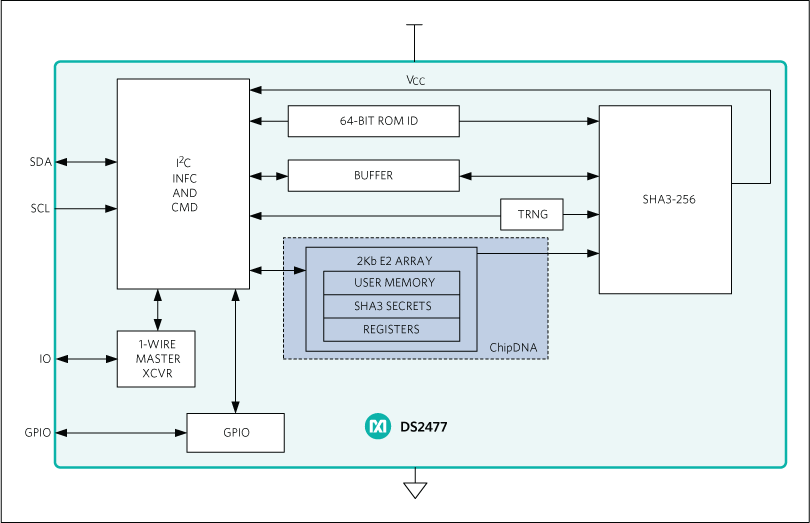
DS2477DeepCover Secure SHA-3 Coprocessor with ChipDNA PUF Protection | Specialized ICs | 2 | Active | The DS2477 secure I²C coprocessor with built-in 1-Wire® master combines FIPS202-compliant secure hash algorithm (SHA-3) challenge and response authentication with Maxim’s patented ChipDNA™ feature, a physically unclonable technology (PUF) to provide a cost-effective solution with the ultimate protection against security attacks. The ChipDNA implementation utilizes the random variation of semiconductor device characteristics that naturally occur during wafer fabrication. The ChipDNA circuit generates a unique output value that is repeatable over time, temperature, and operating voltage. Attempts to probe or observe ChipDNA operation modifies the underlying circuit characteristics thus preventing discovery of the unique value used by the chip cryptographic functions. The DS2477 utilizes the ChipDNA output as key content to cryptographically secure all device-stored data. With ChipDNA capability, the device provides a core set of cryptographic tools derived from integrated blocks including a SHA-3 engine, a FIPS/NIST compliant true random number generator (TRNG), 2Kb of secured EEPROM, and a unique 64-bit ROM identification number (ROM ID). The unique ROM ID is used as a fundamental input parameter for cryptographic operations and serves as an electronic serial number within the application. The DS2477 provides the SHA-3 and memory functionality required by a host system to communicate with and operate a 1-Wire SHA-3 slave. In addition, it performs protocol conversion between the I²C master and any attached 1-Wire SHA-3 slaves. For 1-Wire line driving, internal user-adjustable timers relieve the system host processor from generating time-critical 1-Wire waveforms, supporting both standard and overdrive 1-Wire communication speeds. The 1-Wire line can be powered down under software control. Strong pullup features support 1-Wire power delivery for commands that require higher current consumption.ApplicationsAuthentication of Medical Sensors and ToolsIoT Node AuthenticationPeripheral AuthenticationPrinter Cartridge Identification and AuthenticationReference Design License ManagementSecure Management of Limited Use Consumables |
| Integrated Circuits (ICs) | 2 | Active | |
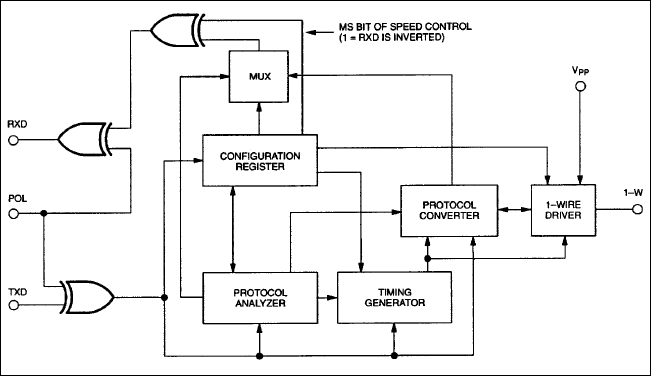
DS2480Serial to 1-Wire Line Driver | Drivers, Receivers, Transceivers | 2 | Active | The DS2480B is a serial port to 1-Wire®interface chip that supports standard and overdrive speeds. It connects directly to UARTs and 5V RS-232 systems. Interfacing to RS-232C (±12V levels) requires a passive clamping circuit and one 5V to ±12V level translator. Internal timers relieve the host of the burden of generating the time-critical 1-Wire communication waveforms. In contrast to the DS9097(E) where a full character must be sent by the host for each 1-Wire time slot, the DS2480B can translate each character into eight 1-Wire time slots, thereby increasing the data throughput significantly. In addition, the DS2480B can be set to communicate at four different data rates, including 115.2kbps, 57.6kbps, and 19.2kbps, with 9.6kbps being the power-on default. Command codes received from the host's crystal controlled UART serve as a reference to continuously calibrate the on-chip timing generator. The DS2480B uses a unique protocol that merges data and control information without requiring control pins. This approach maintains compatibility to off-the-shelf serial to wireless converters, allowing easy realization of 1-Wire media jumpers. The various control functions of the DS2480B are optimized for 1-Wire networks and support the special needs of all current 1-Wire devices including EPROM-based add-only memories, EEPROM devices, and 1-Wire thermometers. SeeApplication Note 192: Using the DS2480B Serial 1-Wire Driverfor detailed software examples. |
| Drivers, Receivers, Transceivers | 2 | Obsolete | |