A
Analog Devices Inc./Maxim Integrated
| Series | Category | # Parts | Status | Description |
|---|---|---|---|---|
| Part | Spec A | Spec B | Spec C | Spec D | Description |
|---|---|---|---|---|---|



| Series | Category | # Parts | Status | Description |
|---|---|---|---|---|
| Part | Spec A | Spec B | Spec C | Spec D | Description |
|---|---|---|---|---|---|
| Part | Category | Description |
|---|---|---|
 Analog Devices Inc./Maxim Integrated LTC1879EGN#TRUnknown | Integrated Circuits (ICs) | IC REG BUCK ADJ 1.2A 16SSOP |
 Analog Devices Inc./Maxim Integrated LTC2208CUP#TRUnknown | Integrated Circuits (ICs) | IC ADC 16BIT 130MSPS 64-QFN |
 Analog Devices Inc./Maxim Integrated ADP2108ACBZ-1.1-R7Obsolete | Integrated Circuits (ICs) | IC REG BUCK 1.1V 600MA 5WLCSP |
 Analog Devices Inc./Maxim Integrated EV1HMC832ALP6GObsolete | Development Boards Kits Programmers | EVAL BOARD FOR HMC832ALP6GE |
 Analog Devices Inc./Maxim Integrated LTC488ISWUnknown | Integrated Circuits (ICs) | IC LINE RCVR RS485 QUAD 16-SOIC |
 Analog Devices Inc./Maxim Integrated LTC6946IUFD-2Obsolete | Integrated Circuits (ICs) | IC CLK/FREQ SYNTH 28QFN |
 Analog Devices Inc./Maxim Integrated MAX5556ESA+TObsolete | Integrated Circuits (ICs) | IC DAC/AUDIO 16BIT 50K 8SOIC |
 Analog Devices Inc./Maxim Integrated EVAL-FLTR-LD-1RZUnknown | Unclassified | EVAL BRD FOR AD800 SERIES |
 Analog Devices Inc./Maxim Integrated | Development Boards Kits Programmers | BOARD EVAL FOR AD9963 |
 Analog Devices Inc./Maxim Integrated LTC1296CCSW#TRUnknown | Integrated Circuits (ICs) | IC DATA ACQ SYS 12BIT 5V 20SOIC |
| Series | Category | # Parts | Status | Description |
|---|---|---|---|---|
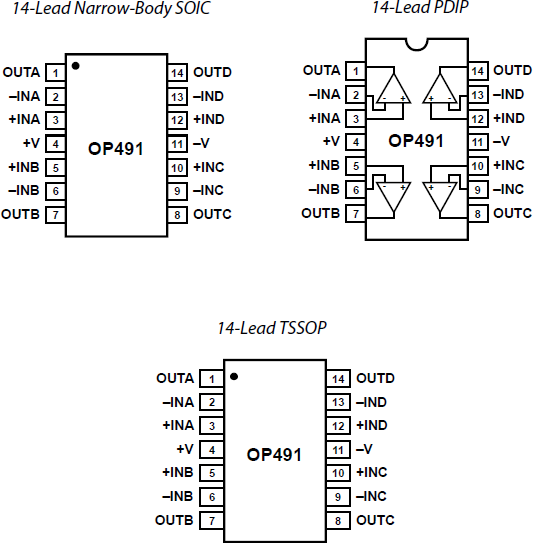
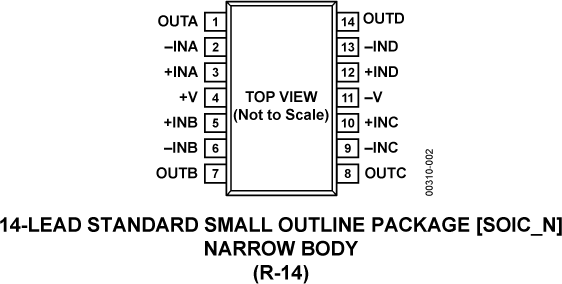
OP491Micropower Single-Supply RRIO Quad Op Amp | Linear | 7 | Active | The OP191, OP291 and OP491 are single, dual and quad micropower, single-supply, 3 MHz bandwidth amplifiers featuring rail-to-rail inputs and outputs. All are guaranteed to operate from a 3 volt single supply as well as ±5 volt dual supplies.Fabricated on Analog Devices' CBCMOS process, the OP191 family has a unique input stage that allows the input voltage to safely extend 10 volts beyond either supply without any phase inversion or latch-up. The output voltage swings to within millivolts of the supplies and continues to sink or source current all the way to the supplies.Applications for these amplifiers include portable telecom equipment, power supply control and protection, and interface for transducers with wide output ranges. Sensors requiring a rail-to-rail input amplifier include Hall effect, piezo electric, and resistive transducers.The ability to swing rail-to-rail at both the input and output enables designers to build multistage filters in single-supply systems and maintain high signal-to-noise ratios.The OP191/OP291/OP491 are specified over the extended industrial (-40°C to +125°C) temperature range. The OP191 single and OP291 dual amplifiers are available in 8-pin plastic DIPs and SO surface mount packages. The OP491 quad is available in 14-pin DIPs and narrow 14-pin SO packages. Consult factory for OP491 TSSOP availability. |
| Linear | 3 | Active | ||
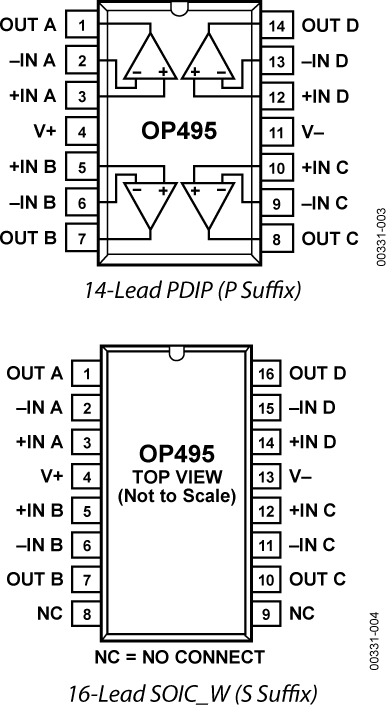
OP495Rail-to-Rail Quad Operational Amplifier | Amplifiers | 2 | Active | Rail-to-rail output swing combined with dc accuracy are the key features of the OP495 quad and OP295 dual CBCMOS operational amplifiers. By using a bipolar front end, lower noise and higher accuracy than those of CMOS designs have been achieved. Both input and output ranges include the negative supply, providing the user with zero-in/zero-out capability. For users of 3.3 V systems such as lithium batteries, the OP295/OP495 are specified for 3 V operation.Maximum offset voltage is specified at 300 μV for 5 V operation, and the open-loop gain is a minimum of 1000 V/mV. This yields performance that can be used to implement high accuracy systems, even in single-supply designs.The ability to swing rail-to-rail and supply 15 mA to the load makes the OP295/OP495 ideal drivers for power transistors and H bridges. This allows designs to achieve higher efficiencies and to transfer more power to the load than previously possible without the use of discrete components.For applications such as transformers that require driving inductive loads, increases in efficiency are also possible. Stability while driving capacitive loads is another benefit of this design over CMOS rail-to-rail amplifiers. This is useful for driving coax cable or large FET transistors. The OP295/OP495 are stable with loads in excess of 300 pF.The OP295 and OP495 are specified over the extended indus-trial (−40°C to +125°C) temperature range. The OP295 is available in 8-lead PDIP and 8-lead SOIC_N surface-mount packages. The OP495 is available in 14-lead PDIP and 16-lead SOIC_W surface-mount packages.ApplicationsBattery-operated instrumentationServo amplifiersActuator drivesSensor conditionersPower supply control |
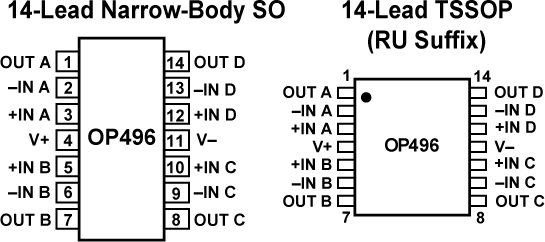
OP496Micropower, RRIO Quad Operational Amplifier | Integrated Circuits (ICs) | 2 | Active | The OP196 family of CBCMOS operational amplifiers features micropower operation and rail-to-rail input and output ranges.The extremely low power requirements and guaranteed operation from +3 V to +12 V make these amplifiers perfectly suited to monitor battery usage and to control battery charging. Their dynamic performance, including 26 nV/(root)Hz voltage noise density, recommends them for battery-powered audio applications. Capacitive loads to 200 pF are handled without oscillation.The OP196/OP296/OP496 are specified over the HOT extended industrial (-40°C to +125°C) temperature range. +3 V operation is specified over the 0°C to +125°C temperature range. The single OP196 and the dual OP296 are available in 8-pin plastic DIP and SO-8 surface mount packages. The quad OP496 is available in 14-pin plastic DIP and narrow SO-14 surface mount packages. Check factory for availability of the OP296 and OP496 in the TSSOP package. |
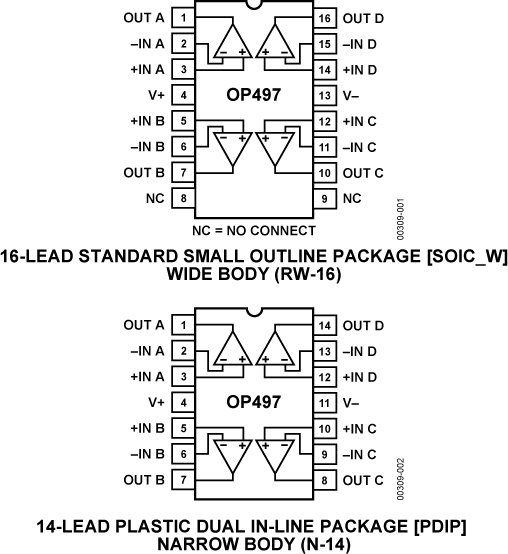
OP497Precision Picoampere Input Current Quad Operational Amplifier | Amplifiers | 6 | Active | The OP497 is a quad op amp with precision performance in the space-saving, industry standard 16-lead SOlC package. Its combination of exceptional precision with low power and extremely low input bias current makes the quad OP497 useful in a wide variety of applications.Precision performance of the OP497 includes very low offset (<50 μV) and low drift (<0.5 μV/°C). Open-loop gain exceeds 2000 V/mV ensuring high linearity in every application. Errors due to common-mode signals are eliminated by its common-mode rejection of >120 dB. The OP497 has a power supply rejection of >120 dB which minimizes offset voltage changes experienced in battery-powered systems. The supply current of the OP497 is <625 μA per amplifier, and it can operate with supply voltages as low as ±2 VThe OP497 uses a superbeta input stage with bias current cancellation to maintain picoamp bias currents at all temperatures. This is in contrast to FET input op amps whose bias currents start in the picoamp range at 25°C but double for every 10°C rise in temperature to reach the nanoamp range above 85°C. The input bias current of the OP497 is <100 pA at 25°C.Combining precision, low power, and low bias current, the OP497 is ideal for a number of applications, including instrumentation amplifiers, log amplifiers, photodiode preamplifiers, and long-term integrators. For a single device, see the OP97 data sheet, and for a dual device, see the OP297 data sheet. |
| Instrumentation, Op Amps, Buffer Amps | 1 | Active | ||
| Integrated Circuits (ICs) | 1 | Obsolete | ||
| Linear | 5 | Active | ||
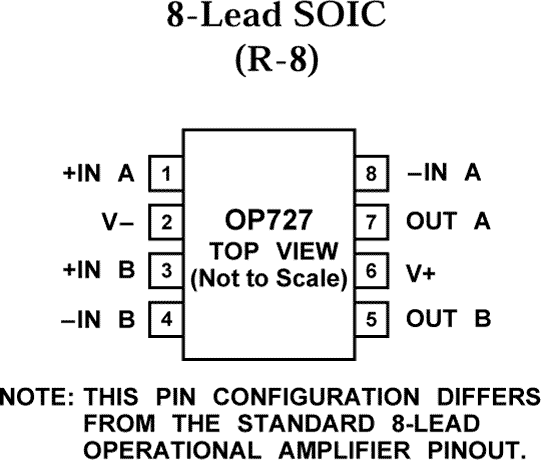
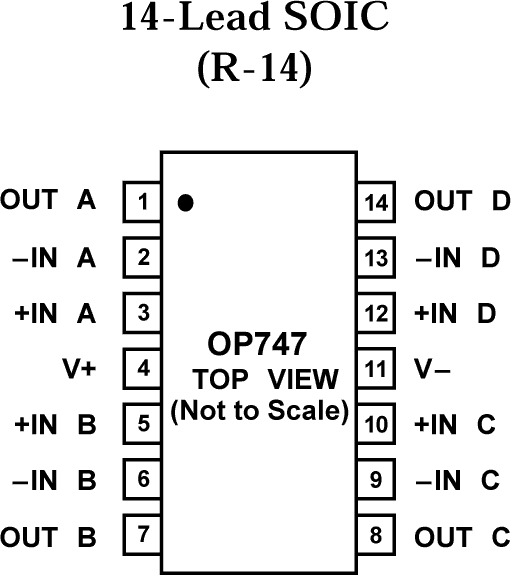
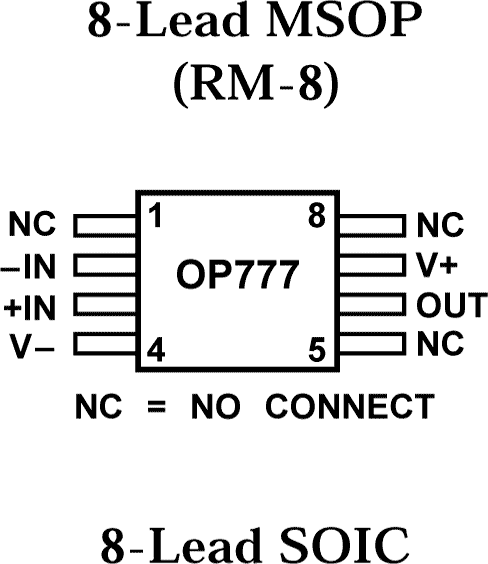
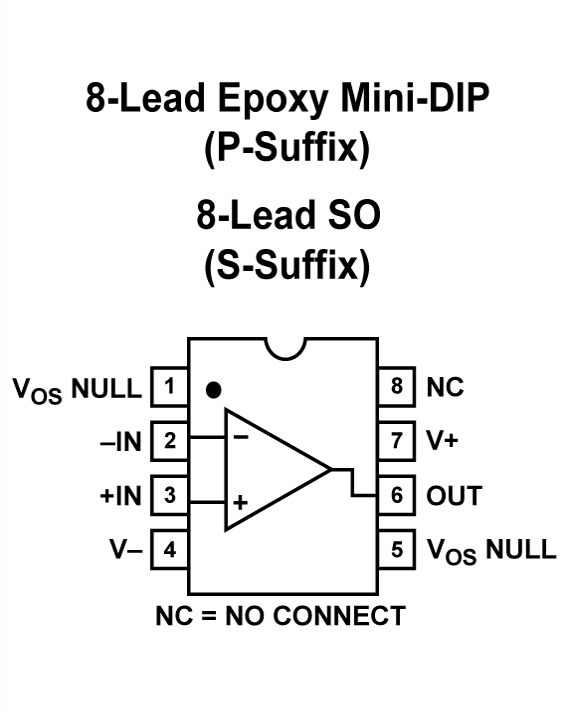
OP777Precision Single Rail-to-Rail Output Single Supply Op Amp | Amplifiers | 1 | Active | The OP777, OP727 and OP747 are precision single, dual and quad rail-to-rail output single supply amplifiers featuring micropower operation and rail to rail output ranges. These amplifiers provide improved performance over the industry standard OP07 with ±15V supplies and offer the further advantages of true single supply operation down to +3.0V and smaller package options than any other high voltage precision bipolar amplifier. Outputs are stable with capacitive loads of over 1000pF. Supply current is less than 300 µA per amplifier at 5V. 500 series resistors protect the inputs, allowing input signal levels several volts above the positive supply without phase reversal. |
| Instrumentation, OP Amps, Buffer Amps | 4 | Active | ||