A
Analog Devices Inc./Maxim Integrated
| Series | Category | # Parts | Status | Description |
|---|---|---|---|---|
| Part | Spec A | Spec B | Spec C | Spec D | Description |
|---|---|---|---|---|---|



| Series | Category | # Parts | Status | Description |
|---|---|---|---|---|
| Part | Spec A | Spec B | Spec C | Spec D | Description |
|---|---|---|---|---|---|
| Part | Category | Description |
|---|---|---|
 Analog Devices Inc./Maxim Integrated LTC1879EGN#TRUnknown | Integrated Circuits (ICs) | IC REG BUCK ADJ 1.2A 16SSOP |
 Analog Devices Inc./Maxim Integrated LTC2208CUP#TRUnknown | Integrated Circuits (ICs) | IC ADC 16BIT 130MSPS 64-QFN |
 Analog Devices Inc./Maxim Integrated ADP2108ACBZ-1.1-R7Obsolete | Integrated Circuits (ICs) | IC REG BUCK 1.1V 600MA 5WLCSP |
 Analog Devices Inc./Maxim Integrated EV1HMC832ALP6GObsolete | Development Boards Kits Programmers | EVAL BOARD FOR HMC832ALP6GE |
 Analog Devices Inc./Maxim Integrated LTC488ISWUnknown | Integrated Circuits (ICs) | IC LINE RCVR RS485 QUAD 16-SOIC |
 Analog Devices Inc./Maxim Integrated LTC6946IUFD-2Obsolete | Integrated Circuits (ICs) | IC CLK/FREQ SYNTH 28QFN |
 Analog Devices Inc./Maxim Integrated MAX5556ESA+TObsolete | Integrated Circuits (ICs) | IC DAC/AUDIO 16BIT 50K 8SOIC |
 Analog Devices Inc./Maxim Integrated EVAL-FLTR-LD-1RZUnknown | Unclassified | EVAL BRD FOR AD800 SERIES |
 Analog Devices Inc./Maxim Integrated | Development Boards Kits Programmers | BOARD EVAL FOR AD9963 |
 Analog Devices Inc./Maxim Integrated LTC1296CCSW#TRUnknown | Integrated Circuits (ICs) | IC DATA ACQ SYS 12BIT 5V 20SOIC |
| Series | Category | # Parts | Status | Description |
|---|---|---|---|---|
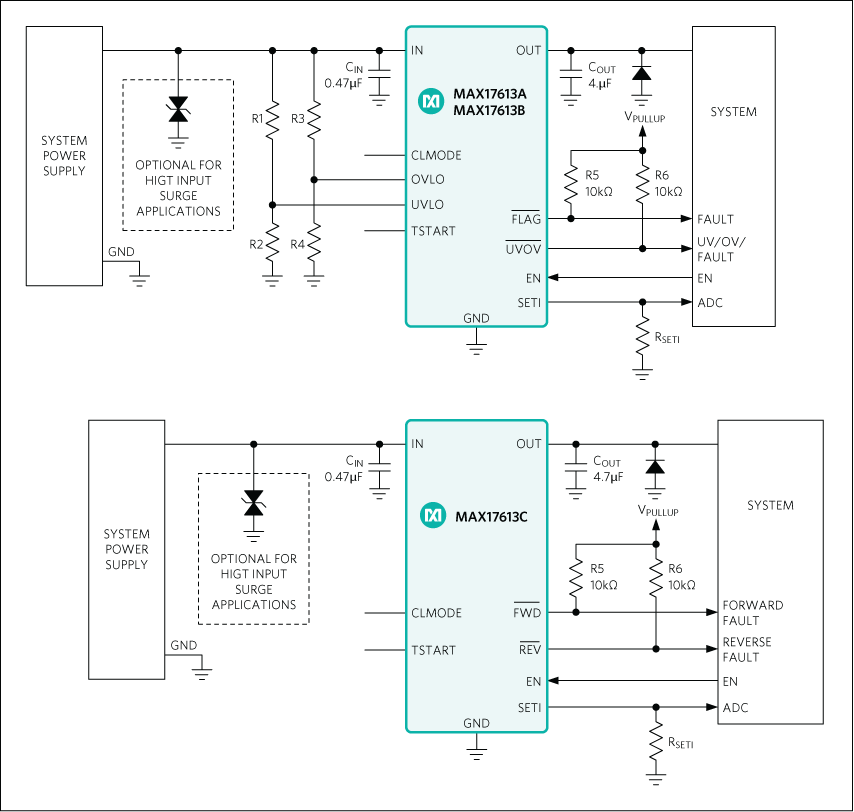
MAX176134.5V to 60V, 3A Current-Limiter with OV, UV, and Reverse Protection | Development Boards, Kits, Programmers | 9 | Active | The Olympus series of ICs is the industry's smallest and most robust integrated system protection solution. The MAX17613A/MAX17613B/MAX17613C adjustable overvoltage and overcurrent protection devices are ideal to protect systems against positive and negative input voltage faults up to +60V and -65V, and feature low 130m Ω (typ) RONFETs.The adjustable input overvoltage protection range is 5.5V to 60V and the adjustable input undervoltage protection range is 4.5V to 59V. The input overvoltage-lockout (OVLO) and undervoltage-lockout (UVLO) thresholds are set using external resistors. Additionally, the devices offer an internal input undervoltage threshold at 4.2V (typ).The devices feature programmable current-limit protection up to 3A; hence, controlling the inrush current at startup while charging large capacitors at the output. The current-limit threshold is programmed by connecting a resistor from the SETI pin to GND. When the device current reaches the programmed threshold, the device prevents further increases in current by modulating the FET resistance. The devices can be programmed to behave in three different ways under current-limit condition: autoretry, continuous, or latchoff modes. The voltage appearing on the SETI pin is proportional to the instantaneous current flowing through the device and can be read by an ADC.The devices offer a programmable startup blanking time that enables charging the large capacitors connected at the output.MAX17613A and MAX17613C block current flowing in the reverse direction (i.e., from OUT to IN) whereas MAX17613B allows current flow in the reverse direction. The devices feature thermal shutdown protection against excessive power dissipation.The devices are available in a small, 20-pin (4mm x 4mm) TQFN-EP package and operate over the -40°C to +125°C extended temperature range.ApplicationsCondition MonitoringFactory SensorsIndustrial Applications such as PLC, Control Network Modules, Battery-Operated ModulesProcess InstrumentationSensor SystemsWeighing and Batching Systems |
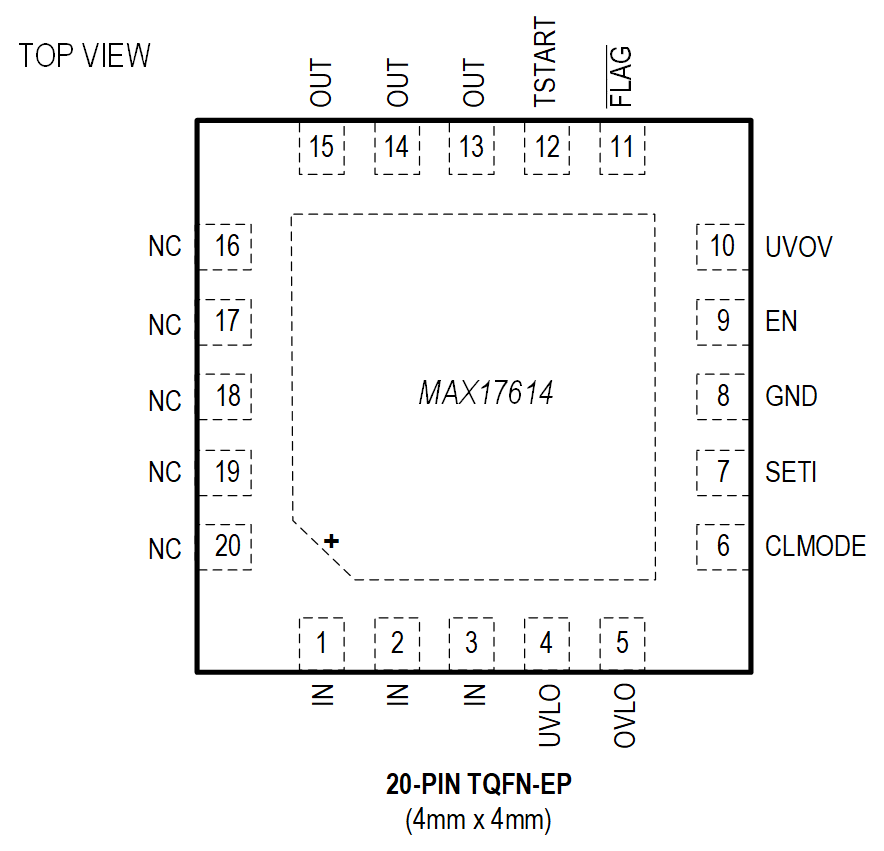
MAX176144.5V to 60V, 3A, Ideal Diode/Power Source Selector with Current Limit, UV, OV Protection | Power Management (PMIC) | 2 | Active | The MAX17614 ideal diode/power source selector device offers adjustable protection boundaries for systems against positive and negative input faults up to +60V and -65V, and output load current up to 3A. The device features two internal nFETs connected in series with a low cumulative RONof 130mΩ (typ) and can be used to implement an ideal diode function to provide reverse input voltage and reverse current protection with improved system efficiency. Input undervoltage protection can be programmed between 4.5V and 59V, while the overvoltage protection can be independently programmed between 5.5V and 60V. Additionally, the device has an internal default UVLO rising threshold set at 4.2V (typ).The device is enabled or disabled through the EN pin by a main supervisory system. This in turn offers a switch operation to turn on or turn off power delivery to connected loads.The current through the device is limited by setting a current limit, which is programmed by a resistor connected from SETI to GND. The current limit can be programmed between 0.15A to 3A. When the device current reaches or exceeds the set current limit, the internal nFET Q2 is controlled to limit the current to set limit. The device offers three current-limit modes: Autoretry, Continuous, and Latch-off. The SETI pin also presents a voltage with reference to GND, which under normal operation is proportional to the device current. The voltage appearing on the SETI pin might be read by an analogto- digital converter or ADC in a monitoring system for recording instantaneous device current.The device offersFLAGand UVOV communication signals to indicate different operational and fault signals. The communication signal pins are open drain in nature and require external pullup resistors to appropriate system interface voltage.The device offers internal thermal shutdown protection against excessive power dissipation.APPLICATIONSSmall Total Solution SizeFaster Response TimesTight Current Limit Accuracy |
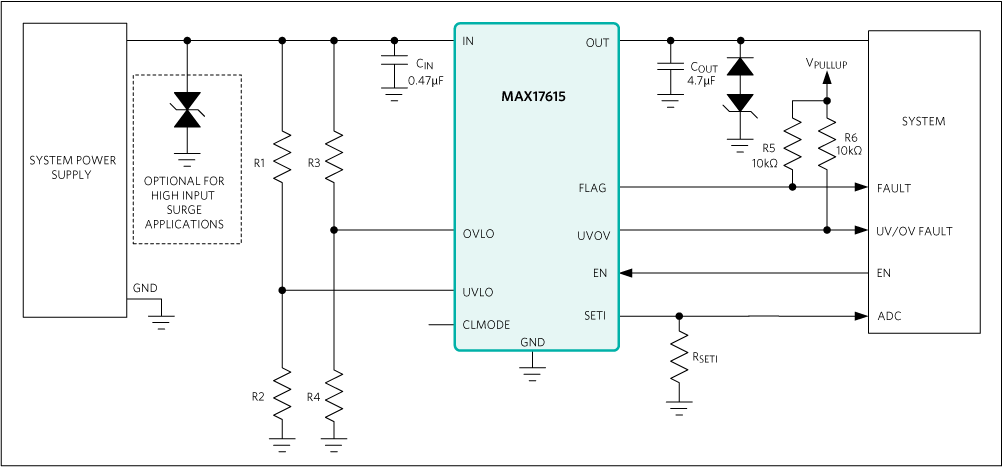
MAX176154.25V to 60V, 250mA Current Limiter with OV, UV, and Reverse Protection | Current Regulation/Management | 2 | Active | The MAX17615 overvoltage and overcurrent-protection device offers adjustable protection boundaries for systems against positive and negative input faults up to +60V and -65V, and output load current up to 250mA. The device features two internal MOSFETs connected in series with a low cumulative RON of 1.42Ω (typ).The device blocks out negative input voltages completely. The device withstands accidental reverse polarity output voltage connection, with magnitudes up to –(65 - VIN)V. Input undervoltage protection can be programmed between 4.25V and 59V, while the overvoltage protection can be independently programmed between 5.5V and 60V. Additionally, the device has an internal undervoltage lockout falling threshold set at 4V (typ).The device is enabled or disabled through the EN pin by a master supervisory system. This in turn offers a switch operation to turn on or turn off power delivery to connected loads.The current through the device is limited by setting a current limit, which is programmed by a resistor connected from SETI to GND. The current limit can be programmed between 10mA to 250mA. When the device current reaches or exceeds the set current limit, the on-resistance of the internal FETs are modulated to limit the current to set limit. The device offers three different behavioral modes when under current limited operations: Auto retry, Continuous, and Latch Off modes. The SETI pin also presents a voltage with reference to GND, which under normal operation is proportional to the device current. The voltage appearing on the SETI pin might be read by an ADC in a monitoring system for recording instantaneous device current.The MAX17615 offersFLAGandUVOVcommunication signals to indicate different operational and fault signals. The communication signal pins are open drain in nature and require external pullup resistors to appropriate system interface voltage.MAX17615 blocks reverse current flow (from OUT to IN). The device offers internal thermal shutdown protection against excessive power dissipationAPPLICATIONSSmall Total Solution Size (Sensor Systems)Tight Current Limit Accuracy (Condition Monitoring, Battery Operated Modules)Output Reverse Polarity Protection (Process Instrumentation, PLC, Network Modules) |
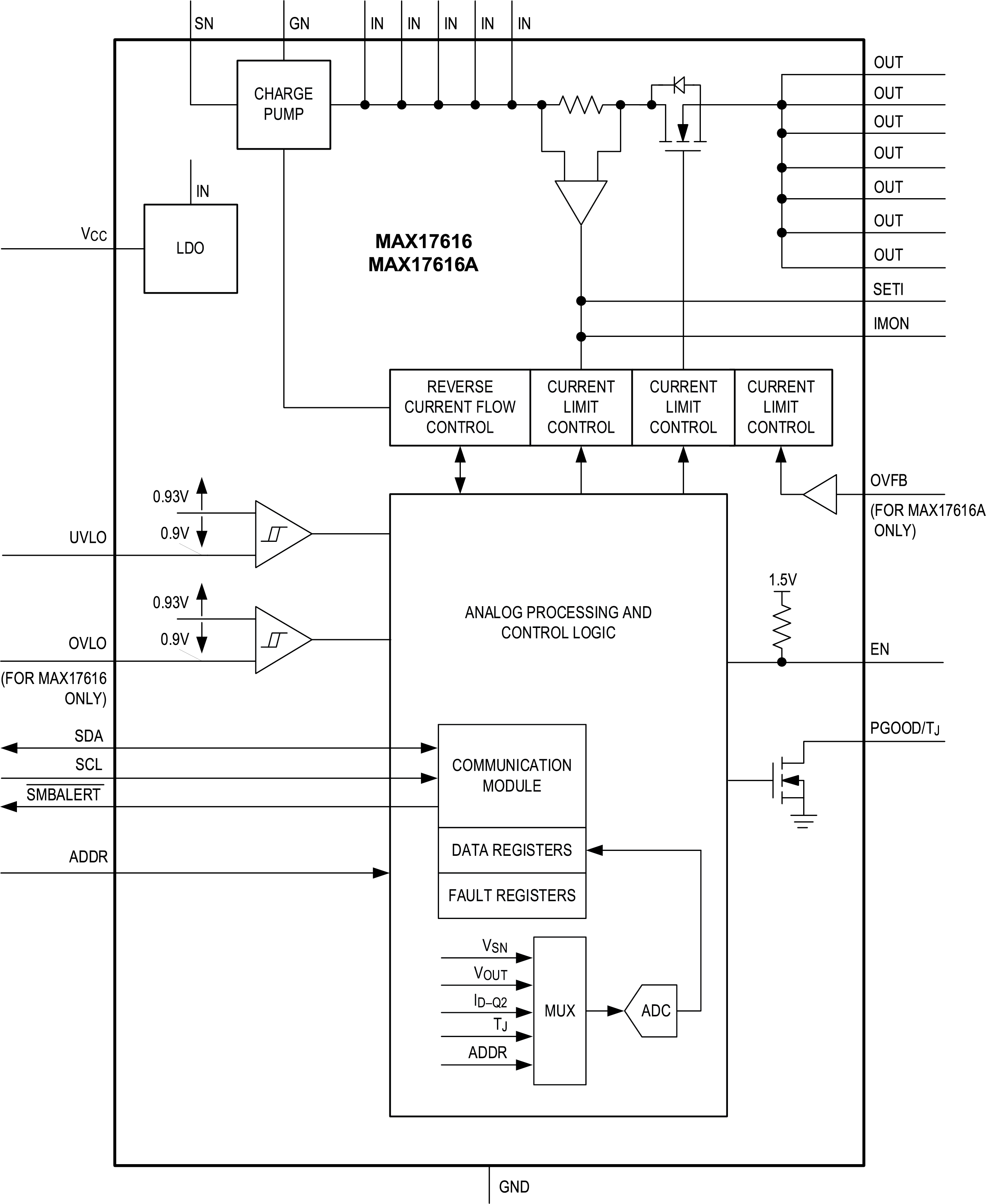
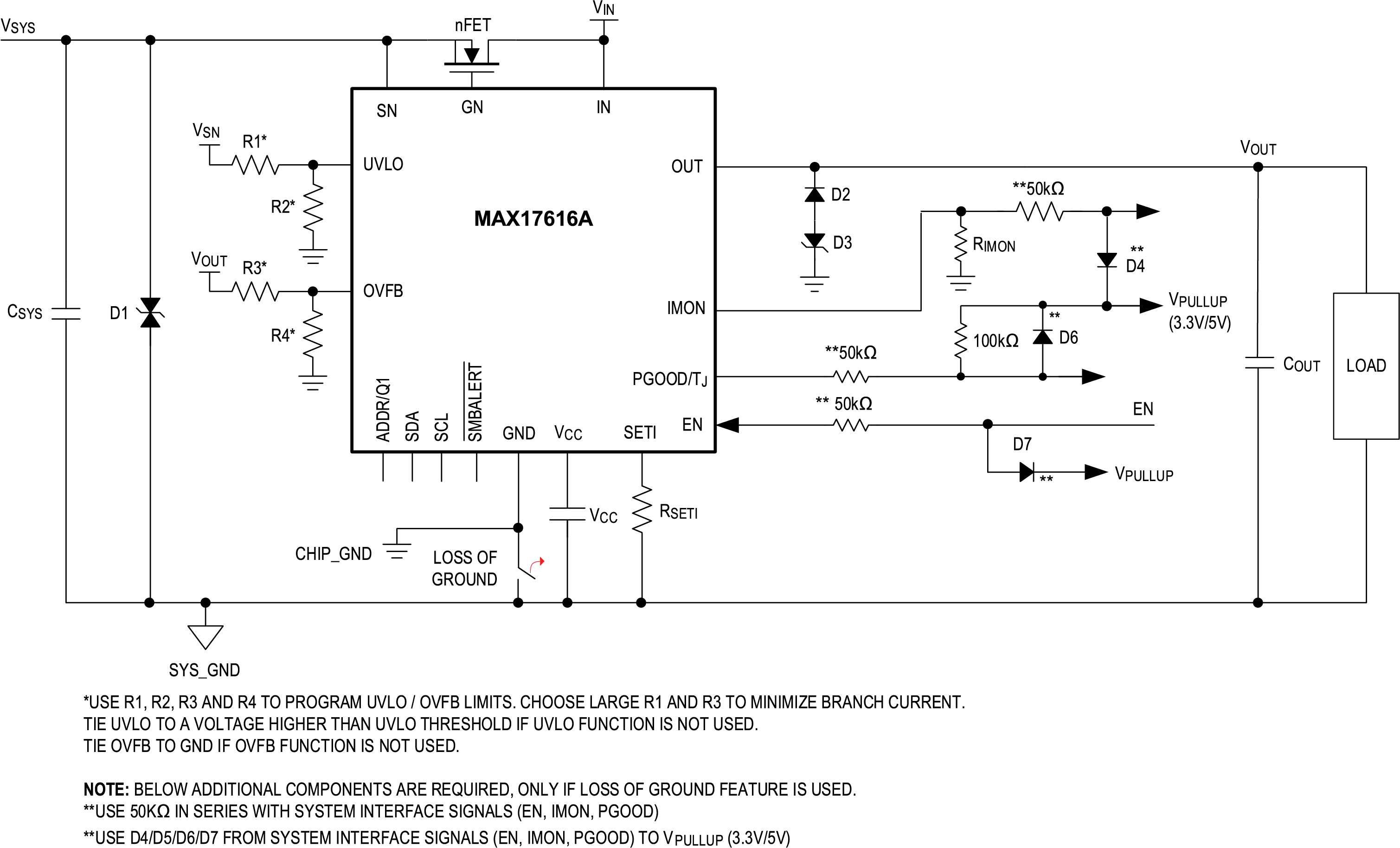
MAX176163V to 80V, 7A, Current-Limiter with OV/Surge, UV, Reverse Polarity, Loss of Ground Protection and PMBus Interface | Evaluation Boards | 3 | Active | The MAX17616/MAX17616A offers highly versatile and programmable protection boundaries for systems against input voltage faults and output overcurrent faults. Input-voltage faults (with positive polarity) are protected up to +80V (without Reverse Current Protection)/+75V (with Reverse Current Protection), by an internal nFET featuring low ON-resistance (20mΩ typ). The devices feature a programmable undervoltage-lockout (UVLO) thresholds by using external voltage-dividers. The MAX17616 features a programmable overvoltage-lockout (OVLO) while MAX17616A offers a programmable output voltage clamp function through the OVFB pin that features an output voltage limiting regulation during input transient surge events. Input undervoltage and overvoltage protection (MAX17616)/output voltage clamp function (MAX17616A) can be programmed across the entire 3V to 80V operating range.Input reverse-polarity protection is realized using an external nFET that is controlled by the devices. The magnitude of reverse-polarity voltage protection is dependent on the operating load-bus voltage (VOUT) and the voltage-blocking capability of the external nFET. For example, for protection down to a -55V input range with VOUT= 30V, an external nFET rated at 85V is needed. The external nFET is also needed for the optional reverse-current protection. When used with a Reverse Protection external nFET (Q1), the devices prevent reverse current flow from load to source by turning off Q1. The reverse current thresholds and forward bias characteristics of the reverse current protection feature are tuned to achieve an ideal diode function suited for OR-ing and Power Multiplexer applications. If reverse polarity protection and reverse-current protection are not needed, SN and GN pins must be connected to IN. The devices are tolerant against accidental output reverse-polarity application due to incorrect wiring across the output terminals.The current limit of the devices is programmed by connecting a resistor from the SETI pin to GND. The current limit can be programmed from 0.7A to 7.0A. When the current through the devices reaches or exceeds the set current limit, the resistance of the internal nFET is modulated to limit the current. The devices offer three current-limit behavioral modes: Continuous, Auto-retry, and Latch-off modes. In addition, the devices allow programmable startup inrush current limit during startup events, to prevent inrush current from limited power sources flowing into capacitive or negative impedance output loads.The IMON pin presents a current proportional to the device current under normal operation. Together with the IMON resistor (between IMON and GND), the IMON pin presents a voltage that is proportional to the device current. This voltage can be read by a monitoring system to record the instantaneous current of the device. Place a 100nF ceramic capacitor from IMON to GND.The device can be turned ON or OFF by enabling input EN by a controller supervisory system. This allows the controller supervisory system to Turn ON or OFF the power delivery to connected loads.The devices offer loss-of-ground protection where it safely turns OFF the device operation during a loss-of-ground fault event, i.e., when the safety ground fuse opens in a redundant safety application.The devices offer a status announcement signal (SMBALERTto indicate operational and fault signals. The devices also offer a Power Good Signal (PGOOD/TJ) that may be used by a supervisory system to enable/disable the downstream loads. PGOOD/TJ is an open drain pin and requires an external pullup resistor to the appropriate system interface.The devices offer a programmable output undervoltage sense threshold that governs the restart response after the output voltage drops below the OUTUV Rising threshold. The device also offers internal thermal shutdown protection against excessive power dissipation.The devices offer a PMBus compatible Serial Peripheral Interface, with commands to control the device operation and observe system level parameters.APPLICATIONSInput Voltage and Output Overcurrent ProtectionsLoss of Ground ProtectionSurge Protection |
MAX17616A3V to 80V, 7A, Current-Limiter with OV/Surge, UV, Reverse Polarity, Loss of Ground Protection and PMBus Interface | Power Distribution Switches, Load Drivers | 2 | Active | The MAX17616/MAX17616A offers highly versatile and programmable protection boundaries for systems against input voltage faults and output overcurrent faults. Input-voltage faults (with positive polarity) are protected up to +80V (without Reverse Current Protection)/+75V (with Reverse Current Protection), by an internal nFET featuring low ON-resistance (20mΩ typ). The devices feature a programmable undervoltage-lockout (UVLO) thresholds by using external voltage-dividers. The MAX17616 features a programmable overvoltage-lockout (OVLO) while MAX17616A offers a programmable output voltage clamp function through the OVFB pin that features an output voltage limiting regulation during input transient surge events. Input undervoltage and overvoltage protection (MAX17616)/output voltage clamp function (MAX17616A) can be programmed across the entire 3V to 80V operating range.Input reverse-polarity protection is realized using an external nFET that is controlled by the devices. The magnitude of reverse-polarity voltage protection is dependent on the operating load-bus voltage (VOUT) and the voltage-blocking capability of the external nFET. For example, for protection down to a -55V input range with VOUT= 30V, an external nFET rated at 85V is needed. The external nFET is also needed for the optional reverse-current protection. When used with a Reverse Protection external nFET (Q1), the devices prevent reverse current flow from load to source by turning off Q1. The reverse current thresholds and forward bias characteristics of the reverse current protection feature are tuned to achieve an ideal diode function suited for OR-ing and Power Multiplexer applications. If reverse polarity protection and reverse-current protection are not needed, SN and GN pins must be connected to IN. The devices are tolerant against accidental output reverse-polarity application due to incorrect wiring across the output terminals.The current limit of the devices is programmed by connecting a resistor from the SETI pin to GND. The current limit can be programmed from 0.7A to 7.0A. When the current through the devices reaches or exceeds the set current limit, the resistance of the internal nFET is modulated to limit the current. The devices offer three current-limit behavioral modes: Continuous, Auto-retry, and Latch-off modes. In addition, the devices allow programmable startup inrush current limit during startup events, to prevent inrush current from limited power sources flowing into capacitive or negative impedance output loads.The IMON pin presents a current proportional to the device current under normal operation. Together with the IMON resistor (between IMON and GND), the IMON pin presents a voltage that is proportional to the device current. This voltage can be read by a monitoring system to record the instantaneous current of the device. Place a 100nF ceramic capacitor from IMON to GND.The device can be turned ON or OFF by enabling input EN by a controller supervisory system. This allows the controller supervisory system to Turn ON or OFF the power delivery to connected loads.The devices offer loss-of-ground protection where it safely turns OFF the device operation during a loss-of-ground fault event, i.e., when the safety ground fuse opens in a redundant safety application.The devices offer a status announcement signal (SMBALERTto indicate operational and fault signals. The devices also offer a Power Good Signal (PGOOD/TJ) that may be used by a supervisory system to enable/disable the downstream loads. PGOOD/TJ is an open drain pin and requires an external pullup resistor to the appropriate system interface.The devices offer a programmable output undervoltage sense threshold that governs the restart response after the output voltage drops below the OUTUV Rising threshold. The device also offers internal thermal shutdown protection against excessive power dissipation.The devices offer a PMBus compatible Serial Peripheral Interface, with commands to control the device operation and observe system level parameters.APPLICATIONSInput Voltage and Output Overcurrent ProtectionsLoss of Ground ProtectionSurge Protection |
| DC DC Switching Controllers | 3 | Obsolete | ||
| Integrated Circuits (ICs) | 2 | Active | ||
| Integrated Circuits (ICs) | 2 | Obsolete | ||
| Development Boards, Kits, Programmers | 3 | Active | ||
| DC/DC & AC/DC (Off-Line) SMPS Evaluation Boards | 3 | Active | ||