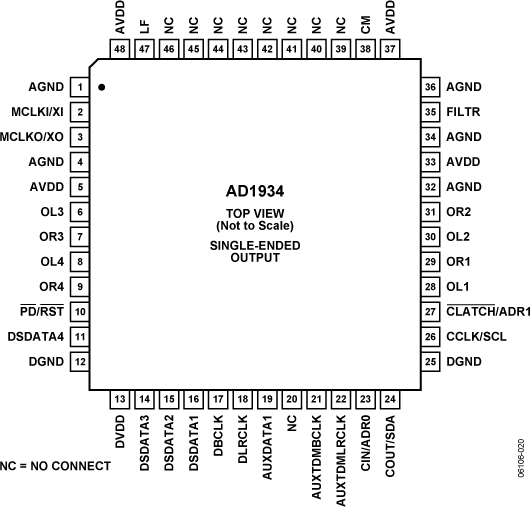
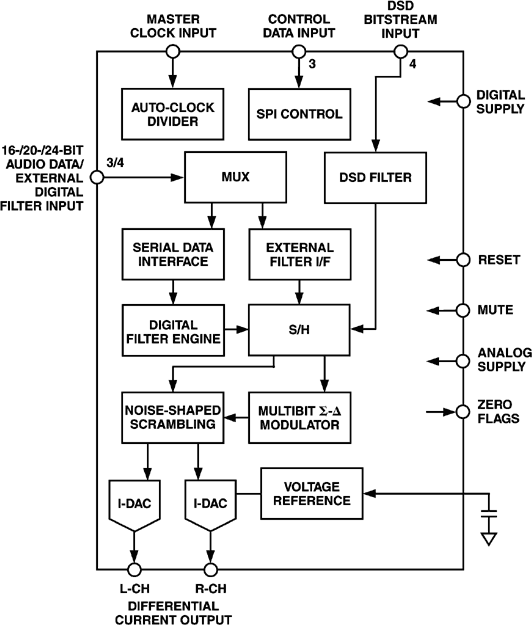
AD19348-Channel DAC with PLL, 192 kHz, 24 Bits | Integrated Circuits (ICs) | 4 | Active | The AD1934 is a high performance, single chip that provides eight digital-to-analog converters (DACs) with single-ended output using the Analog Devices, Inc., patented multibit sigma-delta (Σ-Δ) architecture. An SPI port is included, allowing a microcontroller to adjust volume and many other parameters. The AD1934 operates from 3.3 V digital and analog supplies. The AD1934 is available in a 48-lead (single-ended output) LQFP. Other members of this family include a differential DAC output and I2C®control port version.The AD1934 is designed for low EMI. This consideration is apparent in both the system and circuit design architectures. By using the on-board PLL to derive the master clock from the LR clock or from an external crystal, the AD1934 eliminates the need for a separate high frequency master clock and can also be used with a suppressed bit clock. The DACs are designed using the latest Analog Devices continuous time architectures to further minimize EMI. By using 3.3 V supplies, power consumption is minimized, further reducing emissions.APPLICATIONSAutomotive audio systemsHome theater systemsSet-top boxesDigital audio effects processors |
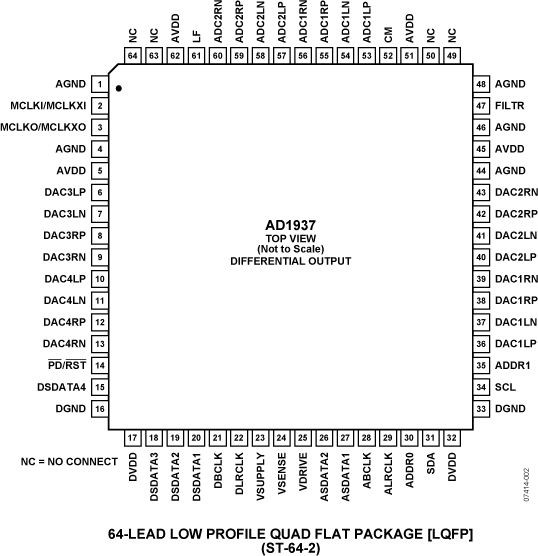
AD1937Four ADCs/Eight DACs with PLL, 192 kHz, 24-Bit Codec | CODECS | 2 | Active | The AD1937 is a high performance, single-chip codec that provides four analog-to-digital converters (ADCs) with differential input and eight digital-to-analog converters (DACs) with differential output, using the Analog Devices, Inc., patented multibit sigma-delta (Σ-Δ) architecture. An I2C® port is included, allowing a microcontroller to adjust volume and many other parameters. The AD1937 operates from 3.3 V digital and analog supplies. The AD1937 is available in a 64-lead (differential output) LQFP.The AD1937 is designed for low EMI. This consideration is apparent in both the system and circuit design architectures. By using the on-board PLL to derive the master clock from the LR (frame) clock or from an external crystal, the AD1937 eliminates the need for a separate high frequency master clock and can also be used with a suppressed bit clock. The DACs and ADCs are designed using the latest Analog Devices continuous time architecture to further minimize EMI. By using 3.3 V supplies, power consumption is minimized and further reduces emissions.ApplicationsAutomotive audio systemsHome theater systemsSet-top boxesDigital audio effects processorsData Sheet, Rev. 0, 9/08 |
| CODECs | 4 | Active | |
| Development Boards, Kits, Programmers | 4 | Active | |
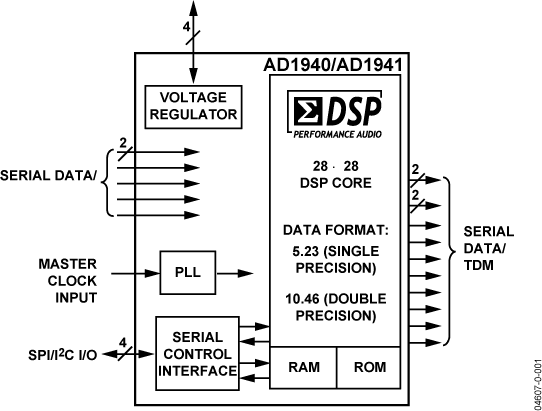
AD1940SigmaDSP®Multichannel 28-Bit Audio Processor | Evaluation and Demonstration Boards and Kits | 3 | Active | The AD1940 /AD1941are a complete 28-bit, single-chip, multi-channel audio SigmaDSP™for equalization, multiband dynamic processing, delay compensation, speaker compensation, and image enhancement. These algorithms can be used to compen-sate for the real world limitations of speakers, amplifiers, and listening environments, resulting in a dramatic improvement of perceived audio quality.The signal processing used in the AD1940 / AD1941 is comparable to that found in high end studio equipment. Most of the processing is done in full, 56-bit double-precision mode, resulting in very good, low level signal performance and the absence of limit cycles or idle tones. The dynamics processor uses a sophisticated, multiple-breakpoint algorithm often found in high end broadcast compressors.The AD1940 / AD1941 are a fully programmable DSP. Easy to use software allows the user to graphically configure a custom signal processing flow using blocks such as biquad filters, dynamics processors, and surround sound processors. An extensive control port allows click-free parameter updates, along with readback capability from any point in the algorithm flow.The AD1940 / AD1941’s digital input and output ports allow a glueless connection to ADCs and DACs by multiple, 2-channel serial data streams or TDM data streams. When in TDM mode, the AD1940 / AD1941 can input 8 or 16 channels of serial data, and can output 8 or 16 channels of serial data. The input and output port configurations can be individually set. The AD1940 is controlled by a 4-wire SPI®port; the AD1941 is controlled by a 2-wire I2C®bus. Other than the control interface, the functions of the two parts are identical.APPLICATIONSAutomotive sound systemsDigital televisionsHome theater systems (Dolby digital/DTS postprocessor)Multichannel audio systemsMini-component stereosMultimedia audioDigital speaker crossoverMusical instrumentsIn-seat sound systems (aircrafts/motor coaches) |
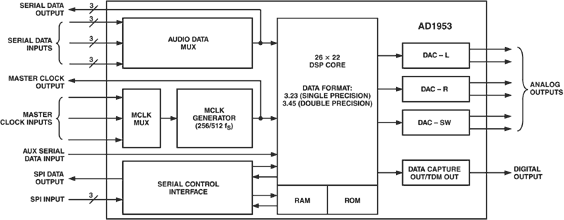
AD1953SigmaDSP®Digital Audio Processor | Digital to Analog Converters (DAC) | 4 | Active | The AD1953 is a complete, 26-bit, single-chip, 3-channel digital audio playback system with built-in DSP functionality. Key features include: 3 channels of digital audio, 6-channel TDM output mode, a 7-band, 48-bit stereo equalizer, delays for loudspeaker location adjustment, Phat Stereo™spatial enhancement, and a dual-band, professional-quality dynamics processor. Its three DACs achieve 112 dB signal-to-noise ratio (SNR) at 48 kHz. Its dynamic processing features include:Finely-tuned bass boost to enhance low frequencies for small loudspeakersAlgorithms that virtually increase loudness by removing distortion at high volumesMidnight mode which automatically reduces loudness in high-volume instances (e.g., sudden loud scenes on DVDs)Low-level expansion to lift low-volume signals above road noise (for car stereos)PRICING AND AVAILABILITY:The AD1953 SigmaDSP Digital Audio Processor is available in a 48-pin TQFP package and is rated for the extended −40°C to +105°C temperature range. The AD1953 is sampling now; production begins Fall 2002. Prices begin at $5.88 in 10,000-piece quantities.APPLICATIONS2.0/2.1 Channel Audio Systems (2 Main Channels Plus Subwoofer)Multichannel Automotive Sound SystemsMultimedia AudioMini Component StereoHome Theater Systems (AC-3 Postprocessor)Musical InstrumentsIn-Seat Sound Systems (Aircraft, Motor Coaches) |
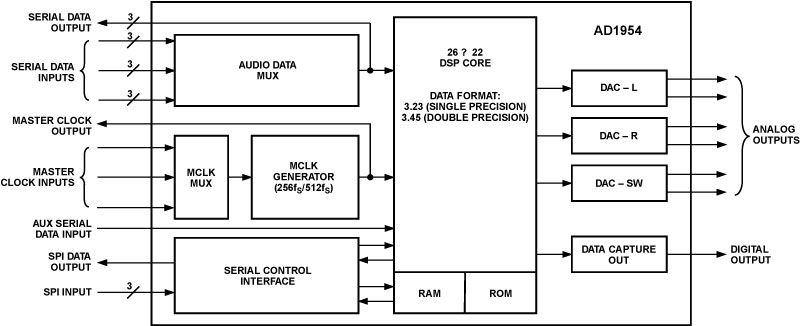
AD1954SigmaDSP®Digital Audio Processor with On-Board Converters | Digital to Analog Converters (DAC) | 5 | Active | The AD1954 is a complete 26-bit single-chip 3-channel digital audio playback system with built-in DSP functionality for speaker equalization, dual-band compression/limiting, delay compensation, and image enhancement. These algorithms can be used to compensate for real-world limitations of speakers, amplifiers, and listening environments, resulting in a dramatic improvement of perceived audio quality.The signal processing used in the AD1954 is comparable to that found in high-end studio equipment. Most of the processing is done in full 48-bit double-precision mode, resulting in very good low-level signal performance and the absence of limit cycles or idle tones. The compressor/limiter uses a sophisticated two-band algorithm often found in high-end broadcast compressors.An extensive SPI port allows click-free parameter updates, along with read-back capability from any point in the algorithm flow.The AD1954 includes ADI’s patented multibit sigma-delta DAC architecture. This architecture provides 112 dB SNR and dynamic range and THD+N of –100 dB. These specifications allow the AD1954 to be used in applications ranging from low-end boom boxes to high-end professional mixing/editing systems.The AD1954 also has a digital output that allows it to be used purely as a DSP. This digital output can also be used to drive an external DAC to extend the number of channels beyond the three that are provided on the chip.This chip can be used with either its default signal processing program or with a custom user-designed program. Graphical programming tools are available from ADI for custom programming.APPLICATIONS2.0/2.1 Channel Audio Systems (Two Main Channels plus Subwoofer)Multimedia AudioAutomotive Sound SystemsMinicomponent StereoHome Theater Systems (AC-3 Postprocessor)Musical InstrumentsIn-Seat Sound Systems (Aircraft, Motor Coaches) |
| Integrated Circuits (ICs) | 3 | Active | |
| Analog to Digital Converters (ADCs) Evaluation Boards | 5 | Active | |
| Integrated Circuits (ICs) | 1 | Active | |