Catalog
12 channel LED driver
Key Features
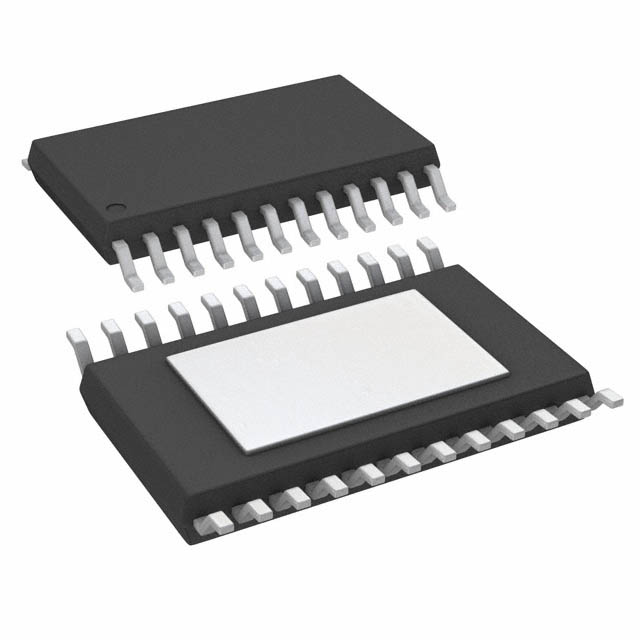
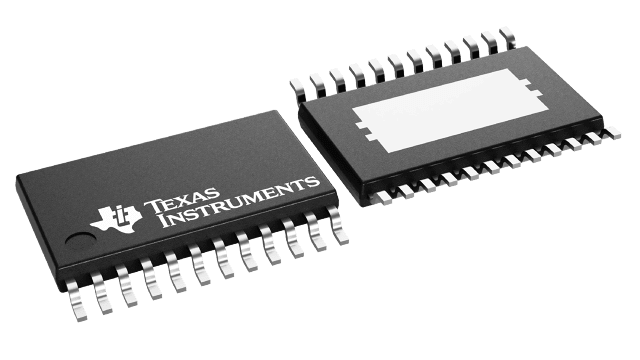
• 0.2-mA to 40-mA (Constant-Current Sink) Drive Capability x 12 Bits Output Count into 24-Pin HTSSOP Package1024 Gray-Scale Display (PWM Control 1024 Steps) with Max 25-MHz Clock Frequency3-Way Brightness AdjustmentPlane Brightness Adjustment for 64 Steps (40% to 100%)Frequency Division for 16 Steps (6.3% to 100%)Dot Correction for 256 Steps (0% to 100%)DS–Link Data Input/Output (Data Rate Max 20 bps) with Packet Operation5 Error Information Types and 2 Gray–Scale Clock Modes3.3-V VCCand LVTTL InterfaceAPPLICATIONFull- or Multi-Color LED Display0.2-mA to 40-mA (Constant-Current Sink) Drive Capability x 12 Bits Output Count into 24-Pin HTSSOP Package1024 Gray-Scale Display (PWM Control 1024 Steps) with Max 25-MHz Clock Frequency3-Way Brightness AdjustmentPlane Brightness Adjustment for 64 Steps (40% to 100%)Frequency Division for 16 Steps (6.3% to 100%)Dot Correction for 256 Steps (0% to 100%)DS–Link Data Input/Output (Data Rate Max 20 bps) with Packet Operation5 Error Information Types and 2 Gray–Scale Clock Modes3.3-V VCCand LVTTL InterfaceAPPLICATIONFull- or Multi-Color LED Display
Description
AI
The TLC5930 is a constant-current sink driver with an adjustable current value, and 1024 gray scale display that uses pulse width control. The output current is 0.2 mA to 40 mA with 12 bits of RGBx4. The maximum current value of the constant-current output can be set by one external resistor.
The TLC5930 includes three kinds of brightness adjustment functions: one adjusts the plane brightness between devices, changing the current values of all outputs uniformly. The second adjusts the frequency division to controls overall panel brightness, and the third adjusts the dot correction per LED, changing the current values of independent output.
The TLC5930 also includes color–tone correction function for correcting color per dot (pixel) and OVM function for constant-current output terminals used for LED failure detection.
Other features include the thermal error flag (TEF). The active wire-check (AWC) to check the communication between the controller and the device. The LED leakage-detect (LKD) to detect the reverse leakage on the LED. The GCLK error flag (GEF) and the HSYNC error flag (HEF) by monitoring the gray-scale clock count, and the dual source gray-scale clock (DSG) function to switch the gray-scale clock to the external input clock or to switch the internally-generated clock.
The TLC5930 requires three signals for standard operation: data input and gray-scale clock. Only three-signal line and 24-pin HTSSOP package reduce board area and total cost.
The TLC5930 is a constant-current sink driver with an adjustable current value, and 1024 gray scale display that uses pulse width control. The output current is 0.2 mA to 40 mA with 12 bits of RGBx4. The maximum current value of the constant-current output can be set by one external resistor.
The TLC5930 includes three kinds of brightness adjustment functions: one adjusts the plane brightness between devices, changing the current values of all outputs uniformly. The second adjusts the frequency division to controls overall panel brightness, and the third adjusts the dot correction per LED, changing the current values of independent output.
The TLC5930 also includes color–tone correction function for correcting color per dot (pixel) and OVM function for constant-current output terminals used for LED failure detection.
Other features include the thermal error flag (TEF). The active wire-check (AWC) to check the communication between the controller and the device. The LED leakage-detect (LKD) to detect the reverse leakage on the LED. The GCLK error flag (GEF) and the HSYNC error flag (HEF) by monitoring the gray-scale clock count, and the dual source gray-scale clock (DSG) function to switch the gray-scale clock to the external input clock or to switch the internally-generated clock.
The TLC5930 requires three signals for standard operation: data input and gray-scale clock. Only three-signal line and 24-pin HTSSOP package reduce board area and total cost.