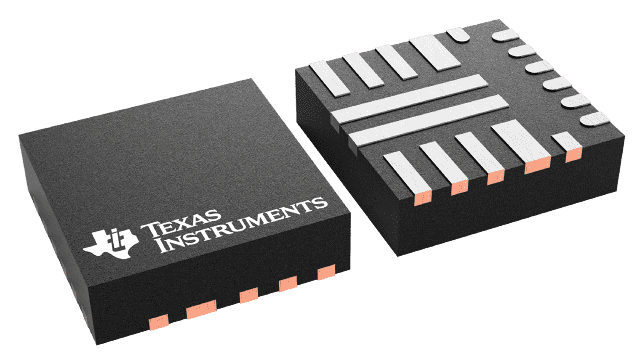
TPS56C231 Series
3.8-V to 17-V, 12-A synchronous buck converter with D-CAP3 control
Manufacturer: Texas Instruments
Catalog
3.8-V to 17-V, 12-A synchronous buck converter with D-CAP3 control
Key Features
• 4.5-V to 17-V input range without external bias3.8-V to 17-V input range with external biasSupports 12-A continuous output currentTPS56C231 supports 15-A peak currentIntegrated 7.8-mΩ and 3.2-mΩ MOSFETs0.6-V ±1% reference voltage across a –40°C to 125°C junction temperature range0.6-V to 5.5-V output voltage range146-µA low quiescent currentD-CAP3™ control mode for fast transient responseSupports ceramic output capacitorsSelectable fSWof 400 kHz, 800 kHz, and 1200 kHzSelectable FCCM (forced continuous conduction mode) for tight output voltage rippleSelectable Eco-mode (auto skip mode) for high light-load efficiencyOptional external 5-V bias for enhanced efficiencyPrebiased start-up capabilityAdjustable soft start with a default 1.2-ms soft-start timePower-good indicator to monitor output voltageTwo adjustable current limit settings with hiccup restart: TPS56C231 (14.7 A, 17 A) and TPS56C231L (11.5 A, 13.8 A)Non-latched protections for UV, OV, OT, and UVLOPin-to-pin compatible with 12-ATPS56C215, and 8-ATPS568231andTPS568215–40°C to 125°C operating junction temperature3.5-mm × 3.5-mm, 18-pin HotRod™ QFN package4.5-V to 17-V input range without external bias3.8-V to 17-V input range with external biasSupports 12-A continuous output currentTPS56C231 supports 15-A peak currentIntegrated 7.8-mΩ and 3.2-mΩ MOSFETs0.6-V ±1% reference voltage across a –40°C to 125°C junction temperature range0.6-V to 5.5-V output voltage range146-µA low quiescent currentD-CAP3™ control mode for fast transient responseSupports ceramic output capacitorsSelectable fSWof 400 kHz, 800 kHz, and 1200 kHzSelectable FCCM (forced continuous conduction mode) for tight output voltage rippleSelectable Eco-mode (auto skip mode) for high light-load efficiencyOptional external 5-V bias for enhanced efficiencyPrebiased start-up capabilityAdjustable soft start with a default 1.2-ms soft-start timePower-good indicator to monitor output voltageTwo adjustable current limit settings with hiccup restart: TPS56C231 (14.7 A, 17 A) and TPS56C231L (11.5 A, 13.8 A)Non-latched protections for UV, OV, OT, and UVLOPin-to-pin compatible with 12-ATPS56C215, and 8-ATPS568231andTPS568215–40°C to 125°C operating junction temperature3.5-mm × 3.5-mm, 18-pin HotRod™ QFN package
Description
AI
The TPS56C231 is a small, high-efficiency, synchronous buck converter with an adaptive on-time D-CAP3 control mode. Because external compensation is not required, the device is easy to use and requires few external components. The device is well-suited for space-constrained data center applications.
The TPS56C231 has competitive features including a very accurate reference voltage, fast load transient response, and no requirement for external compensation, adjustable current limit, and both Eco-mode and FCCM operation modes for selection at light-load condition through the configuration of the MODE pin. To attain high efficiency at light load, Eco-mode can be selected. To support tight output voltage ripple requirement, FCCM can be selected. The TPS56C231 operates from a –40°C to 125°C junction temperature range.
The TPS56C231 is a small, high-efficiency, synchronous buck converter with an adaptive on-time D-CAP3 control mode. Because external compensation is not required, the device is easy to use and requires few external components. The device is well-suited for space-constrained data center applications.
The TPS56C231 has competitive features including a very accurate reference voltage, fast load transient response, and no requirement for external compensation, adjustable current limit, and both Eco-mode and FCCM operation modes for selection at light-load condition through the configuration of the MODE pin. To attain high efficiency at light load, Eco-mode can be selected. To support tight output voltage ripple requirement, FCCM can be selected. The TPS56C231 operates from a –40°C to 125°C junction temperature range.