BQ24616 Series
Standalone 1-6 cell Buck battery charge controller with JEITA compliance
Manufacturer: Texas Instruments
Catalog
Standalone 1-6 cell Buck battery charge controller with JEITA compliance
Key Features
• Battery Thermistor Sense for JEITA GuidelineCompatible Charger600-kHz NMOS-NMOS Synchronous BuckConverterStand-Alone Charger Support for Li-Ion or Li-Polymer5-V–28-V VCC Input Operating Range andSupports 1 to 6 Battery CellsUp to 10-A Charge Current and Adapter CurrentHigh-Accuracy Voltage and Current Regulation±0.5% Charge Voltage Accuracy±3% Charge Current Accuracy±3% Adapter Current AccuracyIntegrationAutomatic System Power Selection FromAdapter or BatteryInternal Loop CompensationInternal Soft-StartDynamic Power ManagementSafety ProtectionInput Overvoltage ProtectionBattery DetectionReverse Protection Input FETProgrammable Safety TimerCharge Overcurrent ProtectionBattery Short ProtectionBattery Overvoltage ProtectionThermal ShutdownStatus OutputsAdapter PresentCharger Operation StatusCharge Enable Pin6-V Gate Drive for Synchronous Buck Converter30-ns Driver Dead-Time and 99.5% MaximumEffective Duty Cycle24-Pin, 4-mm × 4-mm QFN PackageEnergy Star Low Quiescent Current Iq< 15-µA Off-State Battery Discharge Current< 1.5-mA Off-State Input Quiescent CurrentBattery Thermistor Sense for JEITA GuidelineCompatible Charger600-kHz NMOS-NMOS Synchronous BuckConverterStand-Alone Charger Support for Li-Ion or Li-Polymer5-V–28-V VCC Input Operating Range andSupports 1 to 6 Battery CellsUp to 10-A Charge Current and Adapter CurrentHigh-Accuracy Voltage and Current Regulation±0.5% Charge Voltage Accuracy±3% Charge Current Accuracy±3% Adapter Current AccuracyIntegrationAutomatic System Power Selection FromAdapter or BatteryInternal Loop CompensationInternal Soft-StartDynamic Power ManagementSafety ProtectionInput Overvoltage ProtectionBattery DetectionReverse Protection Input FETProgrammable Safety TimerCharge Overcurrent ProtectionBattery Short ProtectionBattery Overvoltage ProtectionThermal ShutdownStatus OutputsAdapter PresentCharger Operation StatusCharge Enable Pin6-V Gate Drive for Synchronous Buck Converter30-ns Driver Dead-Time and 99.5% MaximumEffective Duty Cycle24-Pin, 4-mm × 4-mm QFN PackageEnergy Star Low Quiescent Current Iq< 15-µA Off-State Battery Discharge Current< 1.5-mA Off-State Input Quiescent Current
Description
AI
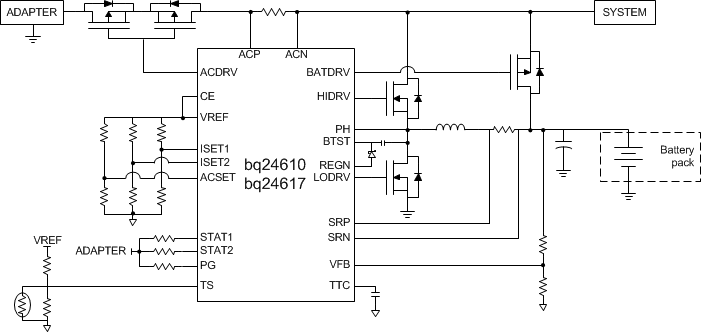
The bq2461x device is a highly integrated, Japan Electronic Information Technology Association (JEITA) guideline-compatible, Li-ion or Li-polymer switched-mode battery charge controller. The device offers a constant-frequency synchronous switching PWM controller with high-accuracy charge current and voltage regulation, charge preconditioning, termination, adapter current regulation, and charge status monitoring
The bq2461x charges the battery in three phases: preconditioning, constant current, and constant voltage. Charge is terminated when the current reaches a minimum user-selectable level. A programmable charge timer provides a safety backup. The bq2461x automatically restarts the charge cycle if the battery voltage falls below an internal threshold, and enters a low quiescent current sleep mode when the input voltage falls below the battery voltage.
The bq2461x device is a highly integrated, Japan Electronic Information Technology Association (JEITA) guideline-compatible, Li-ion or Li-polymer switched-mode battery charge controller. The device offers a constant-frequency synchronous switching PWM controller with high-accuracy charge current and voltage regulation, charge preconditioning, termination, adapter current regulation, and charge status monitoring
The bq2461x charges the battery in three phases: preconditioning, constant current, and constant voltage. Charge is terminated when the current reaches a minimum user-selectable level. A programmable charge timer provides a safety backup. The bq2461x automatically restarts the charge cycle if the battery voltage falls below an internal threshold, and enters a low quiescent current sleep mode when the input voltage falls below the battery voltage.