Catalog
Quadruple Low-Power Differential Line Receiver
Key Features
• Designed for TIA/EIA-485, TIA/EIA-422, and ISO 8482 ApplicationsSignaling Rate(1)Exceeding 50 MbpsFail-Safe in Bus Short-Circuit, Open-Circuit, and Idle-Bus ConditionsESD Protection on Bus Inputs Exceeds 6 kVCommon-Mode Bus Input Range –7 V to 12 VPropagation Delay Times <16 nsLow Standby Power Consumption <20 µAPin-Compatible Upgrade for AM26LS32, DS96F173, LTC488, and SN75173(1)The signaling rate of a line is the number of voltage transitions that are made per second expressed in the units bps (bits per second).Designed for TIA/EIA-485, TIA/EIA-422, and ISO 8482 ApplicationsSignaling Rate(1)Exceeding 50 MbpsFail-Safe in Bus Short-Circuit, Open-Circuit, and Idle-Bus ConditionsESD Protection on Bus Inputs Exceeds 6 kVCommon-Mode Bus Input Range –7 V to 12 VPropagation Delay Times <16 nsLow Standby Power Consumption <20 µAPin-Compatible Upgrade for AM26LS32, DS96F173, LTC488, and SN75173(1)The signaling rate of a line is the number of voltage transitions that are made per second expressed in the units bps (bits per second).
Description
AI
The SN65LBC173A and SN75LBC173A are quadruple differential line receivers with 3-state outputs, designed for TIA/EIA-485 (RS-485), TIA/EIA-422 (RS-422), and ISO 8482 (Euro RS-485) applications.
These devices are optimized for balanced multipoint bus communication at data rates up to and exceeding 50 million bits per second. The transmission media may be twisted-pair cables, printed-circuit board traces, or backplanes. The ultimate rate and distance of data transfer is dependent upon the attenuation characteristics of the media and the noise coupling to the environment.
Each receiver operates over a wide range of positive and negative common-mode input voltages, and features ESD protection to 6 kV, making it suitable for high-speed multipoint data transmission applications in harsh environments. These devices are designed using LinBiCMOSt, facilitating low power consumption and robustness.
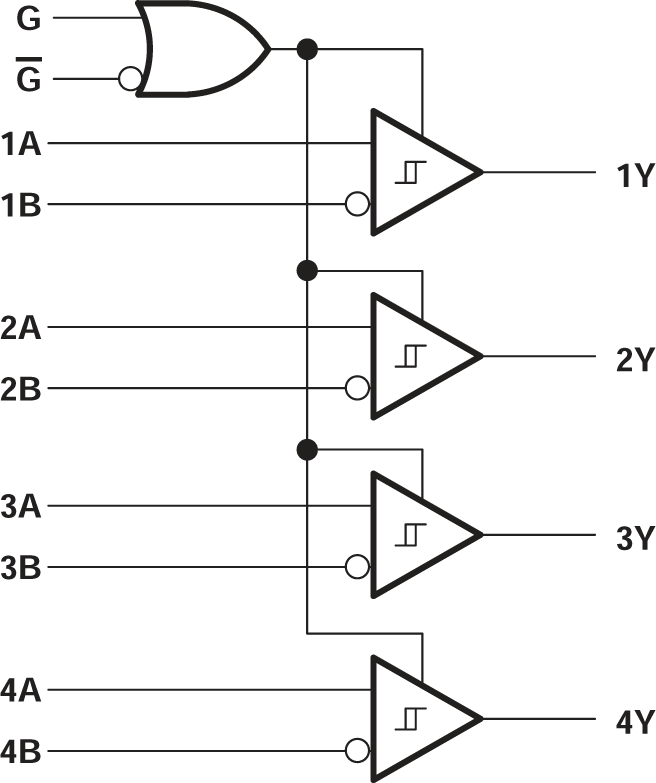
The G and G inputs provide enable control logic for either positive- or negative-logic enabling all four drivers. When disabled or powered off, the receiver inputs present a high-impedance to the bus for reduced system loading.
The SN75LBC173A is characterized for operation over the temperature range of 0°C to 70°C. The SN65LBC173A is characterized over the temperature range from −40°C to 85°C.
The SN65LBC173A and SN75LBC173A are quadruple differential line receivers with 3-state outputs, designed for TIA/EIA-485 (RS-485), TIA/EIA-422 (RS-422), and ISO 8482 (Euro RS-485) applications.
These devices are optimized for balanced multipoint bus communication at data rates up to and exceeding 50 million bits per second. The transmission media may be twisted-pair cables, printed-circuit board traces, or backplanes. The ultimate rate and distance of data transfer is dependent upon the attenuation characteristics of the media and the noise coupling to the environment.
Each receiver operates over a wide range of positive and negative common-mode input voltages, and features ESD protection to 6 kV, making it suitable for high-speed multipoint data transmission applications in harsh environments. These devices are designed using LinBiCMOSt, facilitating low power consumption and robustness.
The G and G inputs provide enable control logic for either positive- or negative-logic enabling all four drivers. When disabled or powered off, the receiver inputs present a high-impedance to the bus for reduced system loading.
The SN75LBC173A is characterized for operation over the temperature range of 0°C to 70°C. The SN65LBC173A is characterized over the temperature range from −40°C to 85°C.