


TDC1000-Q1 Series
Automotive Ultrasonic Sensing Analog Front End for Level and Concentration Sensing
Manufacturer: Texas Instruments
Catalog
Automotive Ultrasonic Sensing Analog Front End for Level and Concentration Sensing
Key Features
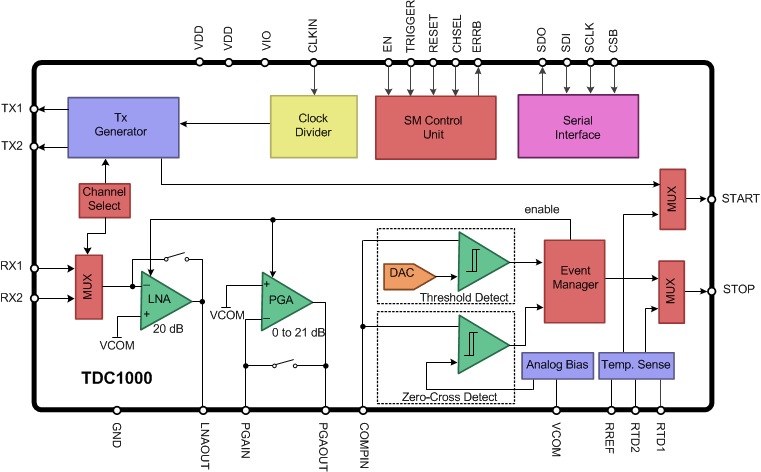
• AEC-Q100 qualified for automotive applications:Temperature grade 1: –40°C to +125°C, TAMeasurement range: up to 8 msOperating current: 1.8 µA (2 SPS)Transmitter channels TX1/TX2:Supports single or dual-transducer applicationProgrammable excitation: 31.25 kHz to 4 MHz, up to 31 pulsesReceiver channels RX1/RX2:STOP cycle-to-cycle jitter: 50 psRMSLow-noise and programmable gain amplifiersAccess to signal chain for external filter designProgrammable threshold comparator for echo qualificationAutomatic channel swapping for differential Time-of-Flight (TOF) measurementProgrammable low power mode for long TOF measurementsTemperature measurementInterface to two PT1000/500 RTDsRTD-to-RTD matching accuracy 0.02°CRMSOperating temperature range: –40°C to 125°CAEC-Q100 qualified for automotive applications:Temperature grade 1: –40°C to +125°C, TAMeasurement range: up to 8 msOperating current: 1.8 µA (2 SPS)Transmitter channels TX1/TX2:Supports single or dual-transducer applicationProgrammable excitation: 31.25 kHz to 4 MHz, up to 31 pulsesReceiver channels RX1/RX2:STOP cycle-to-cycle jitter: 50 psRMSLow-noise and programmable gain amplifiersAccess to signal chain for external filter designProgrammable threshold comparator for echo qualificationAutomatic channel swapping for differential Time-of-Flight (TOF) measurementProgrammable low power mode for long TOF measurementsTemperature measurementInterface to two PT1000/500 RTDsRTD-to-RTD matching accuracy 0.02°CRMSOperating temperature range: –40°C to 125°C
Description
AI
The TDC1000-Q1 is a fully integrated analog front-end (AFE) for ultrasonic sensing measurements of level, fluid identification/concentration, and proximity/distance applications common in automotive, industrial, and consumer markets. When paired with an MSP430/C2000 MCU, power, wireless, and source code, TI provides the complete ultrasonic sensing solution.
TI’s Ultrasonic AFE offers programmability and flexibility to accommodate a wide-range of applications and end equipment. The TDC1000-Q1 can be configured for multiple transmit pulses and frequencies, gain, and signal thresholds for use with a wide-range of transducer frequencies (31.25 kHz to 4 MHz) and Q-factors. Similarly, the programmability of the receive path allows ultrasonic waves to be detected over a wider range of distances/tank sizes and through various mediums.
Selecting different modes of operation, the TDC1000-Q1 can be optimized for low power consumption for battery-powered flow meters, level instrumentation, and distance/proximity measurements. The low noise amplifiers and comparators provide extremely low jitter, enabling picosecond resolution and accuracy for zero and low flow measurements.
The TDC1000-Q1 is a fully integrated analog front-end (AFE) for ultrasonic sensing measurements of level, fluid identification/concentration, and proximity/distance applications common in automotive, industrial, and consumer markets. When paired with an MSP430/C2000 MCU, power, wireless, and source code, TI provides the complete ultrasonic sensing solution.
TI’s Ultrasonic AFE offers programmability and flexibility to accommodate a wide-range of applications and end equipment. The TDC1000-Q1 can be configured for multiple transmit pulses and frequencies, gain, and signal thresholds for use with a wide-range of transducer frequencies (31.25 kHz to 4 MHz) and Q-factors. Similarly, the programmability of the receive path allows ultrasonic waves to be detected over a wider range of distances/tank sizes and through various mediums.
Selecting different modes of operation, the TDC1000-Q1 can be optimized for low power consumption for battery-powered flow meters, level instrumentation, and distance/proximity measurements. The low noise amplifiers and comparators provide extremely low jitter, enabling picosecond resolution and accuracy for zero and low flow measurements.
