Catalog
Isolated 5-V CAN transceiver
Key Features
• Meets the requirements of ISO11898-25000-V RMS isolation (ISO1050DW)2500-V RMS isolation (ISO1050DUB)Fail-safe outputsLow loop delay: 150 ns (typical), 210 ns (maximum)50-kV/µs typical transient immunityBus-fault protection of –27 V to 40 VDriver (TXD) dominant time-out functionI/O voltage range supports 3.3 V and 5 V microprocessorsSafety-related certificationsVDE approval per DIN EN IEC 60747-17 (VDE 0884-17)UL 1577 approvedCSA approved for IEC 61010-1, IEC 60601-1TUV Reinforced Insulation Approval for EN/UL/CSA 62368-1 (ISO1050DW-Only)CQC reinforced insulation per GB4943.1 (ISO1050DW-only)Typical 25-year life at rated working voltage (see application reportSLLA197and Life Expectancy vs Working Voltage)Meets the requirements of ISO11898-25000-V RMS isolation (ISO1050DW)2500-V RMS isolation (ISO1050DUB)Fail-safe outputsLow loop delay: 150 ns (typical), 210 ns (maximum)50-kV/µs typical transient immunityBus-fault protection of –27 V to 40 VDriver (TXD) dominant time-out functionI/O voltage range supports 3.3 V and 5 V microprocessorsSafety-related certificationsVDE approval per DIN EN IEC 60747-17 (VDE 0884-17)UL 1577 approvedCSA approved for IEC 61010-1, IEC 60601-1TUV Reinforced Insulation Approval for EN/UL/CSA 62368-1 (ISO1050DW-Only)CQC reinforced insulation per GB4943.1 (ISO1050DW-only)Typical 25-year life at rated working voltage (see application reportSLLA197and Life Expectancy vs Working Voltage)
Description
AI
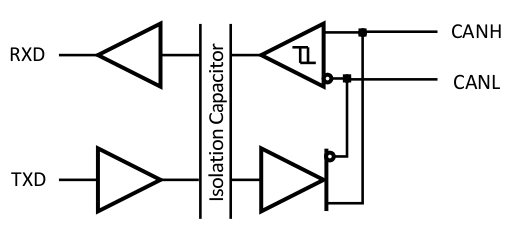
The ISO1050 is a galvanically isolated CAN transceiver that meets the specifications of the ISO11898-2 standard. The device has the logic input and output buffers separated by a silicon oxide (SiO 2) insulation barrier that provides galvanic isolation of up to 5000 V RMS for ISO1050DW and 2500 V RMS for ISO1050DUB. Used in conjunction with isolated power supplies, the device prevents noise currents on a data bus or other circuits from entering the local ground and interfering with or damaging sensitive circuitry.
As a CAN transceiver, the device provides differential transmit capability to the bus and differential receive capability to a CAN controller at signaling rates up to 1 megabit per second (Mbps). The device is designed for operation in especially harsh environments, and it features cross-wire, overvoltage and loss of ground protection from –27 V to 40 V and overtemperature shutdown, as well as –12V to 12V common-mode range.
The ISO1050 is characterized for operation over the ambient temperature range of –55°C to 105°C.
The ISO1050 is a galvanically isolated CAN transceiver that meets the specifications of the ISO11898-2 standard. The device has the logic input and output buffers separated by a silicon oxide (SiO 2) insulation barrier that provides galvanic isolation of up to 5000 V RMS for ISO1050DW and 2500 V RMS for ISO1050DUB. Used in conjunction with isolated power supplies, the device prevents noise currents on a data bus or other circuits from entering the local ground and interfering with or damaging sensitive circuitry.
As a CAN transceiver, the device provides differential transmit capability to the bus and differential receive capability to a CAN controller at signaling rates up to 1 megabit per second (Mbps). The device is designed for operation in especially harsh environments, and it features cross-wire, overvoltage and loss of ground protection from –27 V to 40 V and overtemperature shutdown, as well as –12V to 12V common-mode range.
The ISO1050 is characterized for operation over the ambient temperature range of –55°C to 105°C.