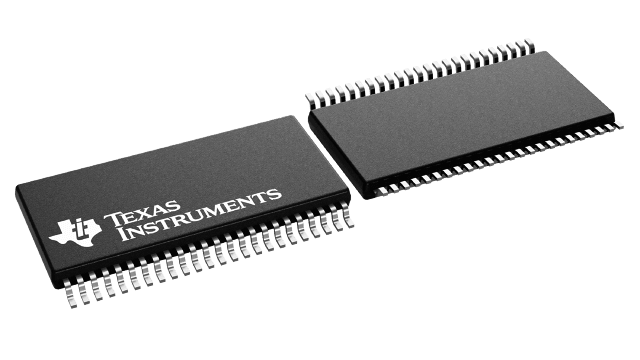
SN74ALB16244 Series
16-ch, 3-V to 3.6-V bipolar buffers with 3-state outputs
Manufacturer: Texas Instruments
Catalog
16-ch, 3-V to 3.6-V bipolar buffers with 3-state outputs
Key Features
• Member of Texas Instruments' WidebusTMFamilyState-of-the-Art Advanced Low-Voltage BiCMOS (ALB) Technology Design for 3.3-V OperationSchottky Diodes on All Inputs to Eliminate Overshoot and UndershootIndustry Standard '16244 PinoutDistributed VCCand GND Pins Minimize High-Speed Switching NoiseFlow-Through Architecture Optimizes PCB LayoutWidebus is a trademark of Texas Instruments.Member of Texas Instruments' WidebusTMFamilyState-of-the-Art Advanced Low-Voltage BiCMOS (ALB) Technology Design for 3.3-V OperationSchottky Diodes on All Inputs to Eliminate Overshoot and UndershootIndustry Standard '16244 PinoutDistributed VCCand GND Pins Minimize High-Speed Switching NoiseFlow-Through Architecture Optimizes PCB LayoutWidebus is a trademark of Texas Instruments.
Description
AI
The SN74ALB16244 16-bit buffer and line driver is designed for high-speed, low-voltage (3.3-V) VCCoperation. This device is intended to replace the conventional driver in any speed-critical path. The small propagation delay is achieved using a unity-gain amplifier on the input and feedback resistors from input to output, which allows the output to track the input with a small offset voltage.
The device can be used as four 4-bit buffers, two 8-bit buffers, or one 16-bit buffer. This device provides true outputs and symmetrical active-low output-enable (OE\) inputs.
The SN74ALB16244 16-bit buffer and line driver is designed for high-speed, low-voltage (3.3-V) VCCoperation. This device is intended to replace the conventional driver in any speed-critical path. The small propagation delay is achieved using a unity-gain amplifier on the input and feedback resistors from input to output, which allows the output to track the input with a small offset voltage.
The device can be used as four 4-bit buffers, two 8-bit buffers, or one 16-bit buffer. This device provides true outputs and symmetrical active-low output-enable (OE\) inputs.