


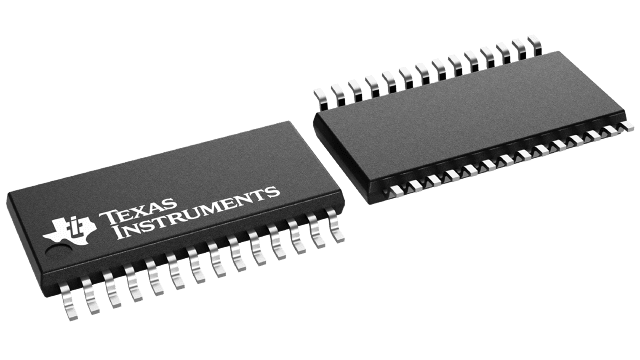
ADS1234 Series
24-Bit, 80SPS, 4-Ch (Differential), Pin-Programmable Delta-Sigma ADC for Bridge Sensors
Manufacturer: Texas Instruments
Catalog
24-Bit, 80SPS, 4-Ch (Differential), Pin-Programmable Delta-Sigma ADC for Bridge Sensors
Key Features
• Complete front-end for bridge sensors23.5-bits effective resolution at gain = 119.2-bits noise-free resolution at gain = 64Low-noise PGASelectable gains of 1, 2, 64, and 128RMS noise:17 nV at 10 SPS at gain = 12844 nV at 80 SPS at gain = 128100-dB simultaneous 50-Hz and 60-Hz rejectionFlexible clocking:Low-drift internal oscillatorOptional external crystalSelectable 10-SPS or 80-SPS data ratesEasy ratiometric measurements:External voltage reference up to 5 VTwo-channel differential input with internal temperature sensor (ADS1232)Four-channel differential input (ADS1234)Two-wire serial interfaceSupply voltage range: 2.7 V to 5.3 VTemperature range: –40°C to +105°CPackages: TSSOP-24 (ADS1232) or TSSOP-28 (ADS1234)Complete front-end for bridge sensors23.5-bits effective resolution at gain = 119.2-bits noise-free resolution at gain = 64Low-noise PGASelectable gains of 1, 2, 64, and 128RMS noise:17 nV at 10 SPS at gain = 12844 nV at 80 SPS at gain = 128100-dB simultaneous 50-Hz and 60-Hz rejectionFlexible clocking:Low-drift internal oscillatorOptional external crystalSelectable 10-SPS or 80-SPS data ratesEasy ratiometric measurements:External voltage reference up to 5 VTwo-channel differential input with internal temperature sensor (ADS1232)Four-channel differential input (ADS1234)Two-wire serial interfaceSupply voltage range: 2.7 V to 5.3 VTemperature range: –40°C to +105°CPackages: TSSOP-24 (ADS1232) or TSSOP-28 (ADS1234)
Description
AI
The ADS1232 and ADS1234 (ADS123x) are precision, 24-bit, analog-to-digital converters (ADCs). With a low-noise programmable gain amplifier (PGA), a precision delta-sigma ADC, and internal oscillator, the ADS123x provide a complete front-end solution for bridge sensor applications including weigh scales, strain gauges, and pressure sensors.
An input multiplexer (MUX) accepts either two (ADS1232) or four (ADS1234) differential inputs. The ADS1232 also includes a temperature sensor to monitor ambient temperature. The low-noise PGA has a selectable gain of 1, 2, 64, or 128, supporting a full-scale differential input of ±2.5 V, ±1.25 V, ±39 mV, or ±19.5 mV.
The delta-sigma ADC provides a maximum of 23.5-bits effective resolution, and supports two data rates: 10 SPS (providing 50-Hz and 60-Hz rejection) and 80 SPS. The ADS123x can be clocked externally using an oscillator or a crystal, or by the internal oscillator.
Offset calibration is performed on-demand, and the ADS123x can be put in a low-power standby mode or shut off completely in power-down mode. The ADS123x are operated through simple pin-driven control—there are no digital registers to program.
Data are output over a two-wire serial interface that connects directly to the MSP430 and other microcontrollers.
The ADS1232 and ADS1234 (ADS123x) are precision, 24-bit, analog-to-digital converters (ADCs). With a low-noise programmable gain amplifier (PGA), a precision delta-sigma ADC, and internal oscillator, the ADS123x provide a complete front-end solution for bridge sensor applications including weigh scales, strain gauges, and pressure sensors.
An input multiplexer (MUX) accepts either two (ADS1232) or four (ADS1234) differential inputs. The ADS1232 also includes a temperature sensor to monitor ambient temperature. The low-noise PGA has a selectable gain of 1, 2, 64, or 128, supporting a full-scale differential input of ±2.5 V, ±1.25 V, ±39 mV, or ±19.5 mV.
The delta-sigma ADC provides a maximum of 23.5-bits effective resolution, and supports two data rates: 10 SPS (providing 50-Hz and 60-Hz rejection) and 80 SPS. The ADS123x can be clocked externally using an oscillator or a crystal, or by the internal oscillator.
Offset calibration is performed on-demand, and the ADS123x can be put in a low-power standby mode or shut off completely in power-down mode. The ADS123x are operated through simple pin-driven control—there are no digital registers to program.
Data are output over a two-wire serial interface that connects directly to the MSP430 and other microcontrollers.
