


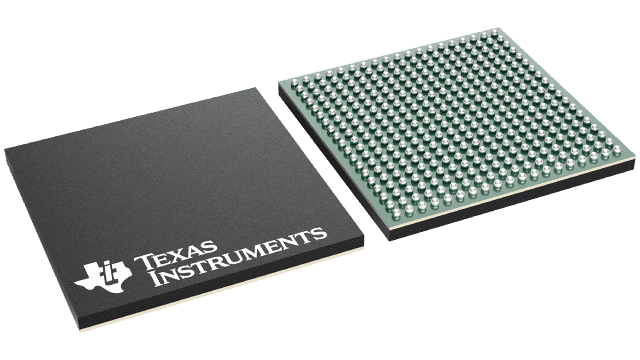
OMAPL138B-EP Series
Enhanced product low power C674x floating-point DSP + Arm9 processor - 345 MHz
Manufacturer: Texas Instruments
Catalog
Enhanced product low power C674x floating-point DSP + Arm9 processor - 345 MHz
Key Features
• HighlightsDual Core SoC345-MHz ARM926EJ-S™ RISC MPU345-MHz C674x Fixed/Floating-Point VLIW DSPSupports TI’s Basic Secure BootEnhanced Direct-Memory-Access Controller (EDMA3)Serial ATA (SATA) ControllerDDR2/Mobile DDR Memory ControllerTwo Multimedia Card (MMC)/Secure Digital (SD) Card InterfaceLCD ControllerVideo Port Interface (VPIF)10/100 Mb/s Ethernet MAC (EMAC)Programmable Real-Time Unit SubsystemThree Configurable UART ModulesUSB 1.1 OHCI (Host) With Integrated PHYOne Multichannel Audio Serial PortTwo Multichannel Buffered Serial PortsDual Core SoC345-MHz ARM926EJ-S™ RISC MPU345-MHz C674x Fixed/Floating-Point VLIW DSPARM926EJ-S Core32-Bit and 16-Bit (Thumb®) InstructionsDSP Instruction ExtensionsSingle Cycle MACARM® Jazelle® TechnologyEmbeddedICE-RT™ for Real-Time DebugARM9 Memory Architecture16K-Byte Instruction Cache16K-Byte Data Cache8K-Byte RAM (Vector Table)64K-Byte ROMC674x™ Instruction Set FeaturesSuperset of the C67x+™ and C64x+™ ISAsUp to 3648/2746 C674x MIPS/MFLOPSByte-Addressable (8-/16-/32-/64-Bit Data)8-Bit Overflow ProtectionBit-Field Extract, Set, ClearNormalization, Saturation, Bit-CountingCompact 16-Bit InstructionsC674x Two Level Cache Memory Architecture32K-Byte L1P Program RAM/Cache32K-Byte L1D Data RAM/Cache256K-Byte L2 Unified Mapped RAM/CacheFlexible RAM/Cache Partition (L1 and L2)Enhanced Direct-Memory-Access Controller 3 (EDMA3):2 Channel Controllers3 Transfer Controllers64 Independent DMA Channels16 Quick DMA ChannelsProgrammable Transfer Burst SizeTMS320C674x Floating-Point VLIW DSP CoreLoad-Store Architecture With Non-Aligned Support64 General-Purpose Registers (32 Bit)Six ALU (32-/40-Bit) Functional UnitsSupports 32-Bit Integer, SP (IEEE Single Precision/32-Bit)and DP (IEEE Double Precision/64-Bit) Floating PointSupports up to Four SP Additions Per Clock, Four DPAdditions Every 2 ClocksSupports up to Two Floating Point (SP or DP)Reciprocal Approximation (RCPxP) and Square-Root ReciprocalApproximation (RSQRxP) Operations Per CycleTwo Multiply Functional UnitsMixed-Precision IEEE Floating PointMultiply Supported up to:2 SP x SP → SP Per Clock2 SP x SP → DP Every Two Clocks2 SP x DP → DP Every Three Clocks2 DP x DP → DP Every Four ClocksFixed Point Multiply Supports Two 32 × 32-Bit Multiplies,Four 16 × 16-Bit Multiplies, or Eight 8 × 8-BitMultiplies per Clock Cycle, and Complex MultiplesInstruction Packing Reduces Code SizeAll Instructions ConditionalHardware Support for Modulo Loop OperationProtected Mode OperationExceptions Support for Error Detection and Program RedirectionSoftware SupportTI DSP/BIOS™Chip Support Library and DSP Library128K-Byte RAM Shared Memory1.8V or 3.3V LVCMOS IOs (except for USB and DDR2 interfaces)Two External Memory Interfaces:EMIFANOR (8-/16-Bit-Wide Data)NAND (8-/16-Bit-Wide Data)16-Bit SDRAM With 128 MB Address SpaceDDR2/Mobile DDR Memory Controller16-Bit DDR2 SDRAM With 512 MB Address Space or16-Bit mDDR SDRAM With 256 MB Address SpaceThree Configurable 16550 type UART Modules:With Modem Control Signals16-byte FIFO16x or 13x Oversampling OptionLCD ControllerTwo Serial Peripheral Interfaces (SPI) Each With Multiple Chip-SelectsTwo Multimedia Card (MMC)/Secure Digital (SD) Card Interface withSecure Data I/O (SDIO) InterfacesTwo Master/Slave Inter-Integrated Circuit (I2C Bus™)One Host-Port Interface (HPI) With 16-Bit-Wide Muxed Address/Data BusFor High BandwidthProgrammable Real-Time Unit Subsystem (PRUSS)Two Independent Programmable Realtime Unit (PRU) Cores32-Bit Load/Store RISC architecture4K Byte instruction RAM per core512 Bytes data RAM per corePRU Subsystem (PRUSS) can be disabled via software to save powerRegister 30 of each PRU is exported from the subsystem in addition to thenormal R31 output of the PRU cores.Standard power management mechanismClock gatingEntire subsystem under a single PSC clock gating domainDedicated interrupt controllerDedicated switched central resourceUSB 1.1 OHCI (Host) With Integrated PHY (USB1)USB 2.0 OTG Port With Integrated PHY (USB0)USB 2.0 High-/Full-Speed ClientUSB 2.0 High-/Full-/Low-Speed HostEnd Point 0 (Control)End Points 1,2,3,4 (Control, Bulk, Interrupt or ISOC) Rx and TxOne Multichannel Audio Serial Port:Two Clock Zones and 16 Serial Data PinsSupports TDM, I2S, and Similar FormatsDIT-CapableFIFO buffers for Transmit and ReceiveTwo Multichannel Buffered Serial Ports:Supports TDM, I2S, and Similar FormatsAC97 Audio Codec InterfaceTelecom Interfaces (ST-Bus, H100)128-channel TDMFIFO buffers for Transmit and Receive10/100 Mb/s Ethernet MAC (EMAC):IEEE 802.3 CompliantMII Media Independent InterfaceRMII Reduced Media Independent InterfaceManagement Data I/O (MDIO) ModuleVideo Port Interface (VPIF):Two 8-bit SD (BT.656), Single 16-bit or Single Raw (8-/10-/12-bit)Video Capture ChannelsTwo 8-bit SD (BT.656), Single 16-bit Video Display ChannelsUniversal Parallel Port (uPP):High-Speed Parallel Interface to FPGAs and Data ConvertersData Width on Each of Two Channels is 8- to 16-bit InclusiveSingle Data Rate or Dual Data Rate TransfersSupports Multiple Interfaces with START, ENABLE and WAIT ControlsSerial ATA (SATA) Controller:Supports SATA I (1.5 Gbps) and SATA II (3.0 Gbps)Supports all SATA Power Management FeaturesHardware-Assisted Native Command Queueing (NCQ) for up to 32 EntriesSupports Port Multiplier and Command-Based SwitchingReal-Time Clock With 32 KHz Oscillator(1)and Separate Power RailThree 64-Bit General-Purpose Timers (Each Configurable as Two 32-Bit Timers)One 64-bit General-Purpose/Watchdog Timer (Configurable as Two 32-bit General-Purpose Timers)Two Enhanced Pulse Width Modulators (eHRPWM):Dedicated 16-Bit Time-Base Counter With Period And Frequency Control6 Single Edge, 6 Dual Edge Symmetric or 3 Dual Edge Asymmetric OutputsDead-Band GenerationPWM Chopping by High-Frequency CarrierTrip Zone InputThree 32-Bit Enhanced Capture Modules (eCAP):Configurable as 3 Capture Inputs or 3 Auxiliary Pulse Width Modulator (APWM) outputsSingle Shot Capture of up to Four Event Time-Stamps361-Ball SnPb Plastic Ball Grid Array (PBGA) [GWT Suffix], 0.80-mm Ball PitchAvailable in Military (-55°C to 125°C) Temperature RangeSupports Defense, Aerospace, and Medical ApplicationsControlled BaselineOne Assembly/Test SiteOne Fabrication SiteAvailable in Extended (–55°C/125°C) Temperature RangeExtended Product Life CycleExtended Product-Change NotificationProduct Traceability(1)Crystal oscillator cannot be operated beyond 105°C.HighlightsDual Core SoC345-MHz ARM926EJ-S™ RISC MPU345-MHz C674x Fixed/Floating-Point VLIW DSPSupports TI’s Basic Secure BootEnhanced Direct-Memory-Access Controller (EDMA3)Serial ATA (SATA) ControllerDDR2/Mobile DDR Memory ControllerTwo Multimedia Card (MMC)/Secure Digital (SD) Card InterfaceLCD ControllerVideo Port Interface (VPIF)10/100 Mb/s Ethernet MAC (EMAC)Programmable Real-Time Unit SubsystemThree Configurable UART ModulesUSB 1.1 OHCI (Host) With Integrated PHYOne Multichannel Audio Serial PortTwo Multichannel Buffered Serial PortsDual Core SoC345-MHz ARM926EJ-S™ RISC MPU345-MHz C674x Fixed/Floating-Point VLIW DSPARM926EJ-S Core32-Bit and 16-Bit (Thumb®) InstructionsDSP Instruction ExtensionsSingle Cycle MACARM® Jazelle® TechnologyEmbeddedICE-RT™ for Real-Time DebugARM9 Memory Architecture16K-Byte Instruction Cache16K-Byte Data Cache8K-Byte RAM (Vector Table)64K-Byte ROMC674x™ Instruction Set FeaturesSuperset of the C67x+™ and C64x+™ ISAsUp to 3648/2746 C674x MIPS/MFLOPSByte-Addressable (8-/16-/32-/64-Bit Data)8-Bit Overflow ProtectionBit-Field Extract, Set, ClearNormalization, Saturation, Bit-CountingCompact 16-Bit InstructionsC674x Two Level Cache Memory Architecture32K-Byte L1P Program RAM/Cache32K-Byte L1D Data RAM/Cache256K-Byte L2 Unified Mapped RAM/CacheFlexible RAM/Cache Partition (L1 and L2)Enhanced Direct-Memory-Access Controller 3 (EDMA3):2 Channel Controllers3 Transfer Controllers64 Independent DMA Channels16 Quick DMA ChannelsProgrammable Transfer Burst SizeTMS320C674x Floating-Point VLIW DSP CoreLoad-Store Architecture With Non-Aligned Support64 General-Purpose Registers (32 Bit)Six ALU (32-/40-Bit) Functional UnitsSupports 32-Bit Integer, SP (IEEE Single Precision/32-Bit)and DP (IEEE Double Precision/64-Bit) Floating PointSupports up to Four SP Additions Per Clock, Four DPAdditions Every 2 ClocksSupports up to Two Floating Point (SP or DP)Reciprocal Approximation (RCPxP) and Square-Root ReciprocalApproximation (RSQRxP) Operations Per CycleTwo Multiply Functional UnitsMixed-Precision IEEE Floating PointMultiply Supported up to:2 SP x SP → SP Per Clock2 SP x SP → DP Every Two Clocks2 SP x DP → DP Every Three Clocks2 DP x DP → DP Every Four ClocksFixed Point Multiply Supports Two 32 × 32-Bit Multiplies,Four 16 × 16-Bit Multiplies, or Eight 8 × 8-BitMultiplies per Clock Cycle, and Complex MultiplesInstruction Packing Reduces Code SizeAll Instructions ConditionalHardware Support for Modulo Loop OperationProtected Mode OperationExceptions Support for Error Detection and Program RedirectionSoftware SupportTI DSP/BIOS™Chip Support Library and DSP Library128K-Byte RAM Shared Memory1.8V or 3.3V LVCMOS IOs (except for USB and DDR2 interfaces)Two External Memory Interfaces:EMIFANOR (8-/16-Bit-Wide Data)NAND (8-/16-Bit-Wide Data)16-Bit SDRAM With 128 MB Address SpaceDDR2/Mobile DDR Memory Controller16-Bit DDR2 SDRAM With 512 MB Address Space or16-Bit mDDR SDRAM With 256 MB Address SpaceThree Configurable 16550 type UART Modules:With Modem Control Signals16-byte FIFO16x or 13x Oversampling OptionLCD ControllerTwo Serial Peripheral Interfaces (SPI) Each With Multiple Chip-SelectsTwo Multimedia Card (MMC)/Secure Digital (SD) Card Interface withSecure Data I/O (SDIO) InterfacesTwo Master/Slave Inter-Integrated Circuit (I2C Bus™)One Host-Port Interface (HPI) With 16-Bit-Wide Muxed Address/Data BusFor High BandwidthProgrammable Real-Time Unit Subsystem (PRUSS)Two Independent Programmable Realtime Unit (PRU) Cores32-Bit Load/Store RISC architecture4K Byte instruction RAM per core512 Bytes data RAM per corePRU Subsystem (PRUSS) can be disabled via software to save powerRegister 30 of each PRU is exported from the subsystem in addition to thenormal R31 output of the PRU cores.Standard power management mechanismClock gatingEntire subsystem under a single PSC clock gating domainDedicated interrupt controllerDedicated switched central resourceUSB 1.1 OHCI (Host) With Integrated PHY (USB1)USB 2.0 OTG Port With Integrated PHY (USB0)USB 2.0 High-/Full-Speed ClientUSB 2.0 High-/Full-/Low-Speed HostEnd Point 0 (Control)End Points 1,2,3,4 (Control, Bulk, Interrupt or ISOC) Rx and TxOne Multichannel Audio Serial Port:Two Clock Zones and 16 Serial Data PinsSupports TDM, I2S, and Similar FormatsDIT-CapableFIFO buffers for Transmit and ReceiveTwo Multichannel Buffered Serial Ports:Supports TDM, I2S, and Similar FormatsAC97 Audio Codec InterfaceTelecom Interfaces (ST-Bus, H100)128-channel TDMFIFO buffers for Transmit and Receive10/100 Mb/s Ethernet MAC (EMAC):IEEE 802.3 CompliantMII Media Independent InterfaceRMII Reduced Media Independent InterfaceManagement Data I/O (MDIO) ModuleVideo Port Interface (VPIF):Two 8-bit SD (BT.656), Single 16-bit or Single Raw (8-/10-/12-bit)Video Capture ChannelsTwo 8-bit SD (BT.656), Single 16-bit Video Display ChannelsUniversal Parallel Port (uPP):High-Speed Parallel Interface to FPGAs and Data ConvertersData Width on Each of Two Channels is 8- to 16-bit InclusiveSingle Data Rate or Dual Data Rate TransfersSupports Multiple Interfaces with START, ENABLE and WAIT ControlsSerial ATA (SATA) Controller:Supports SATA I (1.5 Gbps) and SATA II (3.0 Gbps)Supports all SATA Power Management FeaturesHardware-Assisted Native Command Queueing (NCQ) for up to 32 EntriesSupports Port Multiplier and Command-Based SwitchingReal-Time Clock With 32 KHz Oscillator(1)and Separate Power RailThree 64-Bit General-Purpose Timers (Each Configurable as Two 32-Bit Timers)One 64-bit General-Purpose/Watchdog Timer (Configurable as Two 32-bit General-Purpose Timers)Two Enhanced Pulse Width Modulators (eHRPWM):Dedicated 16-Bit Time-Base Counter With Period And Frequency Control6 Single Edge, 6 Dual Edge Symmetric or 3 Dual Edge Asymmetric OutputsDead-Band GenerationPWM Chopping by High-Frequency CarrierTrip Zone InputThree 32-Bit Enhanced Capture Modules (eCAP):Configurable as 3 Capture Inputs or 3 Auxiliary Pulse Width Modulator (APWM) outputsSingle Shot Capture of up to Four Event Time-Stamps361-Ball SnPb Plastic Ball Grid Array (PBGA) [GWT Suffix], 0.80-mm Ball PitchAvailable in Military (-55°C to 125°C) Temperature RangeSupports Defense, Aerospace, and Medical ApplicationsControlled BaselineOne Assembly/Test SiteOne Fabrication SiteAvailable in Extended (–55°C/125°C) Temperature RangeExtended Product Life CycleExtended Product-Change NotificationProduct Traceability(1)Crystal oscillator cannot be operated beyond 105°C.
Description
AI
The OMAPL138B C6-Integra™ DSP+ARM® processor is a low-power applications processor based on an ARM926EJ-S™ and a C674x DSP core. It provides significantly lower power than other members of the TMS320C6000™ platform of DSPs.
The device enables OEMs and ODMs to quickly bring to market devices featuring robust operating systems support, rich user interfaces, and high processing performance life through the maximum flexibility of a fully integrated mixed processor solution.
The dual-core architecture of the device provides benefits of both DSP and Reduced Instruction Set Computer (RISC) technologies, incorporating a high-performance TMS320C674x DSP core and an ARM926EJ-S core.
The ARM926EJ-S is a 32-bit RISC processor core that performs 32-bit or 16-bit instructions and processes 32-bit, 16-bit, or 8-bit data. The core uses pipelining so that all parts of the processor and memory system can operate continuously.
The ARM core has a coprocessor 15 (CP15), protection module, and Data and program Memory Management Units (MMUs) with table look-aside buffers. It has separate 16K-byte instruction and 16K-byte data caches. Both are four-way associative with virtual index virtual tag (VIVT). The ARM core also has a 8KB RAM (Vector Table) and 64KB ROM.
The device DSP core uses a two-level cache-based architecture. The Level 1 program cache (L1P) is a 32KB direct mapped cache and the Level 1 data cache (L1D) is a 32KB 2-way set-associative cache. The Level 2 program cache (L2P) consists of a 256KB memory space that is shared between program and data space. L2 memory can be configured as mapped memory, cache, or combinations of the two. Although the DSP L2 is accessible by ARM and other hosts in the system, an additional 128KB RAM shared memory is available for use by other hosts without affecting DSP performance.
For security enabled devices, TI’s Basic Secure Boot allows users to protect proprietary intellectual property and prevents external entities from modifying user-developed algorithms. By starting from a hardware-based "root-of-trust", the secure boot flow guarantees a known good starting point for code execution. By default, the JTAG port is locked down to prevent emulation and debug attacks but can be enabled during the secure boot process during application development. The boot modules themselves are encrypted while sitting in external non-volatile memory, such as flash or EEPROM, and are decrypted and authenticated when loaded during secure boot. This protects the users’ IP and enables them to securely set up the system and begin device operation with known, trusted code. Basic Secure Boot utilizes either SHA-1 or SHA-256, and AES-128 for boot image validation. It also uses AES-128 for boot image encryption. The secure boot flow employs a multi-layer encryption scheme which not only protects the boot process but offers the ability to securely upgrade boot and application software code. A 128-bit device-specific cipher key, known only to the device and generated using a NIST-800-22 certified random number generator, is used to protect user encryption keys. When an update is needed, the customer creates a new encrypted image using its encryption keys. Then the device can acquire the image via an external interface, such as Ethernet, and overwrite the existing code. For more details on the supported security features or TI’s Basic Secure Boot, refer to theTMS320C674x/OMAP-L1x Processor Security User’s Guide(SPRUGQ9).
The peripheral set includes: a 10/100 Mb/s Ethernet MAC (EMAC) with a Management Data Input/Output (MDIO) module; one USB2.0 OTG interface; one USB1.1 OHCI interface; two inter-integrated circuit (I2C) Bus interfaces; one multichannel audio serial port (McASP) with 16 serializers and FIFO buffers; two multichannel buffered serial ports (McBSP) with FIFO buffers; two SPI interfaces with multiple chip selects; four 64-bit general-purpose timers each configurable (one configurable as watchdog); a configurable 16-bit host port interface (HPI) ; up to 9 banks of 16 pins of general-purpose input/output (GPIO) with programmable interrupt/event generation modes, multiplexed with other peripherals; three UART interfaces (each withRTSandCTS); two enhanced high-resolution pulse width modulator (eHRPWM) peripherals; 3 32-bit enhanced capture (eCAP) module peripherals which can be configured as 3 capture inputs or 3 auxiliary pulse width modulator (APWM) outputs; and 2 external memory interfaces: an asynchronous and SDRAM external memory interface (EMIFA) for slower memories or peripherals, and a higher speed DDR2/Mobile DDR controller.
The Ethernet Media Access Controller (EMAC) provides an efficient interface between the device and a network. The EMAC supports both 10Base-T and 100Base-TX, or 10 Mbits/second (Mbps) and 100 Mbps in either half- or full-duplex mode. Additionally an Management Data Input/Output (MDIO) interface is available for PHY configuration. The EMAC supports both MII and RMII interfaces.
The SATA controller provides a high-speed interface to mass data storage devices. The SATA controller supports both SATA I (1.5 Gbps) and SATA II (3.0 Gbps).
The Universal Parallel Port (uPP) provides a high-speed interface to many types of data converters, FPGAs or other parallel devices. The UPP supports programmable data widths between 8- to 16-bits on each of two channels. Single-data rate and double-data rate transfers are supported as well as START, ENABLE and WAIT signals to provide control for a variety of data converters.
A Video Port Interface (VPIF) is included providing a flexible video input/output port.
The rich peripheral set provides the ability to control external peripheral devices and communicate with external processors. For details on each of the peripherals, see the related sections later in this document and the associated peripheral reference guides.
The device has a complete set of development tools for the ARM and DSP. These include C compilers, a DSP assembly optimizer to simplify programming and scheduling, and a Windows™ debugger interface for visibility into source code execution.
The OMAPL138B C6-Integra™ DSP+ARM® processor is a low-power applications processor based on an ARM926EJ-S™ and a C674x DSP core. It provides significantly lower power than other members of the TMS320C6000™ platform of DSPs.
The device enables OEMs and ODMs to quickly bring to market devices featuring robust operating systems support, rich user interfaces, and high processing performance life through the maximum flexibility of a fully integrated mixed processor solution.
The dual-core architecture of the device provides benefits of both DSP and Reduced Instruction Set Computer (RISC) technologies, incorporating a high-performance TMS320C674x DSP core and an ARM926EJ-S core.
The ARM926EJ-S is a 32-bit RISC processor core that performs 32-bit or 16-bit instructions and processes 32-bit, 16-bit, or 8-bit data. The core uses pipelining so that all parts of the processor and memory system can operate continuously.
The ARM core has a coprocessor 15 (CP15), protection module, and Data and program Memory Management Units (MMUs) with table look-aside buffers. It has separate 16K-byte instruction and 16K-byte data caches. Both are four-way associative with virtual index virtual tag (VIVT). The ARM core also has a 8KB RAM (Vector Table) and 64KB ROM.
The device DSP core uses a two-level cache-based architecture. The Level 1 program cache (L1P) is a 32KB direct mapped cache and the Level 1 data cache (L1D) is a 32KB 2-way set-associative cache. The Level 2 program cache (L2P) consists of a 256KB memory space that is shared between program and data space. L2 memory can be configured as mapped memory, cache, or combinations of the two. Although the DSP L2 is accessible by ARM and other hosts in the system, an additional 128KB RAM shared memory is available for use by other hosts without affecting DSP performance.
For security enabled devices, TI’s Basic Secure Boot allows users to protect proprietary intellectual property and prevents external entities from modifying user-developed algorithms. By starting from a hardware-based "root-of-trust", the secure boot flow guarantees a known good starting point for code execution. By default, the JTAG port is locked down to prevent emulation and debug attacks but can be enabled during the secure boot process during application development. The boot modules themselves are encrypted while sitting in external non-volatile memory, such as flash or EEPROM, and are decrypted and authenticated when loaded during secure boot. This protects the users’ IP and enables them to securely set up the system and begin device operation with known, trusted code. Basic Secure Boot utilizes either SHA-1 or SHA-256, and AES-128 for boot image validation. It also uses AES-128 for boot image encryption. The secure boot flow employs a multi-layer encryption scheme which not only protects the boot process but offers the ability to securely upgrade boot and application software code. A 128-bit device-specific cipher key, known only to the device and generated using a NIST-800-22 certified random number generator, is used to protect user encryption keys. When an update is needed, the customer creates a new encrypted image using its encryption keys. Then the device can acquire the image via an external interface, such as Ethernet, and overwrite the existing code. For more details on the supported security features or TI’s Basic Secure Boot, refer to theTMS320C674x/OMAP-L1x Processor Security User’s Guide(SPRUGQ9).
The peripheral set includes: a 10/100 Mb/s Ethernet MAC (EMAC) with a Management Data Input/Output (MDIO) module; one USB2.0 OTG interface; one USB1.1 OHCI interface; two inter-integrated circuit (I2C) Bus interfaces; one multichannel audio serial port (McASP) with 16 serializers and FIFO buffers; two multichannel buffered serial ports (McBSP) with FIFO buffers; two SPI interfaces with multiple chip selects; four 64-bit general-purpose timers each configurable (one configurable as watchdog); a configurable 16-bit host port interface (HPI) ; up to 9 banks of 16 pins of general-purpose input/output (GPIO) with programmable interrupt/event generation modes, multiplexed with other peripherals; three UART interfaces (each withRTSandCTS); two enhanced high-resolution pulse width modulator (eHRPWM) peripherals; 3 32-bit enhanced capture (eCAP) module peripherals which can be configured as 3 capture inputs or 3 auxiliary pulse width modulator (APWM) outputs; and 2 external memory interfaces: an asynchronous and SDRAM external memory interface (EMIFA) for slower memories or peripherals, and a higher speed DDR2/Mobile DDR controller.
The Ethernet Media Access Controller (EMAC) provides an efficient interface between the device and a network. The EMAC supports both 10Base-T and 100Base-TX, or 10 Mbits/second (Mbps) and 100 Mbps in either half- or full-duplex mode. Additionally an Management Data Input/Output (MDIO) interface is available for PHY configuration. The EMAC supports both MII and RMII interfaces.
The SATA controller provides a high-speed interface to mass data storage devices. The SATA controller supports both SATA I (1.5 Gbps) and SATA II (3.0 Gbps).
The Universal Parallel Port (uPP) provides a high-speed interface to many types of data converters, FPGAs or other parallel devices. The UPP supports programmable data widths between 8- to 16-bits on each of two channels. Single-data rate and double-data rate transfers are supported as well as START, ENABLE and WAIT signals to provide control for a variety of data converters.
A Video Port Interface (VPIF) is included providing a flexible video input/output port.
The rich peripheral set provides the ability to control external peripheral devices and communicate with external processors. For details on each of the peripherals, see the related sections later in this document and the associated peripheral reference guides.
The device has a complete set of development tools for the ARM and DSP. These include C compilers, a DSP assembly optimizer to simplify programming and scheduling, and a Windows™ debugger interface for visibility into source code execution.


