CC1350 Series
SimpleLink™ 32-bit Arm Cortex-M3 multiprotocol Sub-1 GHz & 2.4 GHz wireless MCU with 128kB Flash
Manufacturer: Texas Instruments
Catalog
SimpleLink™ 32-bit Arm Cortex-M3 multiprotocol Sub-1 GHz & 2.4 GHz wireless MCU with 128kB Flash
Key Features
• World’s First Dual-Band (Sub-1 GHz and 2.4 GHz) Wireless MicrocontrollerMicrocontrollerPowerful Arm®Cortex®-M3 ProcessorEEMBC CoreMark®Score: 142EEMBC ULPBench™ Score: 158Clock Speed up to 48-MHz128KB of In-System Programmable Flash8KB of SRAM for Cache(or as General-Purpose RAM)20KB of Ultra-Low-Leakage SRAM2-Pin cJTAG and JTAG DebuggingSupports Over-the-Air (OTA) UpdateUltra-Low-Power Sensor ControllerCan Run Autonomously From the Rest of the System16-Bit Architecture2KB of Ultra-Low-Leakage SRAM for Code and DataEfficient Code-Size Architecture, Placing Parts ofTI-RTOS, Drivers,Bluetooth®low energy Controller and Bootloader in ROMRoHS-Compliant Package7-mm × 7-mm RGZ VQFN48 (30 GPIOs)5-mm × 5-mm RHB VQFN32 (15 GPIOs)4-mm × 4-mm RSM VQFN32 (10 GPIOs)PeripheralsAll Digital Peripheral Pins Can Be Routed to Any GPIOFour General-Purpose Timer Modules(Eight 16-Bit or Four 32-Bit Timers, PWM Each)12-Bit ADC, 200 ksamples/s, 8-Channel Analog MUXContinuous Time ComparatorUltra-Low-Power Clocked ComparatorProgrammable Current SourceUART2× SSI (SPI, MICROWIRE, TI)I2C, I2SReal-Time Clock (RTC)AES-128 Security ModuleTrue Random Number Generator (TRNG)Support for Eight Capacitive Sensing ButtonsIntegrated Temperature SensorExternal SystemOn-Chip Internal DC/DC ConverterSeamless Integration With the SimpleLink™ CC1190 and CC2592 Range ExtenderLow PowerWide Supply Voltage Range: 1.8 to 3.8 VRX: 5.4 mA (Sub-1 GHz), 6.4 mA (Bluetooth low energy, 2.4 GHz)TX at +10 dBm: 13.4 mA (Sub-1 GHz)TX at +9 dBm: 22.3 mA (Bluetooth low energy, 2.4 GHz)TX at +0 dBm: 10.5 mA (Bluetooth low energy, 2.4 GHz)Active-Mode MCU 48 MHz Running Coremark: 2.5 mA (51 µA/MHz)Active-Mode MCU: 48.5 CoreMark/mAActive-Mode Sensor Controller at 24 MHz:0.4 mA + 8.2 µA/MHzSensor Controller, One Wakeup Every Second Performing One 12-Bit ADC Sampling: 0.95 µAStandby: 0.7 µA (RTC Running and RAM and CPU Retention)Shutdown: 185 nA (Wakeup on External Events)RF Section2.4-GHz RF Transceiver Compatible With Bluetooth low energy 4.2 SpecificationExcellent Receiver Sensitivity –124 dBm Using Long-Range Mode, –110 dBm at 50 kbps(Sub-1 GHz),–87 dBm at Bluetooth low energyExcellent Selectivity (±100 kHz): 56 dBExcellent Blocking Performance (±10 MHz):90 dBProgrammable Output Power up to +15 dBm (Sub-1 GHz) and +9 dBm at 2.4 GHz (Bluetooth low energy)Single-Ended or Differential RF InterfaceSuitable for Systems Targeting Compliance With Worldwide Radio Frequency RegulationsETSI EN 300 220, EN 303 204 (Europe)EN 300 440 Class 2 (Europe)EN 300 328 (Europe)FCC CFR47 Part 15 (US)ARIB STD-T66 (Japan)ARIB STD-T108 (Japan)Wireless M-Bus (EN 13757-4) and IEEE®802.15.4g PHYTools and Development EnvironmentFull-Feature and Low-Cost Development KitsMultiple Reference Designs for Different RF ConfigurationsPacket Sniffer PC SoftwareSensor Controller StudioSmartRF™ StudioSmartRF Flash Programmer 2IAR Embedded Workbench®for ArmCode Composer Studio™ (CCS) IDECCS UniFlashWorld’s First Dual-Band (Sub-1 GHz and 2.4 GHz) Wireless MicrocontrollerMicrocontrollerPowerful Arm®Cortex®-M3 ProcessorEEMBC CoreMark®Score: 142EEMBC ULPBench™ Score: 158Clock Speed up to 48-MHz128KB of In-System Programmable Flash8KB of SRAM for Cache(or as General-Purpose RAM)20KB of Ultra-Low-Leakage SRAM2-Pin cJTAG and JTAG DebuggingSupports Over-the-Air (OTA) UpdateUltra-Low-Power Sensor ControllerCan Run Autonomously From the Rest of the System16-Bit Architecture2KB of Ultra-Low-Leakage SRAM for Code and DataEfficient Code-Size Architecture, Placing Parts ofTI-RTOS, Drivers,Bluetooth®low energy Controller and Bootloader in ROMRoHS-Compliant Package7-mm × 7-mm RGZ VQFN48 (30 GPIOs)5-mm × 5-mm RHB VQFN32 (15 GPIOs)4-mm × 4-mm RSM VQFN32 (10 GPIOs)PeripheralsAll Digital Peripheral Pins Can Be Routed to Any GPIOFour General-Purpose Timer Modules(Eight 16-Bit or Four 32-Bit Timers, PWM Each)12-Bit ADC, 200 ksamples/s, 8-Channel Analog MUXContinuous Time ComparatorUltra-Low-Power Clocked ComparatorProgrammable Current SourceUART2× SSI (SPI, MICROWIRE, TI)I2C, I2SReal-Time Clock (RTC)AES-128 Security ModuleTrue Random Number Generator (TRNG)Support for Eight Capacitive Sensing ButtonsIntegrated Temperature SensorExternal SystemOn-Chip Internal DC/DC ConverterSeamless Integration With the SimpleLink™ CC1190 and CC2592 Range ExtenderLow PowerWide Supply Voltage Range: 1.8 to 3.8 VRX: 5.4 mA (Sub-1 GHz), 6.4 mA (Bluetooth low energy, 2.4 GHz)TX at +10 dBm: 13.4 mA (Sub-1 GHz)TX at +9 dBm: 22.3 mA (Bluetooth low energy, 2.4 GHz)TX at +0 dBm: 10.5 mA (Bluetooth low energy, 2.4 GHz)Active-Mode MCU 48 MHz Running Coremark: 2.5 mA (51 µA/MHz)Active-Mode MCU: 48.5 CoreMark/mAActive-Mode Sensor Controller at 24 MHz:0.4 mA + 8.2 µA/MHzSensor Controller, One Wakeup Every Second Performing One 12-Bit ADC Sampling: 0.95 µAStandby: 0.7 µA (RTC Running and RAM and CPU Retention)Shutdown: 185 nA (Wakeup on External Events)RF Section2.4-GHz RF Transceiver Compatible With Bluetooth low energy 4.2 SpecificationExcellent Receiver Sensitivity –124 dBm Using Long-Range Mode, –110 dBm at 50 kbps(Sub-1 GHz),–87 dBm at Bluetooth low energyExcellent Selectivity (±100 kHz): 56 dBExcellent Blocking Performance (±10 MHz):90 dBProgrammable Output Power up to +15 dBm (Sub-1 GHz) and +9 dBm at 2.4 GHz (Bluetooth low energy)Single-Ended or Differential RF InterfaceSuitable for Systems Targeting Compliance With Worldwide Radio Frequency RegulationsETSI EN 300 220, EN 303 204 (Europe)EN 300 440 Class 2 (Europe)EN 300 328 (Europe)FCC CFR47 Part 15 (US)ARIB STD-T66 (Japan)ARIB STD-T108 (Japan)Wireless M-Bus (EN 13757-4) and IEEE®802.15.4g PHYTools and Development EnvironmentFull-Feature and Low-Cost Development KitsMultiple Reference Designs for Different RF ConfigurationsPacket Sniffer PC SoftwareSensor Controller StudioSmartRF™ StudioSmartRF Flash Programmer 2IAR Embedded Workbench®for ArmCode Composer Studio™ (CCS) IDECCS UniFlash
Description
AI
The CC1350 device is a cost-effective, ultra-low-power, dual-band RF device from Texas Instruments™ that is part of the SimpleLink™microcontroller (MCU) platform. The platform consists of Wi-Fi®,Bluetooth®low energy, Sub-1 GHz, Ethernet, Zigbee®, Thread, and host MCUs. These devices all share a common, easy-to-use development environment with a single core software development kit (SDK) and a rich tool set. A one-time integration of the SimpleLink platform enables users to add any combination of devices from the portfolio into their design, allowing 100 percent code reuse when design requirements change. For more information, visitwww.ti.com/simplelink.
With very low active RF and MCU current consumption, in addition to flexible low-power modes, the device provides excellent battery life and allows long-range operation on small coin-cell batteries and in energy harvesting applications.
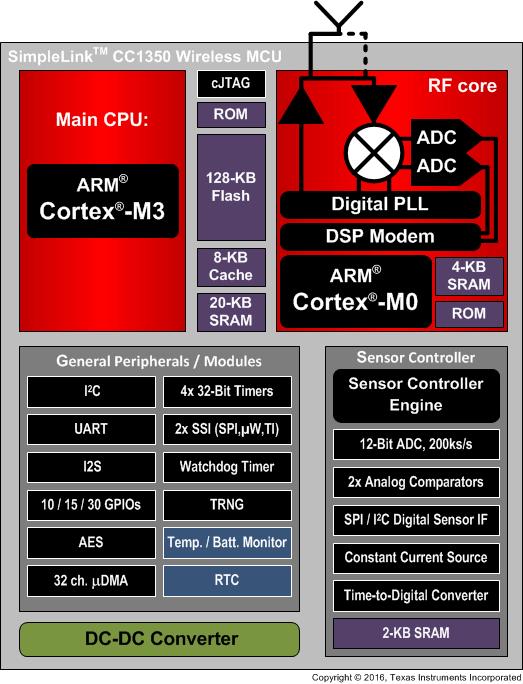
The CC1350 is a device in the CC13xx and CC26xx family of cost-effective, ultra-low-power wireless MCUs capable of handling both Sub-1 GHz and 2.4-GHz RF frequencies. The CC1350 device combines a flexible, very low-power RF transceiver with a powerful 48-MHz Arm®Cortex®-M3 microcontroller in a platform supporting multiple physical layers and RF standards. A dedicated Radio Controller (Cortex®-M0) handles low-level RF protocol commands that are stored in ROM or RAM, thus ensuring ultra-low power and flexibility to handle both Sub-1 GHz protocols and 2.4 GHz protocols (for example Bluetooth low energy). This enables the combination of a Sub-1 GHz communication solution that offers the best possible RF range together with a Bluetooth low energy smartphone connection that enables great user experience through a phone application. The Sub-1 GHz only device in this family is the CC1310.
The CC1350 device is a highly integrated, true single-chip solution incorporating a complete RF system and an on-chip DC/DC converter.
Sensors can be handled in a very low-power manner by a dedicated autonomous ultra-low-power MCU that can be configured to handle analog and digital sensors; thus the main MCU (Arm®Cortex®-M3) can maximize sleep time.
The power and clock management and radio systems of the CC1350 device require specific configuration and handling by software to operate correctly, which has been implemented in the TI-RTOS. TI recommends using this software framework for all application development on the device. The completeTI-RTOSand device drivers are offered free of charge in source code.
The CC1350 device is a cost-effective, ultra-low-power, dual-band RF device from Texas Instruments™ that is part of the SimpleLink™microcontroller (MCU) platform. The platform consists of Wi-Fi®,Bluetooth®low energy, Sub-1 GHz, Ethernet, Zigbee®, Thread, and host MCUs. These devices all share a common, easy-to-use development environment with a single core software development kit (SDK) and a rich tool set. A one-time integration of the SimpleLink platform enables users to add any combination of devices from the portfolio into their design, allowing 100 percent code reuse when design requirements change. For more information, visitwww.ti.com/simplelink.
With very low active RF and MCU current consumption, in addition to flexible low-power modes, the device provides excellent battery life and allows long-range operation on small coin-cell batteries and in energy harvesting applications.
The CC1350 is a device in the CC13xx and CC26xx family of cost-effective, ultra-low-power wireless MCUs capable of handling both Sub-1 GHz and 2.4-GHz RF frequencies. The CC1350 device combines a flexible, very low-power RF transceiver with a powerful 48-MHz Arm®Cortex®-M3 microcontroller in a platform supporting multiple physical layers and RF standards. A dedicated Radio Controller (Cortex®-M0) handles low-level RF protocol commands that are stored in ROM or RAM, thus ensuring ultra-low power and flexibility to handle both Sub-1 GHz protocols and 2.4 GHz protocols (for example Bluetooth low energy). This enables the combination of a Sub-1 GHz communication solution that offers the best possible RF range together with a Bluetooth low energy smartphone connection that enables great user experience through a phone application. The Sub-1 GHz only device in this family is the CC1310.
The CC1350 device is a highly integrated, true single-chip solution incorporating a complete RF system and an on-chip DC/DC converter.
Sensors can be handled in a very low-power manner by a dedicated autonomous ultra-low-power MCU that can be configured to handle analog and digital sensors; thus the main MCU (Arm®Cortex®-M3) can maximize sleep time.
The power and clock management and radio systems of the CC1350 device require specific configuration and handling by software to operate correctly, which has been implemented in the TI-RTOS. TI recommends using this software framework for all application development on the device. The completeTI-RTOSand device drivers are offered free of charge in source code.