Catalog
8-Bit Universal Shift/Storage Registers
Key Features
• Multiplexed Inputs/Outputs Provide Improved Bit DensityFour Modes of Operations:Hold (Store)Shift LeftShift RightLoad DataOperates with Outputs Enabled or at High Z3-State Outputs Drive Bus Lines DirectlyCan Be Cascaded for N-Bit Word LengthsSN54LS323 and SN74LS323 Are Similar But Have Synchronous ClearApplications:Stacked or Push-Down Registers Buffer Storage, and Accumulator RegistersMultiplexed Inputs/Outputs Provide Improved Bit DensityFour Modes of Operations:Hold (Store)Shift LeftShift RightLoad DataOperates with Outputs Enabled or at High Z3-State Outputs Drive Bus Lines DirectlyCan Be Cascaded for N-Bit Word LengthsSN54LS323 and SN74LS323 Are Similar But Have Synchronous ClearApplications:Stacked or Push-Down Registers Buffer Storage, and Accumulator Registers
Description
AI
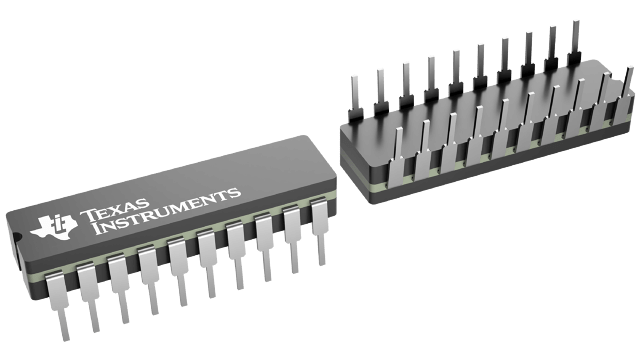
These Schottky TTL eight-bit universal registers feature multiplexed inputs/outputs to achieve full eight-bit data handling in a single 20-pin package. Two function-select inputs and two output-control inputs can be used to choose the modes of operation listed in the function table.
Synchronous parallel loading is accomplished by taking both function-select lines, S0 and S1, high. This places the three-state outputs in a high-impedance state, which permits data that is applied on the input/output lines to be clocked into the register. Reading out of the register can be accomplished while the outputs are enabled in any mode. A direct overriding input is provided to clear the register whether the outputs are enabled or off.
These Schottky TTL eight-bit universal registers feature multiplexed inputs/outputs to achieve full eight-bit data handling in a single 20-pin package. Two function-select inputs and two output-control inputs can be used to choose the modes of operation listed in the function table.
Synchronous parallel loading is accomplished by taking both function-select lines, S0 and S1, high. This places the three-state outputs in a high-impedance state, which permits data that is applied on the input/output lines to be clocked into the register. Reading out of the register can be accomplished while the outputs are enabled in any mode. A direct overriding input is provided to clear the register whether the outputs are enabled or off.