


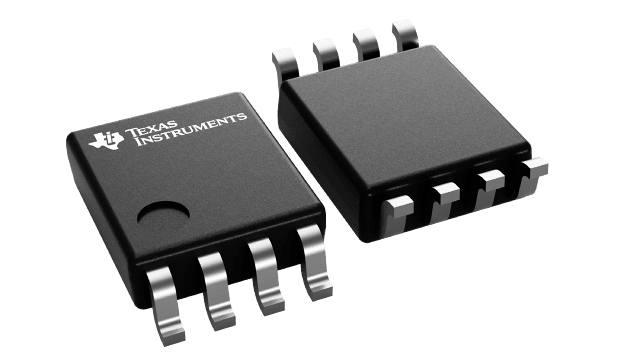
TCA39306-Q1 Series
Automotive FM+ I²C bus and SMBus voltage translator
Manufacturer: Texas Instruments
Catalog
Automotive FM+ I²C bus and SMBus voltage translator
Key Features
• AEC-Q100 Qualified for automotive applicationsFunctional Safety-CapableDocumentation available to aid in functional safety system design2-Bit bidirectional translator for SDA and SCL lines in mixed-mode I 2C applicationsStandard-mode, fast-mode, and fast-mode plus I 2C and SMBus compatibleI 3C compatible (12.5 MHz supported)Allows voltage-level translation between0.9-V V REF1 and 1.8-V, 2.5-V, 3.3-V, or 5-V V REF21.2-V V REF1 and 1.8-V, 2.5-V, 3.3-V, or 5-V V REF21.8-V V REF1 and 2.5-V, 3.3-V, or 5-V V REF22.5-V V REF1 and 3.3-V or 5-V V REF23.3-V V REF1 and 5-V V REF2Provides bidirectional voltage translation with no direction PinLow ON-state resistance between input and output ports provides less signal distortionOpen-drain I 2C I/O ports (SCL1, SDA1, SCL2, and SDA2)5-V Tolerant I 2C I/O ports to support mixed-mode signal operationHigh-impedance SCL1, SDA1, SCL2, and SDA2 pins for EN = LowLockup-free operation for isolation when EN = LowFlow-through pinout for ease of printed-circuit-board trace routingESD Protection Exceeds JESD 222000-V human-body model (A114-A)1000-V charged-device model (C101)AEC-Q100 Qualified for automotive applicationsFunctional Safety-CapableDocumentation available to aid in functional safety system design2-Bit bidirectional translator for SDA and SCL lines in mixed-mode I 2C applicationsStandard-mode, fast-mode, and fast-mode plus I 2C and SMBus compatibleI 3C compatible (12.5 MHz supported)Allows voltage-level translation between0.9-V V REF1 and 1.8-V, 2.5-V, 3.3-V, or 5-V V REF21.2-V V REF1 and 1.8-V, 2.5-V, 3.3-V, or 5-V V REF21.8-V V REF1 and 2.5-V, 3.3-V, or 5-V V REF22.5-V V REF1 and 3.3-V or 5-V V REF23.3-V V REF1 and 5-V V REF2Provides bidirectional voltage translation with no direction PinLow ON-state resistance between input and output ports provides less signal distortionOpen-drain I 2C I/O ports (SCL1, SDA1, SCL2, and SDA2)5-V Tolerant I 2C I/O ports to support mixed-mode signal operationHigh-impedance SCL1, SDA1, SCL2, and SDA2 pins for EN = LowLockup-free operation for isolation when EN = LowFlow-through pinout for ease of printed-circuit-board trace routingESD Protection Exceeds JESD 222000-V human-body model (A114-A)1000-V charged-device model (C101)
Description
AI
The TCA39306-Q1 is a dual bidirectional voltage-level translator compatible with I 2C, SMBus, and I 3C with an enable (EN) input, and is operational from 0.9-V to 3.3-V V REF1 and 1.8-V to 5.5-V V REF2.
The device allows bidirectional voltage translations between 0.85 V and 5 V, without the use of a direction pin. The low ON-state resistance (R ON) of the switch allows connections to be made with minimal propagation delay. When EN is high, the translator switch is ON, and the SCL1 and SDA1 I/O are connected to the SCL2 and SDA2 I/O, respectively, allowing bidirectional data flow between ports. When EN is low, the translator switch is off, and a high-impedance state exists between ports.
In addition to voltage translation, the TCA39306-Q1 can be used to isolate a higher speed bus from a lower speed bus by controlling the EN pin to disconnect the slower bus during fast-mode communication.
The TCA39306-Q1 is a dual bidirectional voltage-level translator compatible with I 2C, SMBus, and I 3C with an enable (EN) input, and is operational from 0.9-V to 3.3-V V REF1 and 1.8-V to 5.5-V V REF2.
The device allows bidirectional voltage translations between 0.85 V and 5 V, without the use of a direction pin. The low ON-state resistance (R ON) of the switch allows connections to be made with minimal propagation delay. When EN is high, the translator switch is ON, and the SCL1 and SDA1 I/O are connected to the SCL2 and SDA2 I/O, respectively, allowing bidirectional data flow between ports. When EN is low, the translator switch is off, and a high-impedance state exists between ports.
In addition to voltage translation, the TCA39306-Q1 can be used to isolate a higher speed bus from a lower speed bus by controlling the EN pin to disconnect the slower bus during fast-mode communication.
