


ADRF5030 Series
100 MHz to 20 GHz, Non-Reflective, Silicon SPDT Switch
Manufacturer: Analog Devices Inc./Maxim Integrated
Catalog
100 MHz to 20 GHz, Non-Reflective, Silicon SPDT Switch
| Part | Package / Case | Topology | Insertion Loss | Test Frequency | RF Type | Circuit | Voltage - Supply (Range 2 Maximum) | Voltage - Supply (Range 1 Minimum) | Voltage - Supply (Range 1 Maximum) | Voltage - Supply (Range 2 Minimum) | Mounting Type | IIP3 | Operating Temperature (Min) | Operating Temperature (Max) | Package Name | Package Length | Package Width | Frequency Range (Min) | Frequency Range (Max) | Isolation | Impedance |
|---|---|---|---|---|---|---|---|---|---|---|---|---|---|---|---|---|---|---|---|---|---|
 Analog Devices Inc./Maxim Integrated | 20-VFLGA Exposed Pad | Absorptive | 1.2 dB | 20 GHz | VSAT | SPDT | 3.45 V | -3.45 V | -3.15 V | 3.15 V | Surface Mount | 60 dBm | -40 °C | 105 °C | 20-LGA | 3 mm | 3 mm | 100 MHz | 20 GHz | 45 dB | 50 Ohm |
Description
AI
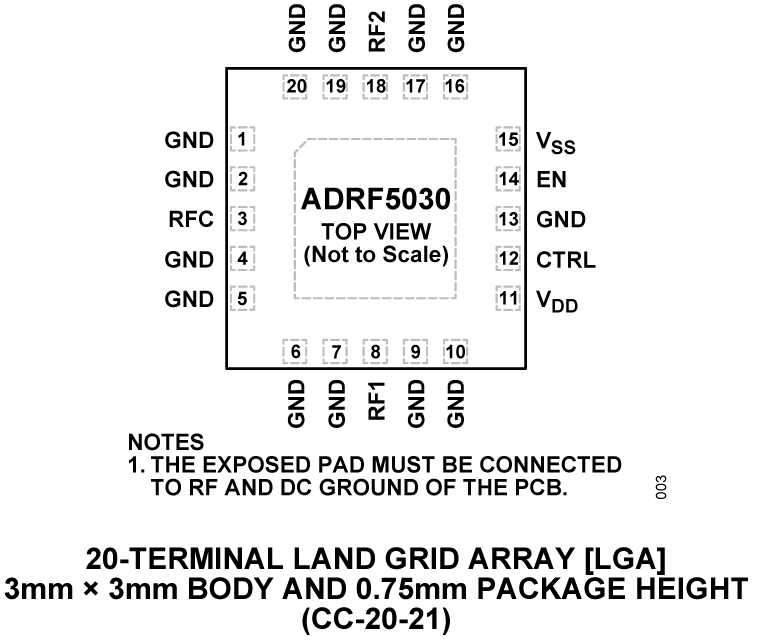
The ADRF5030 is a non-reflective, single-pole double-throw (SPDT) switch manufactured using the silicon on insulator (SOI) process. The ADRF5030 operates from 100 MHz to 20 GHz with insertion loss of lower than 1.2 dB and isolation of higher than 45 dB. The device has an RF input power handling capability of 33 dBm average/36 dBm peak for both RFC and RFx through paths, termination paths, and hot switching for both RFC and RFx ports. The ADRF5030 operates with dual-supply voltages of ±3.3 V. The ADRF5030 employs complementary metal-oxide semiconductor (CMOS) and low-voltage transistor to transistor logic (LVTTL)-compatible control.The ADRF5030 can also operate with a single positive supply voltage (VDD) applied while the negative supply voltage (VSS) is tied to ground. In this operating condition, the small signal performance is maintained while the switching characteristics, linearity, and power handling performance are derated. See Table 2 for more details.The ADRF5030 is pin compatible with the ADRF5022 and ADRF5026, and also pin compatible with ADRF5031, a slow-switching, low cut-off version, which operates between 9 kHz to 20 GHz.The ADRF5030 is packaged in a 20-terminal, 3 mm × 3 mm, RoHS-compliant, land grid array (LGA). The ADRF5030 operates from −40°C to +105°C.APPLICATIONSTest instrumentationMilitary radios, radars, electronic counter measures (ECMs)Microwave radios and very small aperture terminals (VSATs)